MCQ
Ketones are prepared by
  • A
    Clemmensen's reduction
  • B
    Cannizzaro reaction
  • C
    Rosenmund's reduction
  • Oppenaur's oxidation

Answer

Correct option: D.
Oppenaur's oxidation
d
$\underset{Isopropyl\,\,\,alcohol}{\mathop{\begin{matrix}
   R  \\
   R  \\
\end{matrix}>CH-OH}}$ $\xrightarrow[Aluminium\,\,ter\,\,butoxide]{{{[{{(C{{H}_{3}})}_{2}}CO]}_{3}}Al}$ $\underset{Ketone}{\mathop{\begin{matrix}
   R  \\
   R  \\
\end{matrix}>C=O}}\,$

Need a full question paper?

Generate a complete, print-ready paper with questions like this in minutes — across 16+ boards, with answer keys.

Start Generating Free

Similar questions

Which of the following does not show optical isomerism?

($en =$ ethylenediamine)

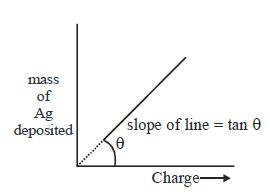
In the electrolysis of $AgNO_3$, the mass of $Ag$ deposited is plotted against the charge Slope of the line gives
The reaction that does not give benzoic acid as the major product is
Vitamin ${B_{12}}$ contains metal
The emf of the following three galvanic cells

$1.\,Zn|Z{n^{2 + }}\,\left( {1\,M} \right)||C{u^{2 + }}\left( {1\,M} \right)|Cu$

$2.\,Zn|Z{n^{2 + }}\,\left( {0.1\,M} \right)||C{u^{2 + }}\left( {1\,M} \right)|Cu$

$3.\,Zn|Z{n^{2 + }}\,\left( {1\,M} \right)||C{u^{2 + }}\left( {0.1\,M} \right)|Cu$

are represented by $E_1,\,E_2,\,E_3$. Which of the following statement is true?

Which of the following statements are correct about the reaction between the copper metal and dilute $HNO_3$ ?

$(I)$ The principal reducing product is $NO$ gas

$(II)$ $Cu$ metal is oxidised to $Cu^{2+}$ ( aq.) ion which is blue in colour.

$(III)$ $NO$ is paramagnetic and has one unpaired electron in antibonding molecular orbital

$(IV)$ $NO$ reacts with $O_2$ to produce $NO_2$ which is linear in shape

Choose the correct statements
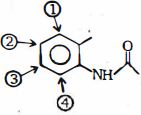
Sulphonation is most favourable at the carbon number ...
$\begin{array}{*{20}{c}}
  {2C{H_3} - C - C{H_3}} \\ 
  {\,\,||} \\ 
  {\,\,\,O} 
\end{array}$ $\xrightarrow[{^{{H^ + }}}]{{Mg/Hg}}$ Product, product in the reaction is
Which of the following reactions are disproportionation reactions?

  1. Cu+ → Cu2+ + Cu

  2. 3MnO4 + 4H+ → 2MnO4 + MnO2 + 2H2O

  3. 2KMnO4 → K2MnO4 + MnO2 + O2

  4. 2MnO4 + 3Mn2+ + 2H2O → 5MnO2 + 4H+

    Consider the given chemical reaction sequence :

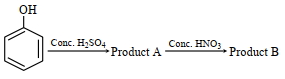
    Total sum of oxygen atoms in Product $A$ and Product $B$ are .........