MCQ
Kirchhoff ’s junction rule is a reflection of:
  • A
    Conservation of current density vector.
  • B
    Conservation of charge.
  • C
    The fact that the momentum with which a charged particle approaches a junction is unchanged (as a vector) as the charged particle leaves the junction.
  • D
    The fact that there is no accumulation of charges at a junction.

Answer

  1. Conservation of charge.
  1. The fact that there is no accumulation of charges at a junction.

Solution:

Key concept: Junction rule: At any junction, the sum of the currents entering the junction is equal to the sum of currents leaving the junction.
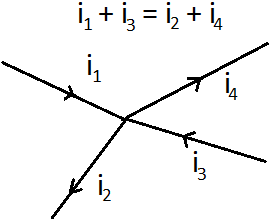
Or
Algebraic sum of the currents flowing towards any point in an electric network is zero, i.e., charges are conserved in an electric network.

The proof of this rule follows from the fact that when currents are steady, there is no accumulation of charges at any junction or at any point in a line.

Thus, the total current flowing in, (which is the rate at which charge flows into the junction), must equal the total current flowing out.

Kirchhoffs junction rule is also known as Kirchhoff’s current law.

So, Kirchhoffs junction rule is the reflection of conservation of charge

Important point: Sign convention of current from a junction: We are taking outgoing current from a junction as negative. And we are taking incoming current towards a junction as positive.

Need a full question paper?

Generate a complete, print-ready paper with questions like this in minutes — across 16+ boards, with answer keys.

Start Generating Free

Similar questions

Assertion :   At 0 K Germanium is a superconductor. 

Reason    :    At 0 K Germanium offers zero resistance.

(a) If both assertion and reason are true and the reason is the correct explanation of the assertion.

(b) If both assertion and reason are true but reason is not the correct explanation of the assertion.

(c) If assertion is true but reason is false.

(d) If the assertion and reason both are false.

A point charge q is rotated along a circle in the electric field generated by another point charge Q. The work done by the electric field on the roatating charge in one complete revolution is:
  1. Zero.
  2. Positive.
  3. Negative.
  4. Zero if the charge Q is at the centre and nonzero otherwise.

Which of the following quantities increase when wavelength is increased? Consider only the magnitudes.

What is the atomic mass (u) of sodium?
Which of the following did Bohr use to explain his theory?
A charged particle enters in a uniform magnetic field with a certain velocity. The power delivered to the particle by the magnetic field depends on:
A moving charge produces:
  1. Electric field only.
  2. Magnetic field only.
  3. Both of them.
  4. None of them.
The shape of wave front at a very large distance from source is ______.

Assertion : Ultraviolet radiation are of higher frequency waves are dangerous to human being.

Reason    : Ultraviolet radiation are absorbed by the atmosphere

(a) If both assertion and reason are true and the reason is the correct explanation of the assertion.

(b) If both assertion and reason are true but reason is not the correct explanation of the assertion.

(c) If assertion is true but reason is false.

(d) If the assertion and reason both are false.

In a hydrogen atom, which of the following electronic transitions would  involve the maximum energy change

(a) From n = 2 to n = 1

(b) From n = 3 to n = 1

(c) From n = 4 to n = 2

(d) From n = 3 to n = 2