Kirchhoff's first law $i.e.$ $\Sigma i = 0$ at a junction is based on the law of conservation of
AIIMS 2000,AIPMT 1997,AIPMT 1992, Easy
Download our app for free and get started
(a) Kirchhoff's first law is based on the law of conservation of charge.

Download our appand get started for free
Experience the future of education. Simply download our apps or reach out to us for more information. Let's shape the future of learning together!No signup needed.*
Similar Questions
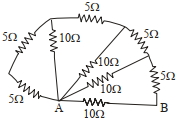
- 1The equivalent resistance between points $A$ and $B$ in the given network is ............ $\Omega$View Solution
- 2$3$ identical bulbs are connected in series and these together dissipate a power $P$. If now the bulbs are connected in parallel, then the power dissipated will beView Solution
- 3Heat produced in a wire of resistance $R$ due to current flowing at constant potential difference is proportional toView Solution
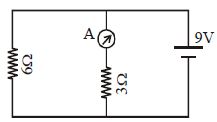
- 4In the figure shown, if the internal resistance of the battery is $1\, ohm$ , the reading of the ammeter will be ................. $\mathrm{A}$View Solution
- 5$A$ potentiometer wire has length $10\, m$ and resistance $10\,\Omega$ . It is connected to a battery of $EMF$ $11\, volt$ and internal resistance $1\, \Omega$ , then the potential gradient in the wire is ............... $V/m$View Solution
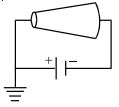
- 6$A$ conductor is made of an isotropic material and has shape of a truncated cone. $A$ battery of constant emf is connected across it and its left end is earthed as shown in figure. If at a section distant $x$ from left end, electric field intensity, potential and the rate of generation of heat per unit length are $E, V$ and $H$ respectively, which of the following graphs is are correct?View Solution
- 7View SolutionTwo wires of the same material are given. The first wire is twice as long as the second and has twice the diameter of the second. The resistance of the first will be
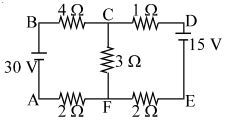
- 8View SolutionThe figure shows a network of five resistances and two batteries Which of the batteries is getting charged.
- 9A bulb of $100\, W$ is connected in parallel with an ideal inductance of $1\, H$. This arrangement is connected to a $90\,V$ battery through a switch. On pressing the switch, theView Solution
- 10For comparing the $e.m.f.$'s of two cells with a potentiometer, a standard cell is used to develop a potential gradient along the wires. Which of the following possibilities would make the experiment unsuccessfulView Solution