MCQ
Kirchoff's junction law is equivalent to ___________.
- AConservation of energy.
- BConservation of charge.
- CConservation of electric potential.
- DConservation of electric flux.
Explanation:
Kirchhoff's junction rule is an application of the principle of conservation of electric charge: current is flow of charge per time, and if current is constant, that which flows into a point in a circuit must equal that which flows out of it.
Generate a complete, print-ready paper with questions like this in minutes — across 16+ boards, with answer keys.
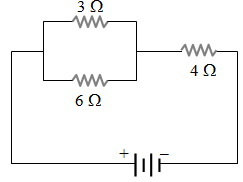
In the figure, current through the 3 Ω resistor is 0.8 ampere, then potential drop through 4 Ω resistor is
|
(a) 9.6 V |
(b) 2.6 V |
(c) 4.8 V |
(d) 1.2 V |
What will be the ratio of de-Broglie wavelengths of proton and α - particle of same energy
|
(a) 2 : 1 |
(b) 1 : 2 |
(c) 4 : 1 |
(d) 1 : 4 |
A transformer is used to
|
(a) Change the alternating potential |
|
(b) Change the alternating current |
|
(c) To prevent the power loss in alternating current flow |
|
(d) To increase the power of current source |
PN-junction diode works as a insulator, if connected
| (a) To A.C. | (b) In forward bias | (c) In reverse bias | (d) None of these |
X-rays when incident on a meta
|
(a) Exert a force on it |
(b) Transfer energy to it |
|
(c) Transfer pressure to it |
(d) All of the above |
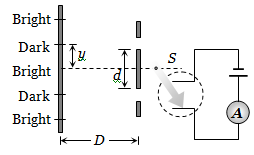
In the following arrangement y = 1.0 mm, d = 0.24 mm and D = 1.2 m. The work function of the material of the emitter is 2.2 eV. The stopping potential V needed to stop the photo current will be
|
(a) 0.9 V |
(b) 0.5 V |
(c) 0.4 V |
(d) 0.1 V |
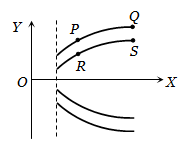
In Thomson spectrograph experiment, four positive ions P,Q,R and S are situated on Y-X curve a shown in the figure
|
(a) The specific charge of R and S are same |
|
(b) The masses of P and S are same |
|
(c) The specific charges of Q and R are same |
|
(d) The velocities of R and S are same |