Question
Kyra has a rectangular painting canvas having a total area of $24\ ft^2$ which includes a border of $0.5$ ft. on the left right and a border of $0.75$ ft. on the bottom, top inside it.
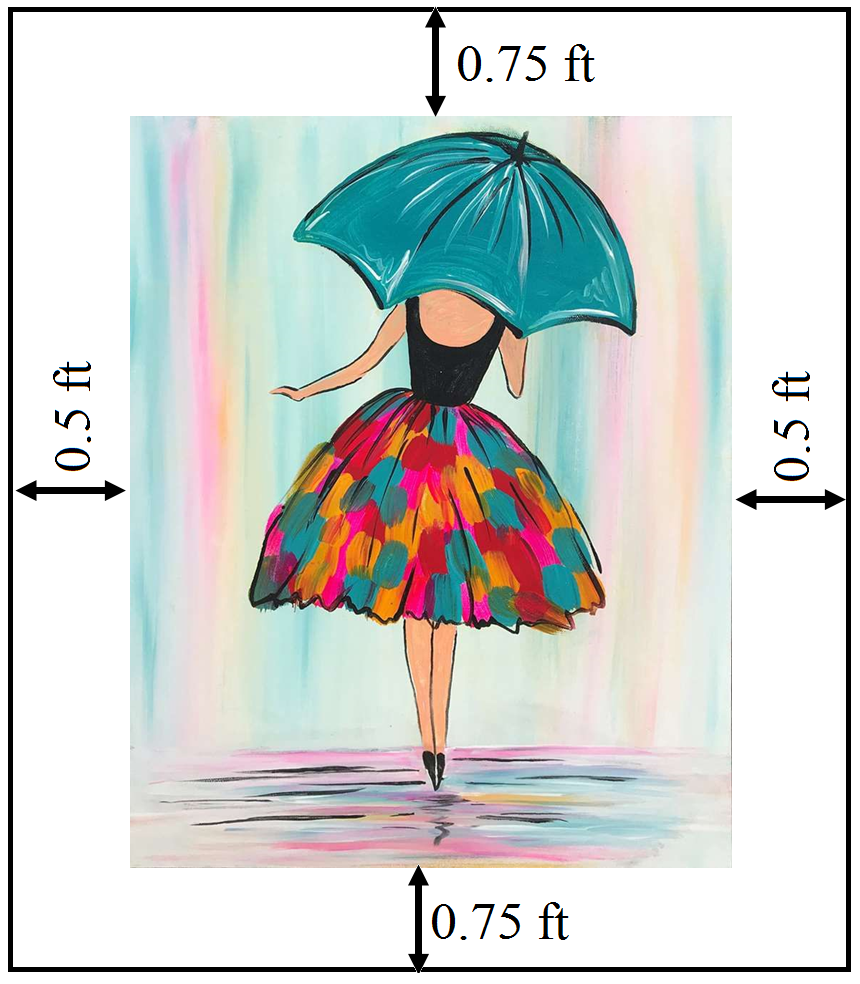
Based on the above information, answer the following questions.

  1. If Kyra wants to paint in the maximum area, then she needs to maximize.
  1. Area of outer rectangle.
  2. Area of inner rectangle.
  3. Area of top border.
  4. None of these.
  1. If x is the length of the outer rectangle, then area of inner rectangle in terms of x is.
  1. $(\text{x}+3)\Big(\frac{24}{\text{x}}-2\Big)$
  2. $(\text{x}-1)\Big(\frac{24}{\text{x}}+1.5\Big)$
  3. $(\text{x}-1)\Big(\frac{24}{\text{x}}-1.5\Big)$
  4. $(\text{x}-1)\Big(\frac{24}{\text{x}}\Big)$
  1. Find the range of x.
  1. $(1, \infty)$
  2. $(1, 16)$
  3. $(-\infty, 16)$
  4. $(-1, 16)$
  1. If area of inner rectangle is maximum, then x is equal to.
  1. 2 ft.
  2. 3 ft.
  3. 4 ft.
  4. 5 ft.
  1. If area of inner rectangle is maximum, then length and breadth of this rectangle are respectively.
  1. 3 ft, 4.5 ft.
  2. 4.5 ft, 5 ft.
  3. 1 ft, 2 ft.
  4. 2 ft, 4 ft.

Answer

  1. (b) Area of inner rectangle
Solution:
In order to paint in the maximum area, Kyra needs to maximize the area of inner rectangle.
  1. (c) $(\text{x}-1)\Big(\frac{24}{\text{x}}-1.5\Big)$
Solution:
Let x be the length and y be the breadth of outer rectangle.
$\therefore$ Length of inner rectangle = $x - 1$
and breadth of inner rectangle = y - 1.5
$\therefore$ A(x) = (x - 1)(y - 1.5) [$\therefore$ xy = 24 (given)
$=\big(\text{x}-1\big)\bigg(\frac{24}{\text{x}}-1.5\bigg)$
  1. (b) $(1, 16)$
Solution:
Dimensions of rectangle (outer/inner) should be positive.
$\therefore\text{x}-1>0\text{ and }\frac{24}{\text{x}}-1.5>0$
$\therefore\text{x}>1\text{ and }{\text{x}}<16$
$\therefore$ Range of x is (1, 16)
  1. (c) 4 ft
Solution:
We have $\text{A}'\text{(x)}=(\text{x}-1)\bigg(\frac{24}{\text{x}}-1.5\bigg)$
$\Rightarrow\text{A}'(\text{x)}=(\text{x}-1)\Big(\frac{-24}{\text{x}^2}\Big)+\bigg(\frac{24}{\text{x}}-1.5\bigg)$
$=\frac{24}{\text{x}^2}-1.5\ \text{and}\ \text{A}''(\text{x})=\frac{-48}{\text{x}^3}$
For A(x) to be maximum or minimum, A'(x) = 0
$\Rightarrow-1.5+\frac{24}{\text{x}^2}=0$
$\Rightarrow\text{x}^2=16$
$\Rightarrow\text{x}=\pm4$
$\therefore\text{x}=4$ [Since, length can't be negative]
Also, $\text{A}''(4)=\frac{-48}{4^3}<0$
Thus, at x = 4, area is maximum.
  1. (a) 3 ft, 4.5 ft.
Solution:
If area of inner rectangle is maximum, then Length of inner rectangle = x - 1 = 4 - 1 = 3 ft.
And breadth of inner rectangle $=\text{y}-1.5=\frac{24}{\text{x}}-1.5$
$=\frac{24}{4}-1.5=6-1.5=4.5\ \text{ft}$

Need a full question paper?

Generate a complete, print-ready paper with questions like this in minutes — across 16+ boards, with answer keys.

Start Generating Free

Similar questions

In a street, two lamp posts are 600 feet apart. The light intensity at a distanced from the first (stronger) lamp post is $\frac{1000}{\text{d}^2}$ the light intensity at distance d from the second (weaker) lamp post is $\frac{125}{\text{d}^2}$ (in both cases the light intensity is inversely proportional to the square of the distance to the light source). The combined light intensity is the sum of the two light intensities coming from both lamp posts.

Based on the above information, answer the following questions.
  1. If you are in between the lamp posts, at distance x feet from the stronger tight, then the formula for the combined light intensity coming from both lamp posts as function of x, is
  1. $\frac{1000}{\text{x}^2}+\frac{125}{\text{x}^2}$
  2. $\frac{1000}{\big(600-\text{x}^2\big)}+\frac{125}{\text{x}^2}$
  3. $\frac{1000}{\text{x}^2}+\frac{125}{\big(600-\text{x}^2\big)}$
  4. $\text{None of these}$
  1. The maximum value of x can not be.
  1. 100
  2. 200
  3. 600
  4. None of these
  1. The minimum value of x can not be.
  1. 0
  2. 100
  3. 200
  4. None of these
  1. If l(x) denote the combined tight intensity, then l(x) will be minimum when x =
  1. 200
  2. 400
  3. 600
  4. 800
  1. The darkest spot between the two lights is.
  1. At a distance of 200 feet from the weaker lamp post.
  2. At distance of 200 feet from the stronger lamp post.
  3. At a distance of 400 feet from the weaker lamp post.
  4. None of these
Nisha and Ayushi appeared for first round of an interview for two vacancies. The probability of Nisha's selection is $\frac{1}{3}$ and that of Ayushi's selection is $\frac{1}{2}.$

Based on the above information, answer the following questions.

  1. The probability that both of them are selected, is:
  1. $\frac{1}{12}$
  2. $\frac{1}{24}$
  3. $\frac{1}{6}$
  4. $\frac{1}{2}$
  1. The probability that none of them is selected, is:
  1. $\frac{2}{7}$
  2. $\frac{3}{8}$
  3. $\frac{5}{8}$
  4. $\frac{1}{3}$
  1. The probability that only one of them is selected, is:
  1. $\frac{5}{8}$
  2. $\frac{2}{3}$
  3. $\frac{2}{5}$
  4. $\frac{1}{2}$
  1. The probability that atleast one of them is selected, is:
  1. $\frac{2}{3}$
  2. $\frac{1}{8}$
  3. $\frac{3}{5}$
  4. $\frac{2}{5}$
  1. Suppose Nisha is selected by the manager and told her about two posts I and II for which selection is independent. If the probability of selection for post I $\frac{1}{6}$ is and for post II is $\frac{1}{5},$ then the probability that Nisha is selected for at least one post, is
  1. $\frac{1}{3}$
  2. $\frac{2}{3}$
  3. $\frac{3}{8}$
  4. $\frac{1}{2}$
Two motorcycles A and Bare running at the speed more than allowed speed on the road along the lines $\vec{\text{r}}=\lambda(\hat{\text{i}}+2\hat{\text{j}}-\hat{\text{k}})$ and $\vec{\text{r}}=3\hat{\text{i}}+3\hat{\text{j}}+\mu(2\hat{\text{i}+\hat{\text{j}}+\hat{\text{k}}}),$ respectively. Based on the above information, answer the following questions.
  1. The cartesian equation of the line along which motorcycle A is running is:
  1. $\frac{\text{x}+1}{1}=\frac{\text{y}+1}{2}=\frac{\text{z}-1}{-1}$
  2. $\frac{\text{x}}{1}=\frac{\text{y}}{2}=\frac{\text{z}}{-1}$
  3. $\frac{\text{x}}{1}=\frac{\text{y}}{2}=\frac{\text{z}}{1}$
  4. None of these
  1. The direction cosines of line along which motorcycle A is running, are:
  1. < 1, -2, 1 >
  2. < I, 2, -1 >
  3. $<\frac{1}{\sqrt{6}},\frac{-2}{\sqrt{6}},\frac{1}{\sqrt{6}}>$
  4. $<\frac{1}{\sqrt{6}},\frac{2}{\sqrt{6}},\frac{-1}{\sqrt{6}}>$
  1. The direction ratios of line along which motorcycle Bis running, are:
  1. < 1, 0, 2 >
  2. < 2, 1, 0 >
  3. < 1, 1, 2 >
  4. < 2, 1, 1 >
  1. The shortest distance between the gives lines is:
  1. 4 units
  2. $2\sqrt{3}\text{ units}$
  3. $3\sqrt{2}\text{ units}$
  4. 0 units
  1. The motorcycles will meet with an accident at the point:
  1. (-1, 1, 2)
  2. (2, 1, -1)
  3. (1, 2, -1)
  4. Does not exist
Logarithmic differentiation is a powerful technique to differentiate functions of the form $\text{f}(\text{x})=[\text{u}(\text{x})]^{\text{v}(\text{x})},$ where both u(x) and v(x) are differentiable functions and f and u need to be positive functions. Let function $\text{y}=\text{f}(\text{x})=(\text{u}(\text{x}))^{\text{v}(\text{x})},$ then $\text{y}'=\text{y}\Big[\frac{\text{v}(\text{x})}{\text{u}(\text{x})}\text{u}'(\text{x})+\text{v}'(\text{x})\cdot\log[\text{u}(\text{x})]\Big]$ On the basis of above information, answer the following questions.
  1. Differentiate $x^x$ w.r.t. $x.$
  1. $\text{x}^\text{x}(1+\log\text{x})$
  2. $\text{x}^\text{x}(1-\log\text{x})$
  3. $-\text{x}^\text{x}(1+\log\text{x})$
  4. $\text{x}^\text{x}\log\text{x}$
  1. Differentiate $x^x + a^x+ x^a + a^a$ w.r.t. $x.$
  1. $(1+\log\text{x})+(\text{a}^\text{x}\log\text{a}+\text{ax}^{\text{a}-1})$
  2. $\text{x}^\text{x}(1+\log\text{x})+\log\text{a}+\text{ax}^{\text{a}-1}$
  3. $\text{x}^\text{x}(1+\log\text{x})+\text{x}^\text{a}\log\text{x}+\text{ax}^{\text{a}-1}$
  4. $\text{x}^\text{x}(1+\log\text{x})+\text{a}^\text{x}\log\text{a}+\text{ax}^{\text{a}-1}$
  1. If $\text{x}=\text{e}^\frac{\text{x}}{\text{y}},$ then find $\frac{\text{dy}}{\text{dx}}.$
  1. $-\frac{(\text{x}+\text{y})}{\text{x}\log\text{x}}$
  2. $-\frac{(\text{x}-\text{y})}{\text{x}\log\text{x}}$
  3. $\frac{(\text{x}+\text{y})}{\text{x}\log\text{x}}$
  4. $\frac{\text{x}-\text{y}}{\text{x}\log\text{x}}$
  1. If $y = (2 - x)^3(3 + 2x)^5,$ then find $\frac{\text{dy}}{\text{dx}}.$
  1. $(2-\text{x})^3(3+2\text{x})^5\Big[\frac{15}{3+2\text{x}}-\frac{8}{2-\text{x}}\Big]$
  2. $(2-\text{x})^3(3+2\text{x})^5\Big[\frac{15}{3+2\text{x}}+\frac{3}{2-\text{x}}\Big]$
  3. $(2-\text{x})^3(3+2\text{x})^5\Big[\frac{10}{3+2\text{x}}-\frac{3}{2-\text{x}}\Big]$
  4. $(2-\text{x})^3(3+2\text{x})^5\cdot\Big[\frac{10}{3+2\text{x}}+\frac{3}{2-\text{x}}\Big]$
  1. If $\text{y}=\text{x}^\text{x}\cdot\text{e}^{(2\text{x}+5)},$ then find $\frac{\text{dy}}{\text{dx}}.$
  1. $\text{x}^\text{x}\text{e}^{2\text{x}+5}$
  2. $\text{x}^\text{x}\text{e}^{2\text{x}+5}(3-\log\text{x})$
  3. $\text{x}^\text{x}\text{e}^{2\text{x}+5}(1-\log\text{x})$
  4. $\text{x}^\text{x}\text{e}^{2\text{x}+5}\cdot(3+\log\text{x})$
Read the following text carefully and answer the questions that follow:
Dinesh is having a jewelry shop at Green Park, normally he does not sit on the shop as he remains busy in political meetings. The manager Lisa takes care of jewelry shop where she sells earrings and necklaces. She gains profit of $₹30$ on pair of earrings & $₹40$ on neckless. It takes $30$ minutes to make a pair of earrings and $1$ hour to make a necklace, and there are $10$ hours a week to make jewelry. In addition, there are only enough materials to make $15$ total of jewelry items per week..
Image
$i$. Formulate the above information mathematically. $(1)$
$ii$. Graphically represent the given data. $(1)$
$iii$. To obtain maximum profit how many pair of earing and neckleses should be sold? $(2)$
OR
What would be the profit if $5$ pairs of earrings and $5$ necklaces are made? $(2)$
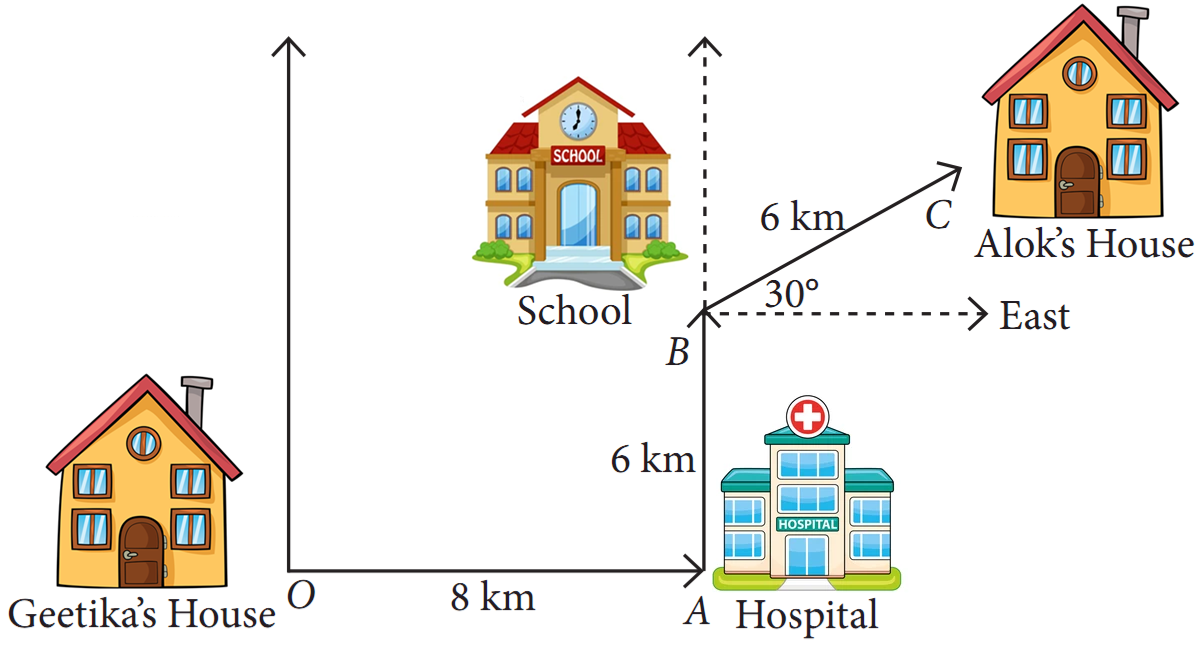
Geetika's house is situated at Shalimar Bagh at point O, for going to Alok's house she first travels 8km by bus in the East. Here at point A, a hospital is situated. From Hospital, Geetika takes an auto and goes 6km in the North, here at point B school is situated. From school, she travels by bus to reach Alok's house which is at 30º East, 6km from point B.

Based on the above information, answer the following questions.
  1. What is the vector distance between Geetika's house and school?
  1. $8\hat{\text{i}}-6\hat{\text{j}}$
  2. $8\hat{\text{i}}+6\hat{\text{j}}$
  3. $8\hat{\text{i}}$
  4. $6\hat{\text{j}}$
  1. How much distance Geetika travels to reach school?
  1. 14km
  2. 15km
  3. 16km
  4. 17km
  1. What is the vector distance from school to Alok's house?
  1. $\sqrt{3}\hat{\text{i}}+\hat{\text{j}}$
  2. $3\sqrt{3}\hat{\text{i}}+3\hat{\text{j}}$
  3. $6\hat{\text{i}}$
  4. $6\hat{\text{j}}$
  1. What is the vector distance from Geetika's house to Alok's house?
  1. $(8+3\sqrt{3})\hat{\text{i}}+9\hat{\text{j}}$
  2. $4\hat{\text{i}}+6\hat{\text{j}}$
  3. $15\hat{\text{i}}$
  4. $16\hat{\text{j}}$
  1. What is the total distance travelled by Geetika from her house to Alok's house?
  1. 19km
  2. 20km
  3. 21km
  4. 22km
Consider the mapping $f: A \rightarrow B$ is defined by $f(x) = x - $1 such that $f$ is a bijection.
Based on the above information, answer the following questions.
  1. Domain of $f$ is:
  1. $R - \{2\}$
  2. $R$
  3. $R -\{1, 2\}$
  4. $R - \{0\}$
  1. Range of $f$ is:
  1. $R$
  2. $R - \{2\}$
  3. $R -\{0\}$
  4. $R - \{1, 2\}$
  1. If $g: R - \{2\} \rightarrow R - \{1\}$ is defined by $g(x) = 2f(x) - 1,$ then $g(x)$ in terms of $x$ is:
  1. $\frac{\text{x}+2}{\text{x}}$
  2. $\frac{\text{x}+1}{\text{x}-2}$
  3. $\frac{\text{x}-2}{\text{x}}$
  4. $\frac{\text{x}}{\text{x}-2}$
  1. The function g defined above, is:
  1. One-one
  2. Many-one
  3. into
  4. None of these
  1. A function $f(x)$ is said to be one-one iff.
  1. $f(x_1) = f(x_2) \Rightarrow -x_1= x_2$ 
  2. $f(-x_1) = f(-x_2) \Rightarrow -x_1 = x_2$ 
  3. $f(x_1) = f(x_2) \Rightarrow x_1 = x_2$ 
  4. None of these
A rumour on whatsapp spreads in a population of 5000 people at a rate proportional to the product of the number of people who have heard it and the number of people who have not. Also, it is given that 100 people initiate the rumour and a total of 500 people know the rumour after 2 days.

Based on the above information, answer the following questions.
  1. If y(t) denote the number of people who know the rumour at an instant t, then maximum value of y(t) is:
  1. 500
  2. 100
  3. 5000
  4. None of these
  1. $\frac{\text{dn}}{\text{dt}}$ is proportional to:
  1. (y - 5000)
  2. y(y - 500)
  3. y(500 - y)
  4. y(5000 - y)
  1. The value of y(0) is:
  1. 100
  2. 500
  3. 600
  4. 200
  1. The value of y(2) is:
  1. 100
  2. 500
  3. 600
  4. 200
  1. The value of y at any time t is given by:
  1. $\text{y}=\frac{5000}{_\text{e}-5000\text{kt}_{+1}}$
  2. $\text{y}=\frac{5000}{_\text{1+e}-5000\text{kt}}$
  3. $\text{y}=\frac{5000}{_\text{49e}-5000\text{kt}_{+1}}$
  4. $\text{y}=\frac{5000}{_\text{49}{(_\text{1+e}}-5000\text{kt})}$
The equation of motion of a rocket are: x = 2t, y = -4t, z = 41, where the time 't' is given in seconds, and the distance measured is in kilometres. Based on the above information, answer the following questions.
  1. What is the path of the rocket?
  1. Straight line.
  2. Circle.
  3. Parabola.
  4. None of these.
  1. Which of the following points lie on the path of the rocket?
  1. (0, 1, 2)
  2. (1, -2, 2)
  3. (2, -2, 2)
  4. None of these
  1. At what distance will the rocket be from the starting point (0, 0, 0) in 10 seconds?
  1. 40km
  2. 60km
  3. 30km
  4. 80km
  1. If the position of rocket at certain instant of time is (3, -6, 6), then what will be the height of the rocket from the ground, which is along the xy-plane?
  1. 3km
  2. 2km
  3. 4km
  4. 6km
  1. At certain instant of time, if the rocket is above sea level, where equation of surface of sea is given by 3x - y + 4z = 2 and position of rocket at that instant of time is (1, -2, 2), then the image of position of rocket in the sea is:
  1. $\Big(\frac{20}{13},\frac{15}{13},\frac{18}{13}\Big)$
  2. $\Big(\frac{-20}{13},\frac{-15}{13},\frac{-18}{13}\Big)$
  3. $\Big(\frac{20}{13},\frac{-15}{13},\frac{18}{13}\Big)$
  4. None of these
If a real valued function $f(x)$ is finitely derivable at any point of its domain, it is necessarily continuous at that point. But its converse need not be true.
For example, every polynomial, constant function are both continuous as well as differentiable and inverse trigonometric functions are continuous and differentiable in its domains etc.
Based on the above information, answer the following questions.
  1. If $\text{f}(\text{x})=\begin{cases}\text{x},\text{for x}\leq0\\0,\text{for x}>0\end{cases},$ then at $x = 0$
  1. $f(x)$ is differentiable and continuous.
  2. $f(x)$ is neither continuous nor differentiable.
  3. $f(x)$ is continuous but not differentiable.
  4. None of these.
  1. If $\text{f}(\text{x})=|\text{x}-1|,\text{x }\in\text{ R},$ then at $x = 1$
  1. $f(x)$ is not continuous.
  2. $f(x)$ is continuous but not differentiable.
  3. $f(x)$ is continuous and differentiable.
  4. None of these.
  1. $f(x) = x^3$ is:
  1. Continuous but not differentiable at $x = 3$
  2. Continuous but not differentiable at $x = 3$
  3. Neither continuous nor differentiable at $x = 3$
  4. None of these.
  1. If $\text{f}(\text{x})=[\sin\text{x}],$ then which of the following is true?
  1. $f(x)$ is continuous and differentiable at $x = 0.$
  2. $f(x)$ is discontinuous at $x = 0.$
  3. $f(x)$ is continuous at $x = 0$ but not differentiable.
  4. $f(x)$ is differentiable but not continuous at $\text{x}=\frac{\pi}{2}.$
  1. If $\text{f}(\text{x})=\sin^{-1}\text{x},-1\leq\text{x}\leq1,$ then:
  1. $f(x)$ is both continuous and differentiable.
  2. $f(x)$ is neither continuous nor differentiable.
  3. $f(x)$ is continuous but not differentiable.
  4. None of these.