Question
Last element of group-$IV$ is found to be

Answer

b
Down the group metallic character increases. Group $IV$ shows variation from non-metallic character to weak metallic character as we move down the group.

Need a full question paper?

Generate a complete, print-ready paper with questions like this in minutes — across 16+ boards, with answer keys.
Start Generating Free

Similar questions

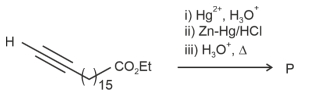
In the following reaction sequence, the major product $P$ is formed.  Glycerol reacts completely with excess $P$ in the presence of an acid catalyst to form $Q$. Reaction of $Q$ with excess $NaOH$ followed by the treatment with $CaCl _2$ yields $Ca$-soap $R$, quantitatively. Starting with one mole of $Q$, the amount of $R$ produced in gram is. . . . [Given, atomic weight: $H =1, C =12, N =14, O =16, Na =23, Cl =35, Ca =40$ ]
Maximum no. of electron in outermost shell of $s, p, d$ and $f$ block elements are respectively
Which of the following cobalt $(III)$ complex is paramagnetic and high spin complex
Major product $(R)$ of following reaction is

Figure $\xrightarrow[{0\, - \,5\,\,{\,^o}C}]{{HN{O_2}}}$ $P$ $\xrightarrow{{HB{F_4}}}Q$ $\xrightarrow[{Cu,\,\,\Delta }]{{NaN{O_2}}}R$
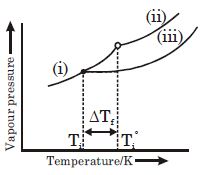
Identify $(i), (ii)$ and $(iii)$ in the following diagram :-
Among the following which has the highest first ionization energy
The $\mathrm{pH}$ of a solution obtained by mixing $50 \,\mathrm{~mL}$ of $1\, \mathrm{M}\, \mathrm{HCl}$ and $30 \,\mathrm{~mL}$ of $1\, \mathrm{M} \,\mathrm{NaOH}$ is $\mathrm{x} \times 10^{-4}$. The value of $\mathrm{x}$ is ...... . (Nearest integer) $[\log 2.5=0.3979]$
Acylation process is preferred than direct alkylation because (by the Friedel-Craft's reaction)
Only $2 \mathrm{~mL}$ of $\mathrm{KMnO}_4$ solution of unknown molarity is required to reach the end point of a titration of $20 \mathrm{~mL}$ of oxalic acid ($2$ M) in acidic medium. The molarity of $\mathrm{KMnO}_4$ solution should be . . . . . . . . . $M$.
Given 

$(A)$ $2 CO ( g )+ O _2( g ) \rightarrow 2 CO _2( g ) \quad \Delta H _1^\theta=- x\,kJ\,mol { }^{-1}$

$(B)$ $C$ (graphite) $+ O _2$ (g) $\rightarrow CO _2$ (g) $\Delta H _2^\theta=- y\,kJ\,mol -1$ The $\Delta H ^\theta$ for the reaction $......$.$C ($ graphite $)+\frac{1}{2} O _2( g ) \rightarrow CO ( g )$ is