MCQ
Lead pipes are readily corroded by:
  • A
    Water.
  • Acetic acid.
  • C
    Conc$. \ce{H_2SO_4}$​
  • D
    Dil$. \ce{H_2SO_4}$​

Answer

Correct option: B.
Acetic acid.
Corrosion of lead is strongly accelerated by traces of acetic acid. Acetic acid in the presence of oxygen rapidly attacks lead and produces very soluble lead$(II)$ acetate which precludes the use of lead to process or store wine or fruit juice.

Need a full question paper?

Generate a complete, print-ready paper with questions like this in minutes — across 16+ boards, with answer keys.

Start Generating Free

Similar questions

Out of aldehyde and ketones, which is more reactive towards nucleophilic addition?
The type of hybrid orbitals used by chlorine atom in $ClO_2^ - $ is
In which of the following molecules are all the bonds are not equal ?
Which of the following products can be obtained from above reaction ?
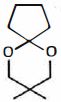
Which pair of reactants compounds may be used to make given acetal ?
Given below are two statements :

Statement $I$: Aniline reacts with con. $\mathrm{H}_2 \mathrm{SO}_4$ followed by heating at $453-473 \mathrm{~K}$ gives $\mathrm{p}$ aminobenzene sulphonic acid, which gives blood red colour in the 'Lassaigne's test'.

Statement $II$: In Friedel - Craft's alkylation and acylation reactions, aniline forms salt with the $\mathrm{AlCl}_3$ catalyst. Due to this, nitrogen of aniline aquires a positive charge and acts as deactivating group.

In the light of the above statements, choose the correct answer from the options given below :

In the given reaction :

$C{H_3} - C{H_2} - \mathop S\limits_{ \bullet \,\, \bullet }^{ \bullet \,\, \bullet }  - \mathop C\limits^* {H_2} - C{H_2} - Br\xrightarrow{{HOH}}[X]$

$[X]$ will be :

Which of the following compounds will give silver mirror with ammoniacal silver nitrate?

($A$) Formic acid

($B$) Formaldehyde

($C$) Benzaldehyde

($D$) Acetone

Choose the correct answer from the options given below :

The total number of possible isomers for $\left[ Pt \left( NH _3\right)_4 Cl _2\right] Br_2$ is. . . . . . .
$0.05 \mathrm{~cm}$ thick coating of silver is deposited on a plate of $0.05 \mathrm{~m}^2$ area. The number of silver atoms deposited on plate are__________ $\times 10^{23}$. (At mass Ag $\left.=108, \mathrm{~d}=7.9 \mathrm{~g} \mathrm{~cm}^{-3}\right)$