MCQ
Least integer in the range of $f(x)$=$\sqrt {(x + 4)(1 - x)}  - {\log _2}x$ is
  • A
    $-2$
  • B
    $-1$
  • $0$
  • D
    $1$

Answer

Correct option: C.
$0$
c
$f(x)=\sqrt{(x+4)(1-x)}+\log _{1 / 2} x$

$\because$ $'f'$ is decreasing

minimum value is $f(1)=0.$

Need a full question paper?

Generate a complete, print-ready paper with questions like this in minutes — across 16+ boards, with answer keys.
Start Generating Free

Similar questions

If $P\left(A^{\prime}\right)=\frac{3}{5}$ and $P(A \cap B)=\frac{1}{5}$ then the value of $P(B / A)$ will be
The vector equation of the plane containing the line $\vec{\text{r}}=(-2\hat{\text{i}}-3\hat{\text{j}}+\hat{\text{k}})+\lambda(3\hat{\text{i}}-2\hat{\text{j}}-\hat{\text{k}})$ and the point $\hat{\text{i}}+2\hat{\text{j}}+3\hat{\text{k}}$ is:
  1. $\vec{\text{r}}.(\hat{\text{i}}+3\hat{\text{k}})=10$
  2. $\vec{\text{r}}.(\hat{\text{i}}-3\hat{\text{k}})=10$
  3. $\vec{\text{r}}.(3\hat{\text{i}}+\hat{\text{k}})=10$
  4. $\text{None of these}$
The distance of point (3, 5, 7) from x axis is
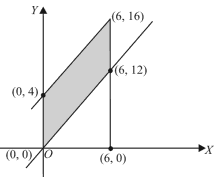
The feasible region for an LPP is shown shaded in the figure. Let $F=3 x-4 y$ be the objective function.
Minimum value of $F$ is
Image
For the given half-cylinder of volume $V$, the total surface area $S$ is minimum, when
The value of the integral $\int\limits_{ - 2}^2 {\frac{{{{\sin }^2}\,x}}{{\left[ {\frac{x}{\pi }} \right] + \frac{1}{2}}}\,\,dx} $ (where $[x]$ denotes the greatest integer less than or equal to $x$ ) is
A function $f: R \rightarrow R$ is defined by:
$f(x)=\left\{\begin{array}{cc}e^{-2 x}, & x<\ln \frac{1}{2} \\ 4, & \ln \frac{1}{2} \leq x \leq 0 \\ e^{-2 x}, & x>0\end{array}\right.$
Which of the following statements is true about the function at the point $x=\ln \frac{1}{2}$ ?
The number of possible orders of a matrix containing 24 elements are:
  1. 5
  2. 7
  3. 8
  4. 9
A problem in Mathematics is given to three students whose chances of solving it are $\frac{1}{2}, \frac{1}{3}, \frac{1}{4}$ respectively. If the events of their solving the problem are independent then the probability that the problem will be solved, is
Let $\alpha, \beta$ and $\gamma$ be real numbers. consider the following system of linear equations

$x+2 y+z=7$

$x+\alpha z=11$

$2 x-3 y+\beta z=\gamma$

Match each entry in List - $I$ to the correct entries in List-$II$

List - $I$ List - $II$
($P$) If $\beta=\frac{1}{2}(7 \alpha-3)$ and $\gamma=28$, then the system has ($1$) a unique solution
($Q$) If $\beta=\frac{1}{2}(7 \alpha-3)$ and $\gamma \neq 28$, then the system has ($2$) no solution

($R$) If $\beta \neq \frac{1}{2}(7 \alpha-3)$ where $\alpha=1$ and $\gamma \neq 28$,

then the system has

($3$) infinitely many solutions
($S$) If $\beta \neq \frac{1}{2}(7 \alpha-3)$ where $\alpha=1$ and $\gamma=28$, then the system has ($4$) $x=11, y=-2$ and $z=0$ as a solution
  ($5$) $x=-15, y=4$ and $z=0$ as a solution

Then the system has