MCQ
$\left| {\,\begin{array}{*{20}{c}}1&5&\pi \\{{{\log }_e}e}&5&{\sqrt 5 }\\{{{\log }_{10}}10}&5&e\end{array}\,} \right| = $
  • A
    $\sqrt \pi $
  • B
    $e$
  • C
    $1$
  • $0$

Answer

Correct option: D.
$0$
d
(d) $\Delta = \left| {\,\begin{array}{*{20}{c}}1&5&\pi \\1&5&{\sqrt 5 }\\1&5&e\end{array}\,} \right|\, = 0$     $(\because\,\,{\log _a}\,a = \,1{\rm{\, and }}\,5\,{C_1} \equiv {C_2})$

Need a full question paper?

Generate a complete, print-ready paper with questions like this in minutes — across 16+ boards, with answer keys.

Start Generating Free

Similar questions

 $(i)$  $f (x)$ is continuous and defined for all real numbers

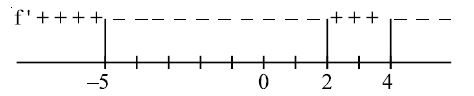
$(ii)$ $f '(-5) = 0 \,; \,f '(2)$ is not defined and $f '(4)  = 0$

$(iii)$ $(-5, 12)$ is a point which lies on the graph of $f (x)$

$(iv)$ $f ''(2)$ is undefined, but $f ''(x)$ is negative everywhere else.

$(v)$ the signs of  $f '(x)$ is given below

On the possible graph of $y = f (x)$ we have  
$\int_{0}^{\frac{\pi}{2}}\sqrt{1+\sin2\text{x}}\text{dx}$ is equal to:
  1. $2\sqrt{2}$
  2. $2(\sqrt{2+1})$
  3. $0$
  4. $2(\sqrt{2-1})$
The inverse of $\left[ {\begin{array}{*{20}{c}}3&5&7\\2&{ - 3}&1\\1&1&2\end{array}} \right]$ is
Let $y = f (x)$ and $y = g (x)$ be two differentiable function in $[0,2]$ such that  $f(0) = 3,$ $f(2) = 5$ , $g (0) = 1$ and $g(2) = 2$. If there exist atlellst one $c \in \left( {0,2} \right)$ such that $f'(c)=kg'(c)$,then $k$ must be
If $x = {\sin ^{ - 1}}(3t - 4{t^3})$ and $y = {\cos ^{ - 1}}\,\,\sqrt {(1 - {t^2})} $, then ${{dy} \over {dx}}$ is equal to
${\cot ^{ - 1}}[{(\cos \alpha )^{1/2}}] - {\tan ^{ - 1}}[{(\cos \alpha )^{1/2}}] = x,$ then $\sin x = $
Consider the system of equations:
a1x + b1y + c1z = 0
a2x + b2y + c2z = 0
a3x + b3y + c3z = 0,
if $\begin{vmatrix}\text{a}_1&\text{b}_1&\text{c}_1\\\text{a}_2&\text{b}_2&\text{c}_2\\\text{a}_3&\text{b}_3&\text{c}_3\end{vmatrix}=0$, then the system has
  1. More than two solutions.
  2. One trivial and one non-trivial solutions.
  3. No solutions.
  4. Only trivial solution (0, 0, 0).
If $\text{y}=\sin(\text{m}\sin^{-1}\text{x}),$ then $(1-\text{x}^2)\text{y}_2-\text{xy}_1$ is equal to:
  1. m2y
  2. my
  3. -m2y
  4. None of these
The area of the region bounded by $x = 0, y = 0,x = 2, y = 2, y \leq\   e^x$ and $y\geq\ log\  x$ is
Considering only the principal values of the inverse trigonometric functions, the domain of the function $f(x)=\cos ^{-1}\left(\frac{x^{2}-4 x+2}{x^{2}+3}\right)$ is.