MCQ
Length cannot be measured by
  • A
    Fermi
  • Debye
  • C
    Micron
  • D
    Light year

Answer

Correct option: B.
Debye
b
The length can be measured in terms of Fermi, Micron and Light year. whereas a unit used to express electric dipole moments of molecules is $debye$.

Need a full question paper?

Generate a complete, print-ready paper with questions like this in minutes — across 16+ boards, with answer keys.
Start Generating Free

Similar questions

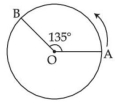
A person moved from $A$ to $B$ on a circular path as shown in figure. If the distance travelled by him is $60 \,m$, then the magnitude of displacement would be$.....\,m$ (Given $\left.\cos 135^{\circ}=-0.7\right)$
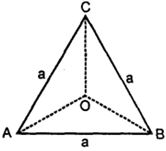
$ABC$ is an equilateral triangle. Length of each side is $a$ and centroid is point $O$. then $\overrightarrow{O A}+\overrightarrow{O B}+\overrightarrow{O C}=.......$
Moment of inertia of a magnetic needle is $40 \,gm-cm^2$ has time period $3$ $seconds$ in earth's horizontal field $=$ $3.6 \times {10^{ - 5}}\, weber/m^2$. Its magnetic moment will be.....$A \times {m^2}$
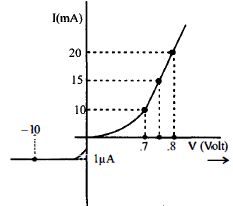
The $V-I$ characteristic of a diode is shown in the figure. The ratio of forward to reverse bias resistance is
Unpolarized light of intensity $I_0$ incident on surface of a block of glass at Brewster's angle. In that case, which one of ihe following statements is true ?
In a single slit diffraction pattern, if first maxima of light of wavelength $\lambda $ coincides with first minima of yellow light $(540\,nm)$ , then $\lambda $ is .........$nm$
In an adiabatic process, the state of a gas is changed from ${P_1},{V_1},{T_1} $ to ${P_2},{V_2},{T_2}$. Which of the following relation is correct
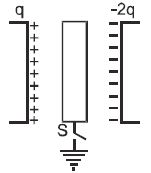
The metal plate on the left in figure carries a charge $+q$. The metal plate on the right has a charge of $-2q$. What charge will flow through $S$ when it is closed, if central plate is initially neutral
The slope of plate characteristic of a vacuum diode is $2 \times {10^{ - 2}}\,mA/V.$ The plate resistance of diode will be
The time dependence of the position of a particle of mass $m = 2$ is given by $\vec r(t) = 2t\hat i - 3{t^2}\hat j$ Its angular momentum with respect to the origin at time $t = 2$ is