MCQ
Lenz’s law applies to
  • A
    Electrostatics
  • B
    Lenses
  • Electro-magnetic induction
  • D
    Cinema slides

Answer

Correct option: C.
Electro-magnetic induction
c
It states that the direction of induced current is always such as to oppose the change in the circuit or the magnetic field that produces it.

Need a full question paper?

Generate a complete, print-ready paper with questions like this in minutes — across 16+ boards, with answer keys.

Start Generating Free

Similar questions

When Uranium is bombarded with neutrons, it undergoes fission. The fission reaction can be written as 

${}_{92}{U^{235}} + {}_0{n^1} \to {}_{56}B{a^{141}} + {}_{36}K{r^{92}} + 3x + Q{\rm{( energy)}}$ where three particles named $x$ are produced and energy $Q$ is released. What is the name of the particle $x$ ?
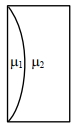
Curved surfaces of a plano-convex lens of refractive index $\mu_{1}$ and a plano-concave lens of refractive index $\mu_{2}$ have equal radius of curvature as shown in figure. Find the ratio of radius of curvature to the focal length of the combined lenses.
If the intensity of incident radiation in a photo$-$cell is increased, how does the stopping potential vary?
The flat face of a plano-convex lens of focal length $10 cm$ is silvered. A point source placed $30 \,cm$ in front of the curved surface will produce a
In the Young's double slit experiment, the spacing between two slits is $0.1\, mm.$ If the screen is kept at a distance of $1.0 \,m$ from the slits and the wavelength of light is $5000 \,Å$, then the fringe width is........$cm$
Two infinitely long parallel conducting plates having surface charge densities +σ and -σ respectively, are separated by a small distance. The medium between the plates is vacuum. If $\varepsilon_0$ is the dielectric permittivity of vacuum, then the electric field in the region between the plates is
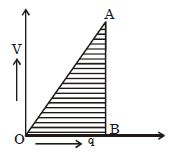
The charge $q$  on a capacitor varies with voltage as shown in figure. The area of the triangle $AOB $ represents
The energy required to excite an electron from the ground state of hydrogen atom to the first excited state, is
Which among the following shows the particle nature of light?
A convex lens makes a real image $4 cm$ long on a screen. When the lens is shifted to a new position without disturbing the object, we again get a real image on the screen which is $16 cm$ tall. The length of the object must be.......$cm$