MCQ
Let $\overrightarrow{\mathrm{a}}$ and $\overrightarrow{\mathrm{b}}$ be two vectors such that $|2 \vec{a}+3 \vec{b}|=|3 \vec{a}+\vec{b}|$ and the angle between $\vec{a}$ and $\vec{b}$ is $60^{\circ}$. If $\frac{1}{8} \vec{a}$ is a unit vector, then $|\vec{b}|$ is equal to :
  • A
    $4$
  • B
    $6$
  • $5$
  • D
    $8$

Answer

Correct option: C.
$5$
c
$|3 \vec{a}+\vec{b}|^{2}=|2 \vec{a}+3 \vec{b}|^{2}$

$(3 \vec{a}+\vec{b}) \cdot(3 \vec{a}+\vec{b})=(2 \vec{a}+3 \vec{b}) \cdot(2 \vec{a}+3 \vec{b})$

$9 \vec{a} \cdot \vec{a}+6 \vec{a} \cdot \vec{b}+\vec{b} \cdot \vec{b}=4 \vec{a} \cdot \vec{a}+12 \vec{a} \cdot \vec{b}+9 \cdot \vec{b} \cdot \vec{b}$

$5|\vec{a}|^{2}-6 \vec{a} \cdot \vec{b}=8|\vec{b}|^{2}$

$5(8)^{2}-6.8 .|\vec{b}| \cos 60^{\circ}=8|\vec{b}|^{2}$ $[\frac{1}{8}|\vec{a}|=1\Rightarrow|\vec{a}|=8]$

$40-3|\overrightarrow{\mathrm{b}}|=|\overrightarrow{\mathrm{b}}|^{2}$

$\Rightarrow|\overrightarrow{\mathrm{b}}|^{2}+3|\overrightarrow{\mathrm{b}}|-40=0$

$|\overrightarrow{\mathrm{b}}|=-8, \quad|\overrightarrow{\mathrm{b}}|=5$

$\quad$(rejected)
Need a full question paper?

Generate a complete, print-ready paper with questions like this in minutes — across 16+ boards, with answer keys.

Start Generating Free

Similar questions

Function $f(x) = \frac{{{x^2} - 2}}{{\sqrt {1 + {x^2}} }}$ 
Three urns $A$, $B$ and $C$ contain $7$ red, $5$ black; $5$ red, $7$ black and $6$ red, $6$ black balls, respectively. One of the urn is selected at random and a ball is drawn from it. If the ball drawn is black, then the probability that it is drawn from urn $\mathrm{A}$ is :
Let $\overrightarrow{ a }=\alpha \hat{ i }+2 \hat{ j }-\hat{ k }$ and $\overrightarrow{ b }=-2 \hat{ i }+\alpha \hat{ j }+\hat{ k }$, where $\alpha \in R$. If the area of the parallelogram whose adjacent sides are represented by the vectors $\vec{a}$ and $\vec{b}$ is $\sqrt{15\left(\alpha^{2}+4\right)}$, then the value of $2|\vec{a}|^{2}+(\vec{a} \cdot \vec{b})|\vec{b}|^{2}$ is equal to
Let $f(x)$ be defined for all $x > 0$ and be continuous. Let $f(x)$ satisfy $f\left( {\frac{x}{y}} \right) = f(x) - f(y)$ for all $x, y$ and $f(e) = 1,$ then
Let $ \vec a ,\vec b$  and $\vec c $ be three non-zero vectors such that no two of them are collinear and $\left( {\vec a \times \vec b} \right) \times \vec c = \frac{1}{3}\left| \vec b \right|\left| \vec c \right|\vec a$. If $\theta $ is the angle between vectors  $\vec b$ and $\vec c$ , then a value of  $\sin \theta $ is :
Let for a triangle $ABC$,

$\overline{A B}=-2 \hat{i}+\hat{j}+3 \hat{k}$

$\overline{C B}=\alpha \hat{i}+\beta \hat{j}+\gamma \hat{k}$

$\overline{C A}=4 \hat{i}+3 \hat{j}+\delta \hat{k}$

If $\delta > 0$ and the area of the triangle $ABC$ is $5 \sqrt{6}$, then $\overline{C B} \cdot \overline{C A}$ is equal to

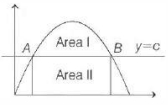
The figure shows a portion of the graph $y=2 x-4 x^3$.The line $y=c$ is such that the areas of the regions marked $I$ and $II$ are equal. If $a, b$ are the $x$-coordinates of $A, B$ respectively, then $a+b$ equals
What is the value of $ \cos (2 \cos^{-1} 0.8)\cos(2\cos−10.8)?$
  1. 0.81
  2. 0.56
  3. 0.48
  4. 0.28
Let $\vec p,\,\vec q$ and $\vec r$ be three non coplanar unit vectors equally inclined to each other at an acute angle $\theta $ . The value of $\left| {\vec p \times \left( {\vec q \times \vec r} \right)} \right|$ is 
If $A, B, C$ are the angles of a triangle and $\left| {\begin{array}{*{20}{c}}1&1&1\\{1 + \sin A}&{1 + \sin B}&{1 + \sin C}\\{\sin A + {{\sin }^2}A}&{\sin B + {{\sin }^2}B}&{\sin C + {{\sin }^2}C} \end{array}} \right|$ $= 0$, then the triangle is