MCQ
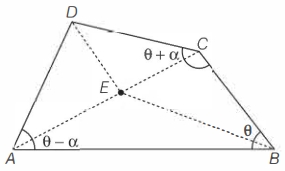
Let $A B C D$ be a quadrilateral such that there exists a point $E$ inside the quadrilateral satisfying $A E=B E=C E=D E$. Suppose $\angle D A B, \angle A B C, \angle B C D$ is an arithmetic progression. Then the median of the set $\{\angle D A B, \angle A B C, \angle B C D\}$ is
  • A
    $\frac{\pi}{6}$
  • B
    $\frac{\pi}{4}$
  • C
    $\frac{\pi}{3}$
  • $\frac{\pi}{2}$

Answer

Correct option: D.
$\frac{\pi}{2}$
d
(d)

Since, $\angle D A B, \angle A B C$ and $\angle B C D$ are in $AP \therefore$ Let $\angle D A B=\theta-\alpha, \angle A B C=\theta$ and $\angle B C D=\theta+\alpha$

$\therefore$ Median of $\angle D A B, \angle A B C$ and $\angle B C D=\theta$

From point $E$ all the vertices are at equal distance.

$\therefore A B C D$ is cyclic.

and $\angle A D C=2 \pi-(\theta-\alpha+\theta+\theta+\alpha)$

$\quad=2 \pi-3 \theta$

and $\angle A D C+\angle A B C=\pi$

$\Rightarrow 2 \pi-3 \theta+\theta=\pi$

$\therefore \quad \theta=\frac{\pi}{2}$

Need a full question paper?

Generate a complete, print-ready paper with questions like this in minutes — across 16+ boards, with answer keys.

Start Generating Free

Similar questions

On $ [1, e] $ the greatest value of ${x^2}\log x$
$\sum\limits_{n = 0}^4 {{{\left( {1009 - 2n} \right)}^4}\left( \begin{gathered}
  4 \hfill \\
  n \hfill \\ 
\end{gathered}  \right)} {\left( { - 1} \right)^n}$   is
Let $S_{1}$ be the sum of first $2 n$ terms of an arithmetic progression. Let, $S_{2}$ be the sum of first $4n$ terms of the same arithmetic progression. If $\left( S _{2}- S _{1}\right)$ is $1000,$ then the sum of the first $6 n$ terms of the arithmetic progression is equal to:
Let $a, b, c$ be positive integers such that $\frac{b}{a}$ is an integer. If $a, b, c$ are in geometric progression and the arithmetic mean of $a, b, c$ is $b+2$, then the value of $\frac{a^2+a-14}{a+1}$ is
$m$ men and $n$ women are to be seated in a row so that no two women sit together. If $m > n$, then the number of ways in which they can be seated is
If $\int_0^{\frac{\pi }{2}} {\frac{{\cot \,x}}{{\cot \,x + \cos ec\,x}}} dx = m\left( {\pi  + n} \right)$, then $m.n$ is equal to
$\mathop {\lim }\limits_{x \to 0} {x^x} = $
If $AA^T = I$ and $C$ is skew symmetric matric then $((A^T CA)^{50})^T$ is equal to
A student score the following marks in five tests : $45, 54, 41, 57, 43$. His score is not known for the sixth test. If the mean score is $48$ in the six tests, then the standard deviation of the marks in six tests is:
If the $10^{\text {th }}$ term of an A.P. is $\frac{1}{20}$ and its $20^{\text {th }}$ term is $\frac{1}{10},$ then the sum of its first $200$ terms is