MCQ
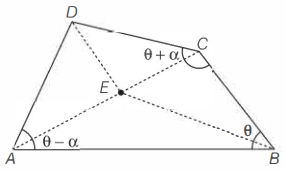
Let $A B C D$ be a quadrilateral such that there exists a point $E$ inside the quadrilateral satisfying $A E=B E=C E=D E$. Suppose $\angle D A B, \angle A B C, \angle B C D$ is an arithmetic progression. Then the median of the set $\{\angle D A B, \angle A B C, \angle B C D\}$ is
  • A
    $\frac{\pi}{6}$
  • B
    $\frac{\pi}{4}$
  • C
    $\frac{\pi}{3}$
  • $\frac{\pi}{2}$

Answer

Correct option: D.
$\frac{\pi}{2}$
d
(d)

Since, $\angle D A B, \angle A B C$ and $\angle B C D$ are in $AP \therefore$ Let $\angle D A B=\theta-\alpha, \angle A B C=\theta$ and $\angle B C D=\theta+\alpha$

$\therefore$ Median of $\angle D A B, \angle A B C$ and $\angle B C D=\theta$

From point $E$ all the vertices are at equal distance.

$\therefore A B C D$ is cyclic.

and $\angle A D C=2 \pi-(\theta-\alpha+\theta+\theta+\alpha)$

$\quad=2 \pi-3 \theta$

and $\angle A D C+\angle A B C=\pi$

$\Rightarrow 2 \pi-3 \theta+\theta=\pi$

$\therefore \quad \theta=\frac{\pi}{2}$

Need a full question paper?

Generate a complete, print-ready paper with questions like this in minutes — across 16+ boards, with answer keys.

Start Generating Free

Similar questions

How many ordered pairs of $(m, n)$ integers satisfy $\frac{m}{12}=\frac{12}{n} ?$
If both the roots of the quadratic equation $\text{x}^2 -2\text{kx}+\text{k}^2-5=0 $ are less than $5,$ than $k$ lies in the interval:
If out of $150$ students who read at least one newspaper The Times of India, The Hindustan Times and The Hindu. There are $65$ who read The Times of India, $41$ who read The Hindu and $50$ who read The Hindustan Times.What is the maximum possible number of students who read all the three newspaper?
$\mathop {\lim }\limits_{x \to \infty } \frac{{(x - 1)(2x + 3)}}{{{x^2}}} = $
If complex numbers $(x -2y) + i(3x -y)$ and $(2x -y) + i(x -y + 6)$ are conjugates of each other, then $|x + iy|$ is $(x,y \in R)$
Choose the correct answer. The coordinates of the foot of perpendiculars from the point $(2, 3)$ on the line $y = 3x + 4$ is given by
If the sum of $n$ terms of a $G.P.$ is $255$ and ${n^{th}}$ terms is $128$ and common ratio is $2$, then first term will be
A line is such that its segment between the straight lines $5x - y - 4 = 0$ and $3x + 4y - 4 = 0$ is bisected at the point $(1, 5)$, then its equation is
Let $z \in C$ with $Im(z) = 10$ and it satisfies $\frac{{2z - n}}{{2z + n}} = 2i - 1$ for some natural number $n$. Then
Let the tangent to the circle $C _{1}: x^{2}+y^{2}=2$ at the point $M (-1,1)$ intersect the circle $C _{2}$ : $( x -3)^{2}+(y-2)^{2}=5$, at two distinct points $A$ and $B$. If the tangents to $C _{2}$ at the points $A$ and $B$ intersect at $N$, then the area of the triangle $ANB$ is equal to