MCQ
Let a function $g:[0,4] \rightarrow R$ be defined as

$g ( x )=\left\{\begin{array}{ll}\max _{0 \leq t \leq x }\left\{ t ^{3}-6 t ^{2}+9 t -3\right\} & , 0 \leq x \leq 3 \\ 4- x & , 3 < x \leq 4\end{array}\right.$ then the number of points in the interval $(0,4)$ where $g(x)$ is NOT differentiable, is $.....$

  • A
    $5$
  • B
    $3$
  • $1$
  • D
    $11$

Answer

Correct option: C.
$1$
c
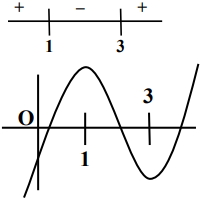
$f(X)=x^{3}-6 x^{2}+9 x-3$

$f(x)=3 x^{2}-12 x+9=3(x-1)(x-3)$

$f(1)=1$ and $f(3)=-3$

$g(x)=f(x) \quad\quad 0 \leq x \leq 1$

$\quad\quad\quad\quad1 \quad\quad\quad 1 \leq x \leq 3$

$\quad\quad\quad\quad4-x \quad 3$

$g(x)$ is continuous

$g^{\prime}(x)=3(x-1)(x-3) \quad\quad 0 \leq x \leq 1$

$\quad\quad\quad\quad0\quad\quad\quad\quad \quad \quad \quad 1 \leq x \leq 3$

$\quad\quad\quad\quad-1 \quad \quad \quad \quad \quad \quad 3$

$g(x)$ is non-differentiable at $x=3$

Need a full question paper?

Generate a complete, print-ready paper with questions like this in minutes — across 16+ boards, with answer keys.

Start Generating Free

Similar questions

If matrix $A=\left[a_{i j}\right]_{m \times n}$ is a square matrix, then
If ${\sin ^2}x + 2\cos y + xy = 0$, then ${{dy} \over {dx}} = $
Let $A=\left[\begin{array}{cc}2 & -1 \\ 1 & 1\end{array}\right]$. If the sum of the diagonal elements of $\mathrm{A}^{13}$ is $3^{\mathrm{n}}$, then $\mathrm{n}$ is equal to ..........
$\int_{}^{} {\frac{{{e^x}\;dx}}{{\sqrt {1 - {e^{2x}}} }} = } $
The area of the region bounded by the parabola y = x2 + 1 and the staight line x + y = 3 is given by:
  1. $\frac{45}{7}$
  2. $\frac{25}{4}$
  3. $\frac{\pi}{18}$
  4. $\frac{9}{2}$ 
Let $S=(-1, \infty)$ and $f: S \rightarrow \mathbb{R}$ be defined as $f(x)=\int_{-1}^x\left(e^1-1\right)^{11}(2 t-1)^5(t-2)^7(t-3)^{12}(2 t-10)^{61} d t$ Let $p=$ Sum of square of the values of $x$, where $\mathrm{f}(\mathrm{x})$ attains local maxima on $\mathrm{S}$. and $\mathrm{q}=$ Sum of the values of $x$, where $f(x)$ attains local minima on $S$. Then, the value of $p^2+2 q$ is
If $\text{A}=\begin{bmatrix}2&0&-3\\4&3&1\\-5&7&2\end{bmatrix}$ is expressed as the sum of a symmetric and skew-symmetric matrix, then the symmetric matrix is:
  1. $\begin{bmatrix}2&2&-4\\2&3&4\\-4&4&2\end{bmatrix}$
  2. $\begin{bmatrix}2&4&-5\\0&3&7\\-3&1&2\end{bmatrix}$
  3. $\begin{bmatrix}4&4&-8\\4&6&8\\-8&8&4\end{bmatrix}$
  4. $\begin{bmatrix}1&0&0\\0&1&0\\0&0&1\end{bmatrix}$
Let $f: R \rightarrow R$ be defined as $f(x)=e^{-x} \sin x$. If $F :[0,1] \rightarrow R$ is a differentiable function such that $F ( x )=\int_{0}^{ x } f ( t ) dt ,$ then the value of $\int_{0}^{1}\left( F ^{\prime}( x )+ f ( x )\right) e ^{ x } dx$ lies in the interval
If a line makes angles $90^{\circ}, 60^{\circ}$ and $30^{\circ}$ with the positive directions of $x, y$ and $z$-axis respectively, then its direction cosines are
Let $I_1 = \int\limits_0^{\frac{\pi }{2}} {{e^{ - {x^2}}}\sin (x)dx} $ ; $I_2 = \int\limits_0^{\frac{\pi }{2}} {{e^{ - {x^2}}}dx} $ ; $I_3 = \int\limits_0^{\frac{\pi }{2}} {{e^{ - {x^2}}}(1 + x)\,dx} $

and consider the statements

$I\,:$ $I_1 < I_2$   

$II\,:$  $I_2 < I_3$ 

$III\,:$  $I_1 = I_3$

Which of the following is $(are)$ true?