MCQ
Let a function $g:[0,4] \rightarrow R$ be defined as

$g ( x )=\left\{\begin{array}{ll}\max _{0 \leq t \leq x }\left\{ t ^{3}-6 t ^{2}+9 t -3\right\} & , 0 \leq x \leq 3 \\ 4- x & , 3 < x \leq 4\end{array}\right.$ then the number of points in the interval $(0,4)$ where $g(x)$ is NOT differentiable, is $.....$

  • A
    $5$
  • B
    $3$
  • $1$
  • D
    $11$

Answer

Correct option: C.
$1$
c
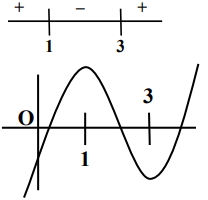
$f(X)=x^{3}-6 x^{2}+9 x-3$

$f(x)=3 x^{2}-12 x+9=3(x-1)(x-3)$

$f(1)=1$ and $f(3)=-3$

$g(x)=f(x) \quad\quad 0 \leq x \leq 1$

$\quad\quad\quad\quad1 \quad\quad\quad 1 \leq x \leq 3$

$\quad\quad\quad\quad4-x \quad 3$

$g(x)$ is continuous

$g^{\prime}(x)=3(x-1)(x-3) \quad\quad 0 \leq x \leq 1$

$\quad\quad\quad\quad0\quad\quad\quad\quad \quad \quad \quad 1 \leq x \leq 3$

$\quad\quad\quad\quad-1 \quad \quad \quad \quad \quad \quad 3$

$g(x)$ is non-differentiable at $x=3$

Need a full question paper?

Generate a complete, print-ready paper with questions like this in minutes — across 16+ boards, with answer keys.

Start Generating Free

Similar questions

$\int\limits^{\frac{\pi}{2}}_0\frac{1}{1+\cot^3\text{x}}\text{ dx}$ is equal to :
The shortest distance between the lines $\frac{x+7}{-6}=\frac{y-6}{7}=z$ and $\frac{7-x}{2}=y-2=z-6$ is
If $A=\left[a_{i j}\right]$ is a square matrix of order $2$ such that $a_{i j}=\left\{\begin{array}{l}1, \text { when } i \neq j \\ 0, \text { when } i=j\end{array}\right.$, then $A^2$ is
The number of all possible matrices of order $3 \times 3$ with each entry $0$ or $1$ is:
If $\left| {\,\begin{array}{*{20}{c}}{x + 1}&3&5\\2&{x + 2}&5\\2&3&{x + 4}\end{array}\,} \right| = 0$, then $ x =$
A square $ABCD$ of diagonal $2a$ is folded along the diagonal $AC$ so that the planes $DAC$ and $BAC$ are at right angle. The shortest distance between $DC$ and $AB$ is
Thirty two persons $X_1, X_2, \ldots, X_{32}$ are randomly seated around a circular table at equal intervals. Two persons $X_i$ and $X_j$ are said to be within earshot of each other if there are at most three persons between them on the minor arc joining $X_i$ and $X_j$. The

probabiliky that $X_1$ and $X_3$ are within earshot of each other is, Here, $\left.{ }^n C_r=\frac{n !}{(n-r) ! r !}\right)$

Let $x > 0$ be a fixed real number. Then, the integral $\int \limits_0^{\infty} e^{-t}|x-t| d t$ is equal to
The area bounded by the line $y = 2x - 2, y = -x$ and $x-$axis is given by:
Let $\quad \overrightarrow{ a }=2 \hat{ i }-7 \hat{ j }+5 \hat{ k } \quad, \quad \overrightarrow{ b }=\hat{ i }+\hat{ k } \quad$ and $\overrightarrow{ c }=\hat{ i }+2 \hat{ j }-3 \hat{ k }$ be three given vectors. If $\overrightarrow{ r }$ is a vector such that $\overrightarrow{ r } \times \overrightarrow{ a }=\overrightarrow{ c } \times \overrightarrow{ a }$ and $\overrightarrow{ r } \cdot \overrightarrow{ b }=0$, then $|\overrightarrow{ r }|$ is equal to :