MCQ
Let $A =\left[\begin{array}{ll} a & b \\ c & d \end{array}\right]$ and $B =\left[\begin{array}{l}\alpha \\ \beta\end{array}\right] \neq\left[\begin{array}{l}0 \\ 0\end{array}\right]$ such that
$AB = B$ and $a + d =2021,$ then the value of $ad - bc$ is equal to ...... .
  • A
    $1010$
  • B
    $1560$
  • C
    $2250$
  • $2020$

Answer

Correct option: D.
$2020$
d
$A =\left[\begin{array}{ll} a & b \\ c & d \end{array}\right], B =\left[\begin{array}{l}\alpha \\ \beta\end{array}\right]$

$AB = B$

$\Rightarrow( A - I ) B = O$

$\Rightarrow| A - I |= O ,$ since $B \neq O$

$\left|\begin{array}{cc}( a -1) & b \\ c & ( d -1)\end{array}\right|=0$

$ad - bc =2020$

Need a full question paper?

Generate a complete, print-ready paper with questions like this in minutes — across 16+ boards, with answer keys.

Start Generating Free

Similar questions

A and B draw two cards each, one after another, from a pack of well-shuffled pack of 52 cards. The probability that all the four cards drawn are of the same suit is
  1. $\frac{44}{85\times49}$
  2. $\frac{11}{85\times49}$
  3. $\frac{13\times24}{17\times25\times49}$
  4. None of these.
Mark the correct alternative in the following question:
Suppose a random variable X follows the binomial distribution with parameters n and p, where 0 < p < 1. If $\frac{\text{P(X = r})}{\text{P(X = n} -\text{r})}$ is independent of n and r, then p equals:
  1. $\frac{1}{2}$
  2. $\frac{1}{3}$
  3. $\frac{1}{5}$
  4. $\frac{1}{7}$
The number of arbitrary constants in the particular solution of a differential equation of third order is:
  1. 3
  2. 2
  3. 1
  4. 0
A line which makes angle ${60^o}$ with $y$ - axis and $z$ - axis, then the angle which it makes with $x$ -axis is ......... $^o$
If $x^{3} d y+x y d x=x^{2} d y+2 y d x ; y(2)=e$ and $x$ $>1,$ then $y (4)$ is equal to
The order and degree of the differential equation,

$\frac{\text{d}^2\text{y}}{\text{dx}^2}+\Big(\frac{\text{dy}}{\text{dx}}\Big)^{\frac{1}{4}}+\text{x}^{\frac{1}{5}}=0$ respectively are:

  1. 2 and not defined
  2. 2 and 2
  3. 2 and 3
  4. 3 and 3


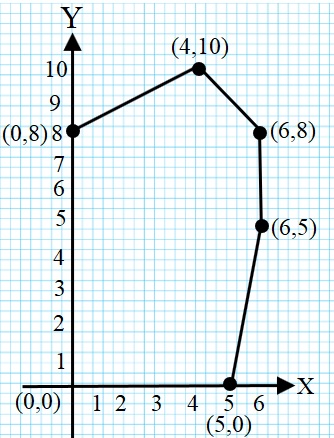
The feasible region for an LPP is shown below:

Let Z = 3x - 4y be the objective function. Minimum of Z occurs at

If $\sin(\text{x}+\text{y})=\log(\text{x}+\text{y}),$ then $\frac{\text{dy}}{\text{dx}}=$
  1. 2
  2. -2
  3. 1
  4. -1
$\operatorname{cosec}\left[2 \cot ^{-1}(5)+\cos ^{-1}\left(\frac{4}{5}\right)\right]$ is equal to ..... .
If $f(x) = \int_{{x^2}}^{{x^2} + 1} {{e^{ - {t^2}}}} dt,$ then $f(x)$ increases in