Question
Let $A=\{a, b, c\}$ and let $R=\{(a, a),(a, b)$, $(b, a)\}$. Then, $R$ is

Answer

(c) : $R$ is symmetric and transitive but not reflexive.

Need a full question paper?

Generate a complete, print-ready paper with questions like this in minutes — across 16+ boards, with answer keys.
Start Generating Free

Similar questions

Choose the correct answers from the given four options:
The set of points where the function f given by $\text{f(x)}=|2\text{x}-1|\sin\text{x}$ is differentiable is:
  1. $\text{R}$
  2. $\text{R}-\Big\{\frac{1}{2}\Big\}$
  3. $(0,\infty)$
  4. $\text{None of these}$
If $\begin{vmatrix}\text{a}&\text{p}&\text{x}\\\text{b}&\text{q}&\text{y}\\\text{c}&\text{r}&\text{z}\end{vmatrix}=16,$ then the value of $\begin{vmatrix}\text{p}+\text{x}&\text{a}+\text{x}&\text{a}+\text{p}\\\text{q}+\text{y}&\text{b}+\text{y}&\text{b}+\text{q}\\\text{r}+\text{z}&\text{c}+\text{z}&\text{c}+\text{r}\end{vmatrix}$ is:
  1. 4
  2. 8
  3. 16
  4. 32
If $\text{f}(\text{x})=\frac{1}{4\text{x}^{2}+2\text{x}+1}$, then its maximum value is :
  1. $\frac{4}{3}$
  2. $\frac{2}{3}$
  3. $1$
  4. $\frac{3}{4}$ 
A bag $X$ contains $2$ white and $3$ black balls and another bag $Y$ contains $4$ white and $2$ black balls. One bag is selected at random and a ball is drawn from it. Then, the probability chosen to be white is,
$\cos ^{-1}\left(\frac{1}{2}\right)+2 \sin ^{-1}\left(\frac{1}{2}\right)+4 \tan ^{-1}\left(\frac{1}{\sqrt{3}}\right)$ is equal to
If $\text{f(x)}=(\text{x+1})^{\cot\text{x}}$ be continuous at x = 0, then f(0) is equal to:
  1. 0
  2. $\frac{1}{\text{e}}$
  3. e
  4. none of these.
The existence of the unique solution of the system of equations:
x + y + z = λ
5x − y + µz = 10
2x + 3y − z = 6
depends on
  1. µ only.
  2. λ only.
  3. λ and µ both.
  4. neither λ nor µ.
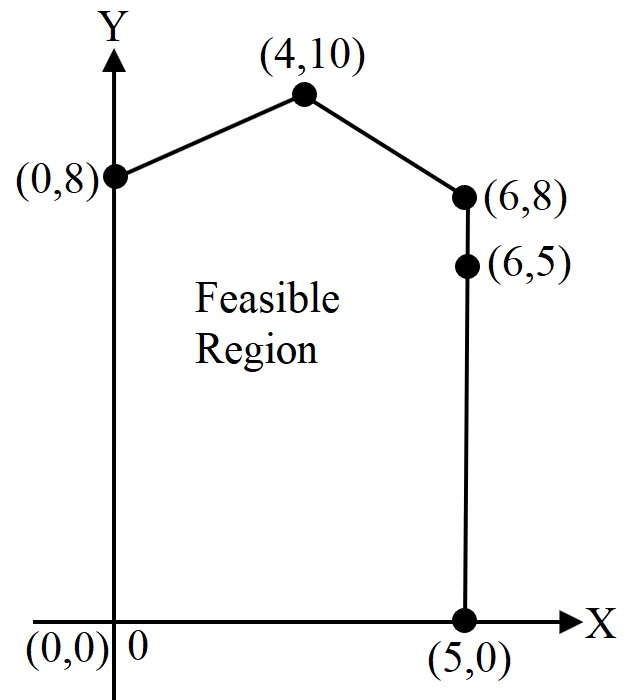
The feasible region for a LPP is shown shaded in the figure. Let Z = 3x - 4y be the objective function. Minimum of Z occurs at.
  1. (0, 0)
  2. (0, 8)
  3. (5, 0)
  4. (4, 10)
The eqution of the plane $\vec{\text{r}}=\hat{\text{i}}-\hat{\text{j}}+\lambda(\hat{\text{i}}+\hat{\text{j}}+\hat{\text{k}})+\mu(\hat{\text{i}}-2\hat{\text{j}}+3\hat{\text{k}})$ in scalar product from is:
The vector equation of the line passing through the point (-1, 5, 4) and perpendicular to the plane z = 0 is:
  1. $\vec{\text{r}}=-\hat{\text{i}}+5\hat{\text{j}}+4\hat{\text{k}}+\lambda(\hat{\text{i}}+\hat{\text{j}})$
  2. $\vec{\text{r}}=-\hat{\text{i}}+5\hat{\text{j}}+(4+\lambda)\hat{\text{k}}$
  3. $\vec{\text{r}}=\hat{\text{i}}-5\hat{\text{j}}-4\hat{\text{k}}+\lambda\hat{\text{k}}$
  4. $\vec{\text{r}}=\lambda\hat{\text{k}}$