Question
Let $\text{A}=\begin{bmatrix}1&2\\-1&3\end{bmatrix},\ \text{B}=\begin{bmatrix}4&0\\1&5\end{bmatrix},$ $\text{C}=\begin{bmatrix}2&0\\1&-2\end{bmatrix},$ a = 4, b = -2, then show that $(\text{A}-\text{B})\text{C}=\text{AC}-\text{BC}.$

Answer

We have, $\text{A}=\begin{bmatrix}1&2\\-1&3\end{bmatrix},\ \text{B}=\begin{bmatrix}4&0\\1&5\end{bmatrix},$ $\text{C}=\begin{bmatrix}2&0\\1&-2\end{bmatrix},$ and a = 4, b = -2$(\text{A}-\text{B})=\begin{bmatrix}1-4&2-0\\-1-1&3-5\end{bmatrix}=\begin{bmatrix}-3&2\\-2&-2\end{bmatrix}$
$(\text{A}-\text{B})\text{C}=\begin{bmatrix}-3&2\\-2&-2\end{bmatrix}\begin{bmatrix}2&0\\1&-2\end{bmatrix}$
$=\begin{bmatrix}-4&-4\\-6&4\end{bmatrix}\ ....(\text{i})$
Now, $\text{AC}=\begin{bmatrix}1&2\\-1&3\end{bmatrix}\begin{bmatrix}2&0\\1&-2\end{bmatrix}$ $=\begin{bmatrix}4&-4\\1&-6\end{bmatrix}\ .....(\text{ii})$ and $\text{BC}=\begin{bmatrix}4&0\\1&5\end{bmatrix}\begin{bmatrix}2&0\\1&-2\end{bmatrix}$ $=\begin{bmatrix}8&0\\7&-10\end{bmatrix}\ ....(\text{iii})$ $\therefore\ \text{AC}-\text{BC}=\begin{bmatrix}4-8&-4-0\\1-7&-6+10\end{bmatrix}$ [Using (ii) and (iii)] $=\begin{bmatrix}-4&-4\\-6&4\end{bmatrix}$ $=(\text{A}-\text{B})\text{C}$ [Using (i)]Hence proved.

Need a full question paper?

Generate a complete, print-ready paper with questions like this in minutes — across 16+ boards, with answer keys.
Start Generating Free

Similar questions

The length $x$ of a rectangle is decreasing at the rate of $5 \ cm$/minute and the width $y$ is increasing at the rate of $4 \ cm$/minute. When $x = 8\ cm$ and $y = 6\ cm,$ find the rates of change of $(a)$ the perimeter, and $(b)$ the area of the rectangle.
By Using properties of definite integral, evaluate the following integral in Exercise:
$\int^{4}_{0}|\text{x}-1|\text{dx}$
Find the general solution of $\frac{{dy}}{{dx}} + \left( {\sec x} \right)y = \tan x\left( {0 \leq x < \frac{\pi }{2}} \right)$
If f(x) = |x|, prove that fof = f.
Probality of solving specific problem independently by $A$ and $B$ are $\frac{1}{2}$ and $\frac{1}{3}$ respectively. If both try to solve the problem independently. Find the probability that the problem is solved.
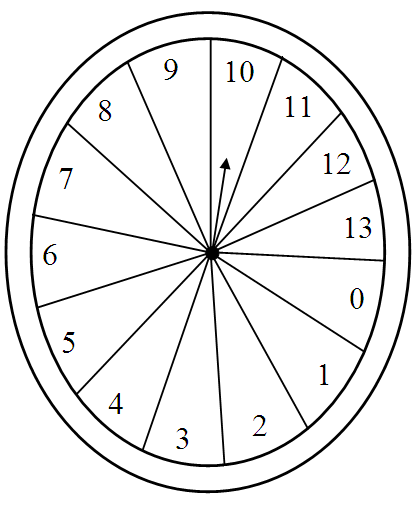
In roulette, Figure, the wheel has 13 numbers 0, 1, 2,...., 12 maked on equally spaced slots. A player sets Rs 10 on a given number. He recieves Rs 100 from the organiser of the game if the ball comes to rest in this slot; otherwise he gets nothing. If X denotes the players net gain/loss, Find E(X).
Evaluate the following definite integrals:
$\int_{0}^\limits{\pi}\Big(\sin^2\frac{\text{x}}{2}-\cos^2\frac{\text{x}}{2}\Big)\text{dx}$
Evaluate:
$\cos\Big(\tan^{-1}\frac{3}{4}\Big)$
Solve the following differential equations:
$\frac{\text{dy}}{\text{dx}}=\text{e}^{\text{x+y}}+\text{e}^{-\text{x+y}}$
Find the points o local maxima or local minima, if any, of the following functions, using the first derivatives test. Also, find the local maximum or local minimum values, as the case may be:
$\text{f}'(\text{x})=\frac{\text{x}}{2}+\frac{2}{\text{x}}, \text{x}\geq0$