MCQ
Let $A=\left[\begin{array}{cc}0 & -2 \\ 2 & 0\end{array}\right]$. If $M$ and $N$ are two matrices given by $M =\sum \limits_{ k =1}^{10} A ^{2 k }$ and $N =\sum \limits_{ k =1}^{10} A ^{2 k -1}$ then $MN ^{2}$ is
  • a non-identity symmetric matrix
  • B
    skew symmetric matrix
  • C
    neither symmetric nor skew-symmetric matrix
  • D
    an identify matrix

Answer

Correct option: A.
a non-identity symmetric matrix
a
$A =\left[\begin{array}{cc}0 & -2 \\ 2 & 0\end{array}\right]$

$A ^{2}=\left[\begin{array}{cc}0 & -2 \\ 2 & 0\end{array}\right]\left[\begin{array}{cc}0 & -2 \\ 2 & 0\end{array}\right]=\left[\begin{array}{cc}-4 & 0 \\ 0 & -4\end{array}\right]=-4 I$

$A ^{3}=-4 A$

$A ^{4}=(-4 I )(-4 I )=(-4)^{2} I$

$A ^{5}=(-4)^{2} A , A ^{6}=(-4)^{3} I$

$M=\sum \limits_{ k =1}^{10} A ^{2 k }= A ^{2}+ A ^{4}+\ldots .+ A ^{20}$

$=\left[-4+(-4)^{2}+(-4)^{3}+\ldots+(-4)^{20}\right] I$

$=-4 \lambda I$

$\Rightarrow \quad M$ is symmetric matrix

$N =\sum \limits_{ k =1}^{10} A ^{2 k -1}= A + A ^{3}+\ldots \ldots+ A ^{19}$

$= A \left[1+(-4)+(-4)^{2}+\ldots .+(-4)^{9}\right]$

$=\lambda A \Rightarrow \text { skew symmetric }$

$\Rightarrow N ^{2} \text { is symmetric matrix }$

$\Rightarrow MN ^{2}$ is non identity symmetric matrix
Need a full question paper?

Generate a complete, print-ready paper with questions like this in minutes — across 16+ boards, with answer keys.

Start Generating Free

Similar questions

The shortest distance between the lines $\frac{x-3}{2}=\frac{y-2}{3}=\frac{z-1}{-1}$ and $\frac{x+3}{2}=\frac{y-6}{1}=\frac{z-5}{3}$ is
A curve is such that the area of the region bounded by the co-ordinate axes, the curve $\&$ the ordinate of any point on it is equal to the cube of that ordinate. The curve represents
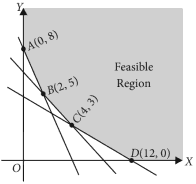
Feasible region for an L.P.P. is shown shaded in the following figure. Minimum of $Z=5 x+3 y$ occurs at the point point
Image
In Graphical solution the feasible solution is any solution to a LPP which satisfies.
If the domain and range of $f(x){ = ^{9 - x}}{C_{x - 1}}$ contains $m$ and $n$ elements respectively, then 
If $a $ and  $b $ are two unit vectors such that $a+2b$ and $5a - 4b$ are perpendicular to each other, then the angle between $a$  and $b $ is ............. $^o$
If ${A_1},{B_1},{C_1}$.... are respectively the co-factors of the elements ${a_1},{b_1},{c_1}$,...... of the determinant $\Delta = \left| {\,\begin{array}{*{20}{c}}{{a_1}}&{{b_1}}&{{c_1}}\\{{a_2}}&{{b_2}}&{{c_2}}\\{{a_3}}&{{b_3}}&{{c_3}}\end{array}\,} \right|$, then $\left| {\begin{array}{*{20}{c}}{{B_2}}&{{C_2}}\\{{B_3}}&{{C_3}}\end{array}} \right| = $
The equations in terms of x and y are:
  1. x – y = 50, 2x – y = 550
  2. x – y = 50, 2x + y = 550
  3. x + y = 50, 2x + y = 550
  4. x + y = 50, 2x – y = 550
If $f(x)$ be a differentiable function such that $f(xy) = f(x) + f(y)$ for all $x$ & $y$ ; then $f(e) + f(1/e) =$ ?
If $\vec{a}$ is a nonzero vector of magnitude $^{\prime} a^{\prime}$ and $\lambda$ a nonzero scalar, then $\lambda \,\,\vec{a}$ is unit vector if