MCQ
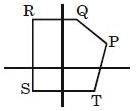
Let $\alpha $ and $\beta $ be integers satisfying $0 < \beta < \alpha $ .Let $P\left( {\alpha ,\beta } \right),Q$ be the reflection of $P$ in the line $y = x, R$ be the reflection of $Q$ in the $y-$ axis, $S$ be the reflection of $R$ in the $x-$ axis and $T$ be the reflection of $S$ in the $y-$ axis. If the area of convex pentagon $PQRST$ is $187\ sq. units$ , then value of $\alpha  + {\beta ^2}$ is
  • A
    $20$
  • B
    $34$
  • C
    $27$
  • $15$

Answer

Correct option: D.
$15$
d
$\mathrm{P}(\alpha, \beta), Q(\beta, \alpha), R(-\beta, \alpha), S(-\beta,-\alpha), T(\beta,-\alpha)$

$187=4 \alpha \beta+\frac{1}{2} \cdot 2 \alpha(\alpha-\beta)$

$187=\alpha(\alpha+3 \beta)$

$\alpha=11,3 \beta+\alpha=17$

$\alpha=11$ and $\beta=2$

Need a full question paper?

Generate a complete, print-ready paper with questions like this in minutes — across 16+ boards, with answer keys.

Start Generating Free

Similar questions

Maximum number of points on parabola $y^2 = 16x$ which are equidistant from a variable point $P$ (which lie inside the parabola), is -
Let the eccentricity of the hyperbola $\frac{x^2}{a^2}-\frac{y^2}{b^2}=1$ be reciprocal to that of the ellips $x^2+4 y^2=4$. If the hyperbola passes through a focus of the ellipse, then

$(A)$ the equation of the hyperbola is $\frac{x^2}{3}-\frac{y^2}{2}=1$

$(B)$ a focus of the hyperbola is $(2,0)$

$(C)$ the eccentricity of the hyperbola is $\sqrt{\frac{5}{3}}$

$(D)$ the equation of the hyperbola is $x^2-3 y^2=3$

Let $x_{0}$ be the point of local maxima of $f(x)=\vec{a} \cdot(\vec{b} \times \vec{c}),$ where $\vec{a}=x \hat{i}-2 \hat{j}+3 \hat{k}$ $\overrightarrow{ b }=-2 \hat{ i }+ x \hat{ j }-\hat{ k }$ and $\overrightarrow{ c }=7 \hat{ i }-2 \hat{ j }+ x \hat{ k } \cdot$ Then the value of $\vec{a} \cdot \vec{b}+\vec{b} \cdot \vec{c}+\vec{c} \cdot \vec{a}$ at $x=x_{0}$ is 
How many words can be made out from the letters of the word $INDEPENDENCE$, in which vowels always come together
The temperature $\mathrm{T}(\mathrm{t})$ of a body at time $\mathrm{t}=0$ is $160^{\circ}$ $\mathrm{F}$ and it decreases continuously as per the differential equation $\frac{\mathrm{dT}}{\mathrm{dt}}=-\mathrm{K}(\mathrm{T}-80)$, where $\mathrm{K}$ is positive constant. If $\mathrm{T}(15)=120^{\circ} \mathrm{F}$, then $\mathrm{T}(45)$ is equal to . . .. . . . . 
The locus of a point which moves so that it is always equidistant from the point $A(a, 0)$ and $B (-a, 0)$ is
Two sides of a parallelogram are along the lines, $x + y = 3$ and $x -y + 3 = 0$. If its diagonals intersect at $(2, 4)$, then one of its vertex is
The area enclosed by the curves $y^2+4 x=4$ and $y-2 x=2$ is :
Sum of the series $1\cdot 2015 + 2\cdot 2014 + 3\cdot 2013 +.....2015\cdot 1$ is equal to :-
If $A \ne O$ and $B \ne O$ are $ n × n$ matrix such that $AB = O,$ then