MCQ
Let

$\alpha=\sum_{ k =1}^{\infty} \sin ^{2 k}\left(\frac{\pi}{6}\right)$

Let $g:[0,1] \rightarrow R$ be the function defined by

$g( x )=2^{\alpha x }+2^{\alpha(1- x )}$

Then, which of the following statements is/are $TRUE$?

$(A)$ The minimum value of $g( x )$ is $2^{\frac{7}{6}}$

$(B)$ The maximum value of $g( x )$ is $1+2^{\frac{1}{3}}$

$(C)$ The function $g( x )$ attains its maximum at more than one point

$(D)$ The function $g( x )$ attains its minimum at more than one point

  • A
    $A,B$
  • B
    $A,B,D$
  • C
    $A,C$
  • $A,B,C$

Answer

Correct option: D.
$A,B,C$
d
$\alpha=\left(\frac{1}{2}\right)^2+\left(\frac{1}{2}\right)^4+\left(\frac{1}{2}\right)^6+\ldots$

$\alpha=\frac{\frac{1}{4}}{1-\frac{1}{4}}=\frac{1}{3}$

$\therefore g(x)=2^{x / 3}+2^{1 / 3(1-x)}$

$\therefore g(x)=2^{x / 3}+\frac{2^{1 / 3}}{2^{x / 3}}$

$\text { where } g(0)=1+2^{1 / 3} \& g(1)=1+2^{1 / 3}$

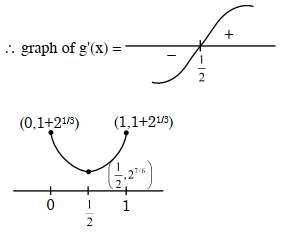
$\therefore g^{\prime}(x)=\frac{1}{3}\left(2^{x / 3}-\frac{2^{1 / 3}}{2^{\pi / 3}}\right)=0$

$\Rightarrow 2^{2 x / 3}=2^{1 / 3} \Rightarrow x=\frac{1}{2}=\text { critical point }$

(image)

& $g\left(\frac{1}{2}\right)=2^{\frac{7}{6}}$

$\therefore \text { graph of } g(x) \text { in }[0,1]$

(image)

Need a full question paper?

Generate a complete, print-ready paper with questions like this in minutes — across 16+ boards, with answer keys.

Start Generating Free

Similar questions

The area enclosed by the curves $y=\log _{ t }\left( x + e ^{2}\right)$, $x=\log _{ e }\left(\frac{2}{ y }\right)$ and $x =\log _{ e } 2$, above the line $y =1$ is.
$\sin \left(\tan ^{-1} x\right),|x|<1=$ __________ .
An urn contains 9 balls two of which are red, three blue and four black. Three balls are drawn at random. The probability that they are of the same colour is,
If $A = \left[ {\begin{array}{*{20}{c}}3&1\\{ - 1}&2\end{array}} \right]$, then ${A^2} = $
If $y = 1 + x + {{{x^2}} \over {2\,!}} + {{{x^3}} \over {3\,!}} + ..... + {{{x^n}} \over {n\,!}}$, then ${{dy} \over {dx}} = $
If $A=\left[\begin{array}{cc}2 & 2 \\ -3 & 2\end{array}\right], B=\left[\begin{array}{cc}0 & -1 \\ 1 & 0\end{array}\right]$ then $\left(B^{-1} A^{-1}\right)^{-1}=$
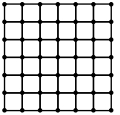
Consider the $6 \times 6$ square in the figure. Let $A_1, \mathrm{~A}_2, \ldots, A_{49}$ be the points of intersections (dots in the picture) in some order. We say that $A_i$ and $A_j$ are friends if they are adjacent along a row or along a column. Assume that each point $A_i$ has an equal chance of being chosen.

(image)

($1$) Let $p_i$ be the probability that a randomly chosen point has $i$ many friends, $i=0,1,2,3,4$. Let $X$ be a random variable such that for $i=0,1,2,3,4$, the probability $P(X=i)=p_i$. Then the value of $7 E(X)$ is

($2$) Two distinct points are chosen randomly out of the points $A_1, A_2, \ldots, A_{4 g}$. Let $p$ be the probability that they are friends. Then the value of $7 p$ is

If $y^{2}+\log _{e}\left(\cos ^{2} x\right)=y, x \in\left(-\frac{\pi}{2}, \frac{\pi}{2}\right),$ then
Let $\alpha $, $\beta$ $\gamma$, $\delta$ are distinct imaginary roots of

$z^5=1$ then value of $\left| {\begin{array}{*{20}{c}}
  {{e^\alpha }}&{{e^{2\alpha }}}&{{e^{3\alpha  + 1}}}&{ - {e^{ - \delta }}} \\ 
  {{e^\beta }}&{{e^{2\beta }}}&{{e^{3\beta  + 1}}}&{ - {e^{ - \delta }}} \\ 
  {{e^\gamma }}&{{e^{2\gamma }}}&{{e^{3\gamma  + 1}}}&{ - {e^{ - \delta }}} 
\end{array}} \right|$

Corner points of the feasible region for an $\operatorname{LPP}$ are $(0,2),(3,0),(6,0),(6,8)$ and $(0,5)$ Let $F=4 x+6 y$ be the objective function. The Minimum value of $F$ occurs at $....$