MCQ
Let $f :[2,4] \rightarrow R$ be a differentiable function such that $\left(x \log _e x\right) f^{\prime}(x)+\left(\log _e x\right) f(x)+f(x) \geq 1$, $x \in[2,4]$ with $f(2)=\frac{1}{2}$ and $f(4)=\frac{1}{4}$.

Consider the following two statements:

$(A): f(x) \leq 1$, for all $x \in[2,4]$

$(B)$ : $f(x) \geq \frac{1}{8}$, for all $x \in[2,4]$

Then,

  • A
    Only statement $(B)$ is true
  • B
    Neither statement $(A)$ nor statement $(B)$ is true
  • Both the statement $(A)$ and $(B)$ are true
  • D
    Only statement $(A)$ is true

Answer

Correct option: C.
Both the statement $(A)$ and $(B)$ are true
c
$x \operatorname{lnxf} f^{\prime}(x)+\ln x f(x)+f(x) \geq I, x \in[2,4]$

And $f (2)=\frac{1}{2}, f (4)=\frac{1}{4}$

Now $x \ln x \frac{d y}{d x}+(\ln +1) y \geq 1$

$\frac{ d }{ dx }( y \cdot x \ln x ) \geq 1$

$\frac{ d }{ dx }( f ( x ) x \ln x ) \geq 1$

$\Rightarrow \frac{ d }{ dx }( x \ln xf ( x )- x ) \geq 0, x \in[2,4]$

$\Rightarrow \text { The function } g(x)=x \ln x f(x)-x \text { is increasing in }$

$\Rightarrow$ The function $g(x)=x \ln x f(x)-x$ is increasing in $[2.4]$

And $g(2)=2 \ln 2 f(2)-2=\ln 2-2$

$g(4)=4 \ln 4 f(4)-4=\ln 4-4$

$=2(\ln 2-2)$

Now $\quad g (2) \leq g ( x ) \leq g (4)$

$\ln 2-2 \leq x \ln x f(x)-x \leq 2(\ln 2-2)$

$\frac{\ln 2-2}{x \ln x}+\frac{1}{\ln x} \leq f(x) \leq \frac{2(\ln 2-2)}{x \ln x}+\frac{1}{\ln x}$

Now for $x \in[2,4]$

$\frac{2(\ln 2-2)}{ x \ln x}+\frac{1}{\ln x}<\frac{2(\ln 2-2)}{2 \ln 2}+\frac{1}{\ln 2}=1-\frac{1}{\ln 2} < 1$

$\Rightarrow f ( x ) \leq 1 \text { for } x \in[2,4]$

Also for $x \in[2,4]$ :

$\frac{\ln 2-2}{x \ln x}+\frac{1}{\ln x} \geq \frac{\ln 2-2}{4 \ln 4}+\frac{1}{\ln 4}$$=\frac{1}{8}+\frac{1}{2 \ln 2}>\frac{1}{8}$

$\Rightarrow f(x) \geq \frac{1}{8} \text { for } x \in[2,4]$

Hence both $A$ and $B$ are true.

LMVT on $(yx (lnx))$ not satisfied.

Hence no such function exists.

Therefore it should be bonus.
Need a full question paper?

Generate a complete, print-ready paper with questions like this in minutes — across 16+ boards, with answer keys.

Start Generating Free

Similar questions

If P(A) + P(B) = 1; then which of the following option explains the event A and B correctly?
  1. Event A and B are mutually exclusive, exhaustive and complementary events.
  2. Event A and B are mutually exclusive and exhaustive events.
  3. Event A and B are mutually exclusive and complementary events.
  4. Event A and B are exhaustive and complementary events.
$\int_{ - 4}^4 {|x + 2|\,dx} = $
Apply linear programming to this problem. A firm wants to determine how many units of each of two products (products D and E) they should produce to make the most money. The profit in the manufacture of a unit of product D is 100 and the profit in the manufacture of a unit of product E is100 and the profit in the manufacture of aunit of product E is 87. The firm is limited by its total available labor hours and total available machine hours. The total labor hours per week are 4,000. Product D takes 5 hours per unit of labor and product E takes 7 hours per unit. The total machine hours are 5,000 per week. Product D takes 9 hours per unit of machine time and product E takes 3 hours per unit. Which of the following is one of the constraints for this linear program?
Find the inverse of each of the matrices (if it exists). $\left[\begin{array}{ccc}1 & 0 & 0 \\ 3 & 3 & 0 \\ 5 & 2 & -1\end{array}\right]$
The value of the integral $\int_0^{\frac{1}{2}} \frac{1+\sqrt{3}}{\left((x+1)^2(1-x)^6\right)^{\frac{1}{4}}} d x$  is . . . . . . . .
The degree of the differntial equation $\left\{5+\Big(\frac{\text{dy}}{\text{dx}}\Big)^{2}\right\}^{\frac{5}{3}}=\text{x}^{5}\Big(\frac{\text{d}^{2}\text{y}}{\text{dx}^{2}}\Big)$ is:
  1. 4
  2. 2
  3. 5
  4. 10
$\int\log_{10}\text{xdx}=$
  1. $\log_{\text{e}}10.\text{x}\log_{\text{e}}\big(\frac{\text{x}}{\text{e}}\big)+\text{c}$
  2. $\log_{10}\text{e.x}\log_{\text{e}}\big(\frac{\text{x}}{\text{e}}\big)+\text{c}$
  3. $\log_{10}\text{e.x}\log_{\text{e}}\big(\frac{\text{x}}{\text{e}}\big)+\text{n}$
  4. $\log_{10}\text{e.x}\log_{\text{e}}\big(\frac{\text{x}}{\text{n}}\big)+\text{n}$
If $\vec{\text{a}}$ and $\vec{\text{b}}$ are unit vectors, then which of the following values of $\vec{\text{a}}.\vec{\text{b}}$ is not possible?
  1. $\sqrt{3}$
  2. $\frac{\sqrt{3}}{2}$
  3. $\frac{1}{\sqrt{2}}$
  4. $\frac{-1}{2}$
$\int_0^{\pi /8} {\frac{{{{\sec }^2}2x}}{2}\,dx = } $
Choose the correct answer from the given four options.

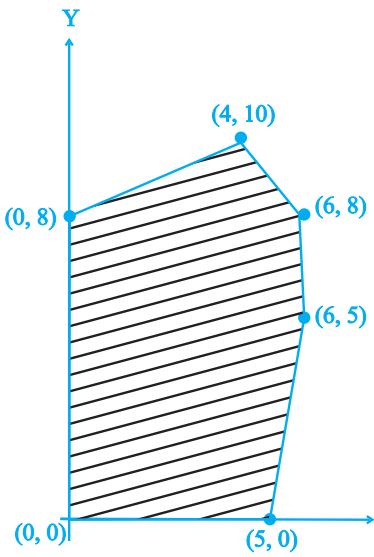
The feasible solution for a LPP is shown in. Let Z = 3x - 4y be the objective function.

Maximum of Z occurs at:

  1. (5, 0)
  2. (6, 5)
  3. (6, 8)
  4. (4, 10)