MCQ
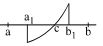
Let $f$ be $a$ differentiable function on the open interval $(a, b)$. Which of the following statements must be true?
$I$. $f$ is continuous on the closed interval $[a, b]$
$II.$ $f$ is bounded on the open interval $(a, b)$
$III.$ If $a$ $< a_1< b_1< b$, and $f (a_1)<0< f (b_1)$, then there is $a$ number $c$ such that $a_1 < c < b_1$ and $f (c)=0$
- A$I$ and $II$ only
- B$I$ and $III$ only
- C$II$ and $III$ only
- ✓only $III$