MCQ
Let $f$ be $a$ differentiable function on the open interval $(a, b)$. Which of the following statements must be true?

$I$. $f$ is continuous on the closed interval $[a, b]$

$II.$ $f$ is bounded on the open interval $(a, b)$

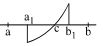
$III.$ If $a$ $< a_1< b_1< b$, and $f (a_1)<0< f (b_1)$, then there is $a$ number $c$ such that $a_1 < c < b_1$ and $f (c)=0$

  • A
    $I$ and $II$ only
  • B
    $I$ and $III$ only
  • C
    $II$ and $III$ only
  • only $III$

Answer

Correct option: D.
only $III$
d
$I$ and $II$ are false.

The function $f (x) = 1/x, 0 < x < 1$, is a counter example.

Statement $III$ is true. Apply the intermediate value theorem to $f$ on the closed interval $[a_1, b_1]$

Need a full question paper?

Generate a complete, print-ready paper with questions like this in minutes — across 16+ boards, with answer keys.

Start Generating Free

Similar questions

The area of the region bounded by the parabola $y = x^2 + 1$ and the straight line $x + y = 3$ is given by:
If $\left[ {a \times b\;\;b \times c\;\;c \times a} \right] = \alpha \;{\left[ {a\;\;b\;\;c} \right]^2}$ then $\lambda$ is equal to 
For real numbers $\alpha, \beta, \gamma$ and $\delta,$ if  $\int \frac{\left(x^{2}-1\right)+\tan ^{-1}\left(\frac{x^{2}+1}{x}\right)}{\left(x^{4}+3 x^{2}+1\right) \tan ^{-1}\left(\frac{x^{2}+1}{x}\right)} d x$  $=\alpha \log _{e}\left(\tan ^{-1}\left(\frac{x^{2}+1}{x}\right)\right)$ $+\beta \tan ^{-1}\left(\frac{\gamma\left(x^{2}-1\right)}{x}\right)+\delta \tan ^{-1}\left(\frac{x^{2}+1}{x}\right)+C$  where $C$ is an arbitrary constant, then the value of $10(\alpha+\beta \gamma+\delta)$ is equal to ....... .
The general solution of the equation $({e^y} + 1)\cos xdx + {e^y}\sin xdy = 0$ is
The degree of the differntial equation $\left\{5+\Big(\frac{\text{dy}}{\text{dx}}\Big)^{2}\right\}^{\frac{5}{3}}=\text{x}^{5}\Big(\frac{\text{d}^{2}\text{y}}{\text{dx}^{2}}\Big)$ is:
$\int\frac{\text{e}^{\text{x}}(1+\text{x})}{\cos^2(\text{x}\text{e}^{\text{x}})}\text{ dx}=$
Choose the correct answer from the given four options. For any two matrices $A$ and $B,$ we have:
lf  $f(x)$  is a differentiable function in the interval $(0,\infty )$  such that $f(1) = 1$ and $\mathop {\lim }\limits_{t \to x} \frac{{{t^2}f(x) - {x^2}f(t)}}{{t - x}} = 1,$ for each $x > 0,$  then $f (\frac {3}{2})$ is equal to
How many lines through the origin in make equal angles with the coordinate axis:
If $\text{A}=\begin{bmatrix}1&\text{a}\\0&1\end{bmatrix},$ then $A^n ($where $n \in N)$ equals: