MCQ
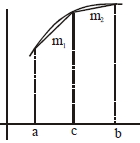
Let $f$ be any function continuous on $[\mathrm{a}, \mathrm{b}]$ and twice differentiable on $(a, b) .$ If for all $x \in(a, b)$ $f^{\prime}(\mathrm{x})>0$ and $f^{\prime \prime}(\mathrm{x})<0,$ then for any $\mathrm{c} \in(\mathrm{a}, \mathrm{b})$ $\frac{f(\mathrm{c})-f(\mathrm{a})}{f(\mathrm{b})-f(\mathrm{c})}$ is greater than
  • A
    $\frac{b+a}{b-a}$
  • B
    $\frac{b-c}{c-a}$
  • $\frac{c-a}{b-c}$
  • D
    $1$

Answer

Correct option: C.
$\frac{c-a}{b-c}$
c
it is clear from graph that $\mathrm{m}_{1}>\mathrm{m}_{2}$

$\Rightarrow \quad \frac{f(\mathrm{c})-f(\mathrm{a})}{\mathrm{c}-\mathrm{a}}>\frac{f(\mathrm{b})-f(\mathrm{c})}{\mathrm{b}-\mathrm{c}}$

$\Rightarrow \quad \frac{f(c)-f(a)}{f(b)-f(c)}>\frac{c-a}{b-c}$

Need a full question paper?

Generate a complete, print-ready paper with questions like this in minutes — across 16+ boards, with answer keys.

Start Generating Free

Similar questions

If lines $\frac{1-x}{3}=\frac{7 y-14}{2 p}=\frac{z-3}{2}$ and $\frac{7-7 x}{3 p}=\frac{y-5}{1}=\frac{6-z}{5}$ are mutually perpendicular to each other then, $p=$ __________ .
Statement $1$ : The vectors $\vec a ,\vec b$ and $\vec c$ lie in the same plane if and only if $\vec a.\left( {\vec b \times \vec c} \right) = 0$
Statement $2$ : The vectors $\vec u$ and $\vec v$ are perpendicular if and only if $\vec u.\vec v = 0$ where $\vec u \times \vec v$ is a vector perpendicular to the plane of $\vec u$ and $\vec v$
$\int\frac{\text{a}}{(1+\text{x}^2)\tan^{-1}\text{x}}\text{dx}=$
  1. $\text{a}\log|\tan^{-1}\text{x}|+\text{c}$
  2. $\frac{1}{2}(\tan^{-1}\text{x})^2+\text{c}$
  3. $\text{a}\log(1+\text{x}^2)+\text{c}$
  4. $\text{None of these}$
Five coins whose faces are marked $2, 3$ are tossed. The chance of obtaining a total of $12$ is
If $\text{y}^\frac{1}{\text{n}}+\text{y}-^\frac{1}{\text{n}}=2\text{x}$ then find $(\text{x}^2-1)\text{y}_2+\text{xy}_1=$ 
  1. -n2y
  2. n2y
  3. 0
  4. None of these.
The distance of the point (-1, -5, -10) from the point of intersection of the line $\vec{\text{r}}.=2\hat{\text{i}}-\hat{\text{j}}+2\hat{\text{k}}+\lambda(3\hat{\text{i}}+4\hat{\text{j}}+12\hat{\text{k}})$ and the plane $\vec{\text{r}}.=(\hat{\text{i}}-\hat{\text{j}}+\hat{\text{k}})=5$ is:
  1. 9
  2. 13
  3. 17
  4. None of these
If $(2 \hat{i}+6 \hat{j}+27 \hat{k}) \times(\hat{i}+p \hat{j}+q \hat{k})=\overrightarrow{0}$, then which of the following is true?
$\tan ^{-1} \sqrt{3}-\cot ^{-1}(-\sqrt{3})=$ _________.
The domain of function $\sin ^{-1} 2 x$ is :
Number of values of $m \in N$ for which $y = e^{mx} $ is a solution of the differential equation $D^3y - 3D^2y - 4Dy + 12y = 0,$ is