MCQ
Let $f: \mathbb{R} \rightarrow(0, \infty)$ and $g: \mathbb{R} \rightarrow \mathbb{R}$ be twice differentiable functions such that $f^{\prime \prime}$ and $g^{\prime \prime}$ are continuous functions on $\mathbb{R}$. Suppose $f^{\prime}(2)=g(2)=0, \quad f^{\prime \prime}(2) \neq 0$ and $g^{\prime}(2) \neq 0$. If $\lim _{x \rightarrow 2} \frac{f(x) g(x)}{f^{\prime}(x) g^{\prime}(x)}=1$, then

($A$) $f$ has a local minimum at $x=2$

($B$) fhas a local maximum at $x=2$

($C$) $f^{\prime \prime}(2)>f(2)$

($D$) $f(x)-f^{\prime \prime}(x)=0$ for at least one $x \in \mathbb{R}$

  • $A,D$
  • B
    $A,B$
  • C
    $A,C$
  • D
    $A,D,B$

Answer

Correct option: A.
$A,D$
a
${ }_5^{12} B \rightarrow{ }_6^{12} C +\beta^{-}+\gamma^{-}$

$Q =\left( m _5^{12} B- m _6^{12} C \right) c ^2$

$ =\left( m _5^{12} B-\left( m _6^{12} C +\Delta m \right)\right) c ^2$

$ =\left( m _5^{12} B- m _6^{12} C \right) c ^2-\Delta mc ^2$

$ =0.014 \times 931.5-4.041$

$ =9 MeV$

Need a full question paper?

Generate a complete, print-ready paper with questions like this in minutes — across 16+ boards, with answer keys.

Start Generating Free

Similar questions

If $\vec{\text{a}} $ lies in the plane of vectors $\vec{\text{b}}$ and $\vec{\text{c}},$ then which of the following is correct?

  1. $\big[\vec{\text{a}}\vec{\text{b}}\vec{\text{c}}\big]=0$

  2. $\big[\vec{\text{a}}\vec{\text{b}}\vec{\text{c}}\big]=1$

  3. $\big[\vec{\text{a}}\vec{\text{b}}\vec{\text{c}}\big]=3$

  4. $\big[\vec{\text{b}}\vec{\text{c}}\vec{\text{a}}\big]=1$

The value of c in Rolle's theorem when
f(x) = 2x3 - 5x2 - 4x + 3, $\text{x}\in\Big[\frac{1}{3},3\Big]$ is:
  1. $2$
  2. $-\frac{1}{3}$
  3. $-2$
  4. $\frac{2}{3}$
The number of relations, on the set $\{1,2,3\}$ containing $(1,2)$ and $(2,3)$, which are reflexive and transitive but not symmetric, is
$\int_{}^{} {{e^x}\sin ({e^x})} \;dx = $
Choose the correct answer from the given four options.
A flashlight has 8 batteries out of which 3 are dead. If two batteries are selected without replacement and tested, the probability that both are dead is:
  1. $\frac{33}{56}$
  2. $\frac{9}{64}$
  3. $\frac{1}{14}$
  4. $\frac{3}{28}$
Let $f : R \rightarrow R$ be a differentiable function with $f(0)=1$ and satisfying the equation $f(x+y)=f(x) f^{\prime}(y)+f^{\prime}(x) f(y)$ for all $x, y \in R$ Then, the value of $\log _c(f(4))$ is. . . . . .
Consider the system of equations $\mathrm{ax}+\mathrm{by}=0, \mathrm{cx}+\mathrm{dy}=0$, where $\mathrm{a}, \mathrm{b}, \mathrm{c}, \mathrm{d} \in\{0,1\}$.

$STATEMENT -1$ : The probability that the system of equations has a unique solution is $3 / 8$. and $STATEMENT - 2$: The probability that the system of equations has a solution is $1$ .

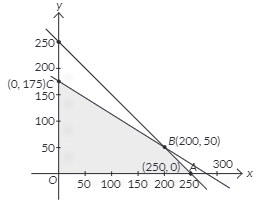
The corner points of the bounded feasible region of an LPP are $O(0,0), A(250,0), B(200,50)$ and $C(0,175)$. If the maximum value of the objective function $Z=2 a x+$ by occurs at the points $A(250,0)$ and $B(200,50)$, then the relation between $a$ and $b$ is:
Image
The linear inequalities or equations or restrictions on the variables of a linear programming problem are called:
Let $h$ be a twice continuously differentiable positive function on an open interval $J.$ Let $g(x) = ln\left( {h(x)} \right)$ for each $x \in J$. Suppose ${\left( {h'(x)} \right)^2} > h''(x) h(x) $ for each $x \in J$. Then