MCQ
Let $f: R \rightarrow R$ be a function defined by

$f(x)=\left\{\begin{array}{l}\max \left\{t^{3}-3 t\right\} ; x \leq 2 \\ t \leq x \\ x^{2}+2 x-6 ; 2 < x < 3 \\ {[x-3]+9 ; 3 \leq x \leq 5} \\ 2 x+1 \quad ; \quad x > 5\end{array}\right\}$

Where $[t]$ is the greatest integer less than or equal to $t$. Let $m$ be the number of points where $f$ is not differentiable and $I =\int\limits_{-2}^{2} f( x ) dx$. Then the ordered pair $( m , I )$ is equal to

  • A
    $\left(3, \frac{27}{4}\right)$
  • B
    $\left(3, \frac{23}{4}\right)$
  • $\left(4, \frac{27}{4}\right)$
  • D
    $\left(4, \frac{23}{4}\right)$

Answer

Correct option: C.
$\left(4, \frac{27}{4}\right)$
c
$\left\{\begin{array}{l} f ( x )= x ^{3}-3 x , x \leq-1 \\ 2,-1< x <2 \\ x ^{2}+2 x -6,2< x <3 \\ 9,3 \leq x <4 \\ 10,4 \leq x <5 \\ 11, x =5 \\ 2 x +1, x >5\end{array}\right.$

Clearly $f ( x )$ is not differentiable at

$x =2,3,4,5 \Rightarrow m =4$

$I =\int\limits_{-2}^{-1}\left( x ^{3}-3 x \right) dx +\int\limits_{-1}^{2} 2 \cdot dx =\frac{27}{4}$

Need a full question paper?

Generate a complete, print-ready paper with questions like this in minutes — across 16+ boards, with answer keys.

Start Generating Free

Similar questions

Let $x, y$ be positive real numbers and $m, n$ positive integers. The maximum value of the expression $\frac{{{x^m}{y^n}}}{{\left( {1 + {x^{2m}}} \right)\,\left( {1 + {y^{2n}}} \right)}}$ is
Which one of the following functions is not continuous on $(0,\pi )$?
The value of $\frac{0.76\times0.76\times0.76+0.24\times0.24\times0.24}{0.76\times0.76-0.76\times0.24+ 0.24+0.24}$is:
Let $A=\left[\begin{array}{cc}1 & \frac{1}{51} \\ 0 & 1\end{array}\right]$. If $B=\left[\begin{array}{cc}1 & 2 \\ -1 & -1\end{array}\right] A \left[\begin{array}{cc}-1 & -2 \\ 1 & 1\end{array}\right]$ then the sum of all the elements of the matrix $\sum \limits_{n=1}^{50} B^n$ is equal to
The lines $\frac{\text{x}}{1}=\frac{\text{y}}{2}=\frac{\text{z}}{3}$ and $\frac{\text{x}-1}{-2}=\frac{\text{y}-2}{-4}=\frac{\text{z}-3}{-6}$ are:
  1. Coinicident.
  2. Skew.
  3. Intersecting.
  4. Parallel.
$r \times a = b \times a;\,\,r \times b = a \times b;\,\,a \ne 0;\,\,b \ne 0;\,\,a \ne \lambda b,\,\,$ $a $ is not perpendicular to $ b,$  then $r = $
The value of the definite integral $\int\limits_0^{\frac{1}{{\sqrt 2 }}} {\frac{{{x^2}dx}}{{\sqrt {1 - {x^2}} \,(1 + \sqrt {1 - {x^2}} )}}} $ is
What is the value of x and y, if 2i + 3j = xi + yj:
  1. 4, 9
  2. 3, 2
  3. 2, 3
  4. 0, 0
Let $\vec{a}$ be any vector such that $|\vec{a}|=a$. The value of $|\vec{a} \times \hat{i}|^2+|\vec{a} \times \hat{j}|^2+|\vec{a} \times \hat{k}|^2$ is :
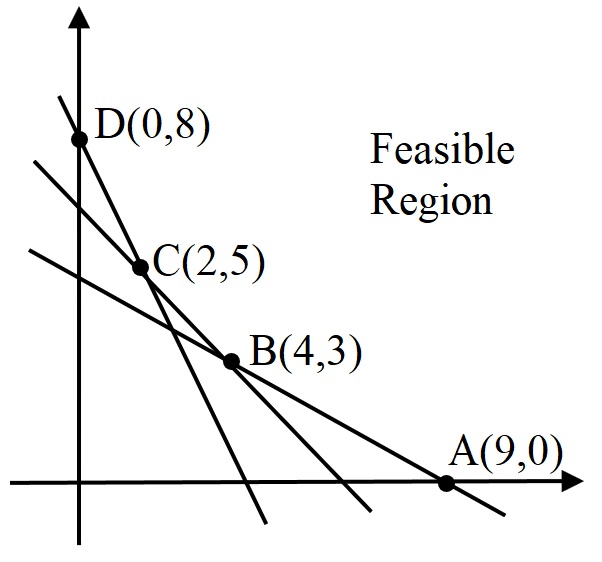
The feasible region for an LPP is shown shaded in the following figure. Minimum of Z = 4x + 3y occurs at the point.