MCQ
Let $\mathrm{f}: R \rightarrow R$ be function defined as

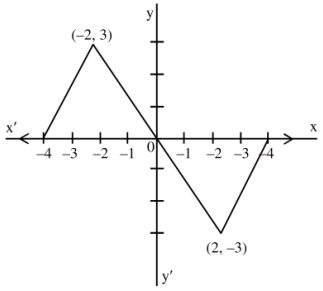
$f ( x )=\left\{\begin{array}{cc}3\left(1-\frac{| x |}{2}\right) & \text { if }| x | \leq 2 \text { } \\ 0 & \text { if }| x |>2 \text { }\end{array}\right.$ Let $g: R \rightarrow R$ be given by $g(x)=f(x+2)-f(x-2)$. If $n$ and $m$ denote the number of points in $R$ where $\mathrm{g}$ is not continuous and not differentiable, respectively, then $\mathrm{n}+\mathrm{m}$ is equal to $....$

  • $4$
  • B
    $3$
  • C
    $2$
  • D
    $1$

Answer

Correct option: A.
$4$
a
$f(x-2)\rightarrow =\frac{3 x}{2} \quad\quad -4 \leq x \leq-2$

$\quad \quad \quad \quad \quad \quad -\frac{3 x}{2} \quad -2\,$

$\quad \quad \quad \quad \quad \quad 0 \quad \quad \quad x \in(-\infty,-4) \cup(0,+\infty)$

$f(x+2)\rightarrow\frac{3 x}{2}+6 \quad \quad 0 \leq x \leq 2$

$\quad \quad \quad \quad \quad -\frac{3 x}{2}+6 \quad 2\,<\,x \leq 4$

$\quad \quad \quad \quad \quad 0 \quad \quad \quad \quad x \in(-\infty, 0) \cup(4,+\infty)$

$g(x)=f(x+2)-f(x-2) \rightarrow\frac{3 x}{2}+6 \quad -4 \leq x \leq-2$

$\quad \quad \quad \quad \quad \quad \quad \quad \quad \quad \quad \quad \quad -\frac{3 x}{2} \quad \quad -2\, < \,x\, < \,2$

$\quad \quad \quad \quad \quad \quad \quad \quad \quad \quad \quad \quad \quad \quad \frac{3 x}{2}-6\quad \quad 2 \leq x \leq 4$

$\quad \quad \quad \quad \quad \quad \quad \quad \quad \quad \quad \quad \quad 0 \quad \quad \quad \quad x \in(-\infty,-4) \cup(4,+\infty)$

$n=0$

$m=4 \Rightarrow(n+m=4)$

Need a full question paper?

Generate a complete, print-ready paper with questions like this in minutes — across 16+ boards, with answer keys.

Start Generating Free

Similar questions

$\mathop \smallint \limits_2^4 \frac{{\log {x^2}}}{{\log {x^2} + {\rm{log}}\left( {36 - 12x + {x^2}} \right)}}\;dx = $
Choose the correct answer from the given four options.If $A$ and $B$ are two matrices of the order $3 \times m$ and $3 \times n,$ respectively and $m = n$, then order of matrix $(5A – 2B)$ is:
If the angle between the vectors $\text{x}\hat{\text{i}}+3\hat{\text{j}}-7\hat{\text{k}}$ and $\text{x}\hat{\text{i}}-\text{x}\hat{\text{j}}+4\hat{\text{k}}$ is acute, then x lies in the interval:
The sum of the maximum and minimum values of the function $f(x)=|5 x-7|+\left[x^{2}+2 x\right]$ is the interval $\left[\frac{5}{4}, 2\right]$, where $[ t ]$ is the greatest integer $\leq t$ is $.......$
Let $ABCD$ be a quadrilateral. If $E$ and $F$ are the mid points of the diagonals $AC$ and $BD$ respectively and $(\overrightarrow{ AB }-\overline{ BC })+(\overrightarrow{ AD }-\overrightarrow{ DC })= k \overline{ FE }$, then $k$ is equal to
The identity element for the binary operation $\times $ defined on $Q - \{0\}$ as $\text{a}\times\text{b}=\frac{\text{ab}}{2}\ \forall a, b \in Q - \{0\}$ is:
The direction ratios of the normal to the plane $7x + 4y - 2z + 5 = 0$ are:
If $x^2y + y^3 = 2$ then the value of $\frac{{{d^2}y}}{{d{x^2}}}$ at the point $(1, 1)$ is :
$\int\frac{\text{x}^3}{\text{x}+1}$ is equal to:
Let $A=\{1,3,7,9,11\}$ and $B=\{2,4,5,7,8,10,12\}$. Then the total number of one-one maps $\mathrm{f}: \mathrm{A} \rightarrow \mathrm{B}$, such that $\mathrm{f}(1)+\mathrm{f}(3)=14$, is :