MCQ
Let $f:R \to R$ be a continuously differentiable function such that $f\left( 2 \right) = 6$ and $f'\left( 2 \right) = \frac{1}{{48}}$. If $\int_6^{f\left( x \right)} {4{t^3}} \,dt = \left( {x - 2} \right)\,g\left( x \right)$, then $\mathop {\lim }\limits_{x \to 2} \,g\left( x \right)$ is equal to
  • A
    $24$
  • $18$
  • C
    $12$
  • D
    $36$

Answer

Correct option: B.
$18$
b
$\mathop {\lim }\limits_{x \to 2} \frac{{\int\limits_6^{f\left( x \right)} {4{t^2}dt} }}{{x - 2}}$

$ = \mathop {\lim }\limits_{x \to 2} \frac{{4.{f^3}\left( x \right).f'\left( x \right)}}{1}$

$ = 4{f^3}\left( 2 \right)f'\left( 2 \right) = 18$

Need a full question paper?

Generate a complete, print-ready paper with questions like this in minutes — across 16+ boards, with answer keys.

Start Generating Free

Similar questions

The value of $\int\limits^\pi_{-\pi}\sin^3\text{x}\cos^2\text{x}\text{ dx}$ is :
$\int\limits_{2}^{2} \mid\text{x}\mid\text{dx}=$
The value of $\big[\vec{\text{a}}-\vec{\text{b}},\vec{\text{b}}-\vec{\text{c}},\vec{\text{c}}-\vec{\text{a}}\big],$ where $\big|\vec{\text{a}}\big|=1,\big|\vec{\text{b}}\big|=5,\big|\vec{\text{c}}\big|=3,$ is:
Let $M =\left[\begin{array}{lll}0 & 1 & a \\ 1 & 2 & 3 \\ 3 & b & 1\end{array}\right]$ and adj $M =\left[\begin{array}{ccc}-1 & 1 & -1 \\ 8 & -6 & 2 \\ -5 & 3 & -1\end{array}\right]$ where $a$ and $b$ are real numbers. Which of the following options is/are correct?

$(1)$ $a+b=3$

$(2)$ $\operatorname{det}\left(\operatorname{adj} M ^2\right)=81$

$(3)$ $(\operatorname{adj} M)^{-1}+\operatorname{adj} M^{-1}=-M$

$(4)$ If $M \left[\begin{array}{l}\alpha \\ \beta \\ \gamma\end{array}\right]=\left[\begin{array}{l}1 \\ 2 \\ 3\end{array}\right]$, then $\alpha-\beta+\gamma=3$

Let $\alpha, \beta$ and $\gamma$ be real numbers. consider the following system of linear equations

$x+2 y+z=7$

$x+\alpha z=11$

$2 x-3 y+\beta z=\gamma$

Match each entry in List - $I$ to the correct entries in List-$II$

List - $I$ List - $II$
($P$) If $\beta=\frac{1}{2}(7 \alpha-3)$ and $\gamma=28$, then the system has ($1$) a unique solution
($Q$) If $\beta=\frac{1}{2}(7 \alpha-3)$ and $\gamma \neq 28$, then the system has ($2$) no solution

($R$) If $\beta \neq \frac{1}{2}(7 \alpha-3)$ where $\alpha=1$ and $\gamma \neq 28$,

then the system has

($3$) infinitely many solutions
($S$) If $\beta \neq \frac{1}{2}(7 \alpha-3)$ where $\alpha=1$ and $\gamma=28$, then the system has ($4$) $x=11, y=-2$ and $z=0$ as a solution
  ($5$) $x=-15, y=4$ and $z=0$ as a solution

Then the system has

The vector equation of a line passing through the point $(1,-1,0)$ and parallel to $Y$-axis is :
Let $*$ be a binary operation defined on $Q ^{+}$by the rule $a^ * b=\frac{ ab }{3} \forall a , b \in Q ^{+}$. The inverse of $4^* 6$ is:
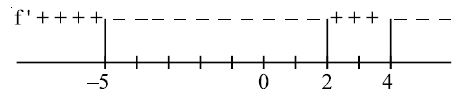
 $(i)$  $f (x)$ is continuous and defined for all real numbers

$(ii)$ $f '(-5) = 0 \,; \,f '(2)$ is not defined and $f '(4)  = 0$

$(iii)$ $(-5, 12)$ is a point which lies on the graph of $f (x)$

$(iv)$ $f ''(2)$ is undefined, but $f ''(x)$ is negative everywhere else.

$(v)$ the signs of  $f '(x)$ is given below

On the possible graph of $y = f (x)$ we have  

The minimum value of $f(x) = x^4 - x^2 - 2x + 6$ is.
If for the matrix $A=\left[\begin{array}{cc}\tan x & 1 \\ -1 & \tan x\end{array}\right], A+A^{\prime}=2 \sqrt{3}$, , then the value of $x \in\left[0, \frac{\pi}{2}\right]$ is :