MCQ
Let $f(\theta)=\sin \left(\tan ^{-1}\left(\frac{\sin \theta}{\sqrt{\cos 2 \theta}}\right)\right)$, where $-\frac{\pi}{4}<\theta<\frac{\pi}{4}$. Then the value of $\frac{d}{d(\tan \theta)}(f(\theta))$ is
  • $1$
  • B
    $2$
  • C
    $3$
  • D
    $4$

Answer

Correct option: A.
$1$
a
$\text { Given, } f(\theta)=\sin \left(\tan ^{-1}(\sin \theta / \sqrt{\cos 2 \theta))}\right.$

$=\sin \left(\sin ^{-1}\left(\frac{\sin \theta}{\sqrt{\sin ^2 \theta+\cos 2 \theta}}\right)\right)$

$=\left(\frac{\sin \theta}{\sqrt{\sin ^2 \theta+\cos ^2 \theta-\sin ^2 \theta}}\right)$

$=\left(\frac{\sin \theta}{\sqrt{\cos ^2 \theta}}\right)$

$=\left(\frac{\sin \theta}{\cos \theta}\right)=\tan \theta$

$\text { Now, } \frac{d}{d(\tan \theta)}(\tan \theta)=1$

Need a full question paper?

Generate a complete, print-ready paper with questions like this in minutes — across 16+ boards, with answer keys.
Start Generating Free

Similar questions

A problem in Mathematics is given to three students whose chances of solving it are $\frac{1}{2}, \frac{1}{3}, \frac{1}{4}$ respectively. If the events of their solving the problem are independent then the probability that the problem will be solved, is
If $\theta$ is the angle between any two vectors $\vec{\text{a}}$ and $\vec{\text{b}},$ then $\big|\vec{\text{a}}.\vec{\text{b}}\big|=\big|\vec{\text{a}}\times\vec{\text{b}}\big|$ when $\theta$ is equal to:
  1. $0$
  2. $\frac{\pi}{4}$
  3. $\frac{\pi}{2}$
  4. $\pi$
The differential equation representing the family of curves ${y^2} = 2c(x + \sqrt c ),$ where  $c$ is a positive parameter, is of
Let $\vec{p}=2 \hat{i}+\hat{j}+3 \hat{k}$ and $\vec{q}=\hat{i}-\hat{j}+\hat{k}$. If for some real numbers $\alpha, \beta$ and $\gamma$, we have $15 \hat{i}+10 \hat{j}+6 \hat{k}=\alpha(2 \vec{p}+\vec{q})+\beta(\vec{p}-2 \vec{q})+\gamma(\vec{p} \times \vec{q})$, then the value of $\gamma$ is. . . . .
The number of real values $\lambda$, such that the system of linear equations $2 x-3 y+5 z=9$  ;  $x+3 y-z=-18$    ; $3 x-y+\left(\lambda^{2}-1 \lambda \mid\right) z=16$ has no solution, is :-
If a line makes angles Q1, Q21 and Q3 respectively with the coordinate axis then the value of $\cos^2 \text{Q}_{1} + \cos^2 \text{Q}_{2} + \cos^2 \text{Q}_{3}$:
  1. 2
  2. 1
  3. 4
  4. $\frac{3}{2}$
If $c_{i j}$ is the cofactor of the element $a_{i j}$ of the determinant $\left|\begin{array}{ccc}2 & -3 & 5 \\ 6 & 0 & 4 \\ 1 & 5 & -7\end{array}\right|$, then write the value of $a_{32} \cdot c_{32}$.
A square piece of tin of side $30\,cm$ is to be made into a box without top by cutting a square from each corner and folding up the flaps to form a box. If the volume of the box is maximum, then its surface area (in $cm ^2$ ) is equal to $............$.
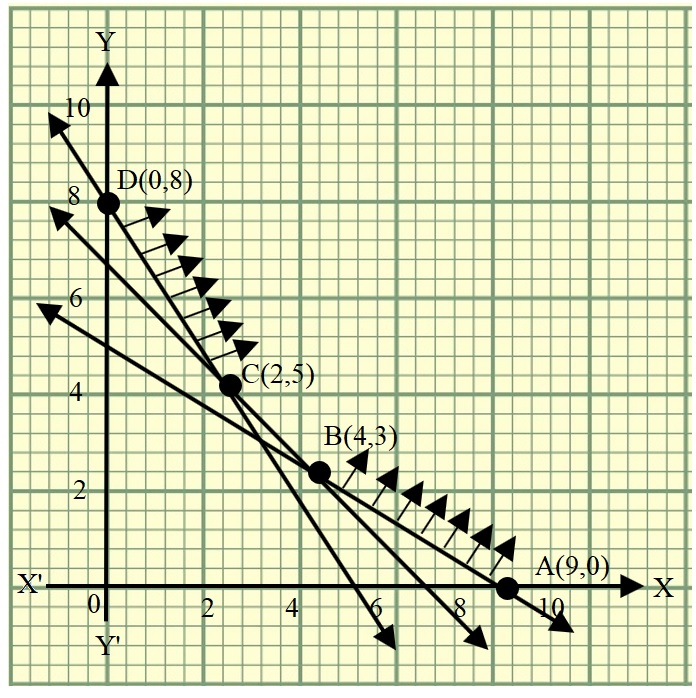
Feasible region (shaded) for a LPP is shown in the given figure. Minimum of z = 4x + 3y occurs at the point.

The ratio of the areas between the curves $\text{y}=\cos\text{x}$ and $\text{y}=\cos2\text{x}$ and x-axis from x = 0 to x = 0 to $\text{x}=\frac{\pi}{3}$
  1. $1:2$
  2. $2:1$
  3. $\sqrt{3}:1$
  4. none of these