MCQ
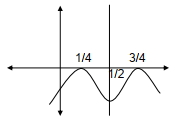
Let $f(x)$ be a non-constant twice differentiable function defined on $(-\infty, \infty)$ such that $f(x)=f(1-x)$ and $f^{\prime}\left(\frac{1}{4}\right)=0$. Then

$(A)$ $f^{\prime \prime}(x)$ vanishes at least twice on $[0,1]$

$(B)$ $f^{\prime}\left(\frac{1}{2}\right)=0$

$(C)$ $\int_{-1 / 2}^{1 / 2} f\left(x+\frac{1}{2}\right) \sin x d x=0$

$(D)$ $\int_0^{1 / 2} f(t) e^{\sin \pi t} d t=\int_{1 / 2}^1 f(1-t) e^{\sin \pi t} d t$

  • A
    $A,C,D,B$
  • $A,B,C,D$
  • C
    $D,B,C,A$
  • D
    $A,C,D,B$

Answer

Correct option: B.
$A,B,C,D$
b
$ f(x)=f(1-x) $

$ \text { Put } x=1 / 2+x $

$ f\left(\frac{1}{2}+x\right)=f\left(\frac{1}{2}-x\right)$

Hence $f(x+1 / 2)$ is an even function or $f(x+1 / 2) \sin x$ is an odd function.

Also, $f^{\prime}(x)=-f^{\prime}(1-x)$ and for $x=1 / 2$, we have $f^{\prime}(1 / 2)=0$.

Also, $\int_{1 / 2}^1 f(1-t) e^{\sin \pi t} d t=-\int_{1 / 2}^0 f(y) e^{\sin \pi y} d y$ (obtained by putting, $1-t=y$ ).

Since $f^{\prime}(1 / 4)=0, f^{\prime}(3 / 4)=0$. Also $f^{\prime}(1 / 2)=0$

$\Rightarrow f^{\prime \prime}(x)=0$ atleast twice in $[0,1]$ (Rolle's Theorem)

Need a full question paper?

Generate a complete, print-ready paper with questions like this in minutes — across 16+ boards, with answer keys.

Start Generating Free

Similar questions

If $\alpha ,\,\,\beta ,\,\gamma $ be the angles which a line makes with the positive direction of co-ordinate axes, then ${\sin ^2}\alpha + {\sin ^2}\beta + {\sin ^2}\gamma = $
If 2x + 5y - 6z + 3 = 0 be the equation of the plane, then the equation of any plane parallel to the given plane is:
Let $R$ be a relation on $Z \times Z$ defined by$ (a, b)$$R(c, d)$ if and only if $ad - bc$ is divisible by $5$ . Then $\mathrm{R}$ is
Let a, b, c be positive real numbers. The following system of equations in x, y and z $\frac{\text{x}^2}{\text{a}^2}+\frac{\text{y}^2}{\text{b}^2}-\frac{\text{z}^2}{\text{c}^2}=1,$ $\frac{\text{x}^2}{\text{a}^2}-\frac{\text{y}^2}{\text{b}^2}+\frac{\text{z}^2}{\text{c}^2}=1,$ $-\frac{\text{x}^2}{\text{a}^2}+\frac{\text{y}^2}{\text{b}^2}+\frac{\text{z}^2}{\text{c}^2}=1$ has:
  1. No solution.
  2. Unique solution.
  3. Infinitely many solutions.
  4. Finitely many solutions.
The area of the plane region bounded by the curves $x + 2{y^2} = 0$ and $x + 3{y^2} = 1$ is equal to
Let $(\alpha, \beta, \gamma)$ be mirror image of the point $(2,3,5)$ in the line $\frac{x-1}{2}=\frac{y-2}{3}=\frac{z-3}{4}$. Then $2 \alpha+3 \beta+4 \gamma$ is equal to
Two events A and B will be independent, if
Domain of the function $f(x) = {\sin ^{ - 1}}\left( {\frac{{2 - |x|}}{4}} \right) + {\cos ^{ - 1}}\left( {\frac{{2 - |x|}}{4}} \right) + {\tan ^{ - 1}}\left( {\frac{{2 - |x|}}{4}} \right)$ is
Maximize Z = 3x + 5y, subject to constraints: $\text{x}+4\text{y}\leq24,3\text{x}+\text{y}\leq21,\text{x}+\text{y}\geq9,\text{x}\geq0,\text{y}\geq0.$
  1. 20 at (1, 0)
  2. 30 at (0, 6)
  3. 37 at (4, 5)
  4. 33 at (6, 3)
The ordinate of a point describing the circle $x^2 + y^2 = 25$ decreases at the rate of $1\, cm/sec$, then the rate of change of abscissa of the point when ordinate equal to $3\,cm$ is- (Given $x > 0, y > 0$)