MCQ
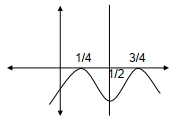
Let $f(x)$ be a non-constant twice differentiable function defined on $(-\infty, \infty)$ such that $f(x)=f(1-x)$ and $f^{\prime}\left(\frac{1}{4}\right)=0$. Then

$(A)$ $f^{\prime \prime}(x)$ vanishes at least twice on $[0,1]$

$(B)$ $f^{\prime}\left(\frac{1}{2}\right)=0$

$(C)$ $\int_{-1 / 2}^{1 / 2} f\left(x+\frac{1}{2}\right) \sin x d x=0$

$(D)$ $\int_0^{1 / 2} f(t) e^{\sin \pi t} d t=\int_{1 / 2}^1 f(1-t) e^{\sin \pi t} d t$

  • A
    $A,C,D,B$
  • $A,B,C,D$
  • C
    $D,B,C,A$
  • D
    $A,C,D,B$

Answer

Correct option: B.
$A,B,C,D$
b
$ f(x)=f(1-x) $

$ \text { Put } x=1 / 2+x $

$ f\left(\frac{1}{2}+x\right)=f\left(\frac{1}{2}-x\right)$

Hence $f(x+1 / 2)$ is an even function or $f(x+1 / 2) \sin x$ is an odd function.

Also, $f^{\prime}(x)=-f^{\prime}(1-x)$ and for $x=1 / 2$, we have $f^{\prime}(1 / 2)=0$.

Also, $\int_{1 / 2}^1 f(1-t) e^{\sin \pi t} d t=-\int_{1 / 2}^0 f(y) e^{\sin \pi y} d y$ (obtained by putting, $1-t=y$ ).

Since $f^{\prime}(1 / 4)=0, f^{\prime}(3 / 4)=0$. Also $f^{\prime}(1 / 2)=0$

$\Rightarrow f^{\prime \prime}(x)=0$ atleast twice in $[0,1]$ (Rolle's Theorem)

Need a full question paper?

Generate a complete, print-ready paper with questions like this in minutes — across 16+ boards, with answer keys.

Start Generating Free

Similar questions

Let $\overrightarrow{ x }$ be a vector in the plane containing vectors $\overrightarrow{ a }=2 \hat{ i }-\hat{ j }+\hat{ k }$ and $\overrightarrow{ b }=\hat{ i }+2 \hat{ j }-\hat{ k }$. If the vector $\overrightarrow{ x }$ is perpendicular to $(3 \hat{ i }+2 \hat{ j }-\hat{ k })$ and its projection on $\overrightarrow{ a }$ is $\frac{17 \sqrt{6}}{2},$ then the value of $|\overrightarrow{ x }|^{2}$ is equal to ...... .
The area bounded by curve $y = x^2- 1$ and tangents to it at $(2, 3)$ and $y -$ axis is:
The differential equation of the ellipse $\frac{\text{x}^{2}}{\text{a}^{2}}+\frac{\text{y}^{2}}{\text{b}^{2}}=\text{C}$ is:
Two fair dice, each with faces numbered $1,2,3,4,5$ and $6$ , are rolled together and the sum of the numbers on the faces is observed. This process is repeated till the sum is either a prime number or a perfect square. Suppose the sum turns out to be a perfect square before it turns out to be a prime number. If $p$ is the probability that this perfect square is an odd number, then the value of $14 p$ is. . . . . 
Let $\text{A}=\begin{bmatrix} 1 & 2 \\ 3 & -5 \end{bmatrix}$ and $B=\begin{bmatrix} 1 & 0 \\ 0 & 2 \end{bmatrix}$ and $X$ be a matrix such that $A = BX,$ then $X$ is equal to:
If the order of a matrix is $20 \times 5$ then the number of elements in the matrix is $...........?$
Side of an equilateral triangle expands at the rate of $2\text{cm}/ \text{sec}.$ The rate of increase of its area when each side is 10cm is:
If the system of equations $x + ay = 0,$ $az + y = 0$ and $ax + z = 0$ has infinite solutions, then the value of $a$ is
If $\sin ^{-1} x=y,$ then
Let $A =\{1,2,3, \ldots, 10\}$ and $f: A \rightarrow A$ be defined as $f( k )=\left\{\begin{array}{cl} k +1 & \text { if } k \text { is odd } \\ k & \text { if } k \text { is even }\end{array}\right.$

Then the number of possible functions $g : A \rightarrow A$ such that $gof=f$ is ...... .