MCQ
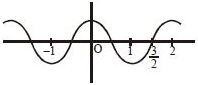
Let $f(x)$ = $\cos \left( {\pi \left( {\left| x \right| + 2\left[ x \right]} \right)} \right)$ where $[.]$ represents greatest integer function, then 
  • A
    $f(x)$ is neither odd nor even
  • B
    $f(x)$ is non periodic function
  • C
    Range of $f(x)$ is $[-1,1]$
  • $f(x)$ = $|f(x)|$ for all $x$ .

Answer

Correct option: D.
$f(x)$ = $|f(x)|$ for all $x$ .
d
$f(x)=\cos (2 \pi[x]+\pi|x|)=\cos (\pi|x|)$

$f(-x)=f(x)$ hence function is even.

It is a periodic function

form graph $f\left( x \right) = f\left| {\left( x \right)} \right|$ is not possible for all $x$.

Need a full question paper?

Generate a complete, print-ready paper with questions like this in minutes — across 16+ boards, with answer keys.

Start Generating Free

Similar questions

$\int\frac{1}{\cos\text{x}+\sqrt{3}\sin\text{x}}\text{ dx}$ is equal to:
  1. $\log\tan\Big(\frac{\pi}{3}+\frac{\pi}{2}\Big)+\text{C}$
  2. $\log\tan\Big(\frac{\pi}{2}-\frac{\pi}{3}\Big)+\text{C}$
  3. $\frac{1}{2}\log\tan\Big(\frac{\pi}{2}+\frac{\pi}{3}\Big)+\text{C}$
  4. None of these.
If $P(\operatorname{Not} A)=3 / 5$, then the value of $P(A)$ will be
$\int_{}^{} {\sqrt {1 - \sin 2x} \;} dx = ........,\;\;x \in (0,\;\pi /4)$
Let $f(x) = \left\{ \begin{array}{l}{x^p}\sin \frac{1}{x},x \ne 0\\0\,\,\,\,\,\,\,\,\,\,\,\,\,\,,x = 0\end{array} \right.$ then $f(x)$ is continuous but not differential at $x = 0$ if
A and B are two events such that P(A / B) =P(B/A). $\neq 0$ then which of the following is correct-
Let $y=y(x)$ be the solution of the differential equation

$x \tan \left(\frac{y}{x}\right) d y=\left(y \tan \left(\frac{y}{x}\right)-x\right) d x,-1 \leq x \leq 1, y\left(\frac{1}{2}\right)=\frac{\pi}{6}$

Then the area of the region bounded by the curves $x=0, x=\frac{1}{\sqrt{2}}$ and $y=y(x)$ in the upper half plane is :

Let $\text{U}=\sin^{-1}\Big(\frac{2\text{x}}{1+\text{x}^2}\Big)$ and $\text{V}=\tan^{-1}\Big(\frac{2\text{x}}{1-\text{x}^2}\Big),$ then $\frac{\text{dU}}{\text{dV}}=$
  1. $\frac{1}{2}$
  2. $\text{x}$
  3. $\frac{1-\text{x}^2}{\text{x}^2-4}$
  4. $1$
The value of $\mathop {Lim}\limits_{n \to \infty } \,\,\sum\limits_{r = 1}^{r = 4n} {\frac{{\sqrt n }}{{\sqrt r {{\left( {\,3\sqrt r  + 4\sqrt n \,} \right)}^2}}}} $ is equal to
Maximum number of equivalence relations on set $A = \{1, 2, 3, 4\}$ is $N$, then -
Let $\mathrm{A}$ be a $3 \times 3$ real matrix. If $\operatorname{det}(2 \operatorname{Adj}(2 \operatorname{Adj}(\operatorname{Adj}(2 \mathrm{~A}))))=2^{41}$, then the value of $\operatorname{det}\left(A^{2}\right)$ equal ..... .