MCQ
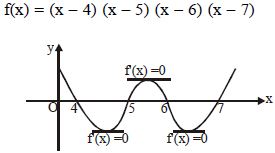
Let $f(x) = (x-4)(x-5)(x-6)(x-7)$ then -
  • A
    $f'(x) = 0$ has four roots
  • Three roots of $f'(x) = 0$ lie in $(4, 5)  \cup  (5, 6)  \cup  (6, 7)$
  • C
    The equation $f'(x) = 0$ has only one root
  • D
    Three roots of $f'(x) = 0$ lie in $(3, 4)  \cup  (4, 5)  \cup  (5, 6)$
Answer

Correct option: B.
Three roots of $f'(x) = 0$ lie in $(4, 5)  \cup  (5, 6)  \cup  (6, 7)$
b

Need a full question paper?

Generate a complete, print-ready paper with questions like this in minutes — across 16+ boards, with answer keys.

Start Generating Free

Similar questions

The smallest value of $k$, for which both the roots of the equation $x^2-8 k x+16\left(k^2-k+1\right)=0$ are real, distinct and have values at least $4$ , is
Differential equation of $y = A{e^{2x}} + B{e^{ - 2x}}$ is (Where $A$ and $B$ are arbitrary constants)
If $M.D.$ is $12$, the value of $S.D.$ will be
If ‘$a$’ and ‘$c$’ are the segments of a focal chord of a parabola and b the semi-latus rectum, then
The solution of the differential equation $ydx - \left( {x + 2{y^2}} \right)dy = 0$ is $x\, = f(y)$. If $f(-1)\, = 1$, then $f(1)$ is equal to
$xy$ - plane divides the line joining the points $(2, 4, 5)$ and $(-4, 3, -2)$ in the ratio
Let â be a unit vector perpendicular to the vectors $\overrightarrow{ b }=\hat{ i }-2 \hat{ j }+3 \hat{ k }$ and $\overrightarrow{ c }=2 \hat{ i }+3 \hat{ j }-\hat{ k }$, and makes an angle of $\cos ^{-1}\left(-\frac{1}{3}\right)$ with the vector $\hat{ i }+\hat{ j }+\hat{ k }$. If $\hat{ a }$ makes an angle of $\frac{\pi}{3}$ with the vector $\hat{ i }+\alpha \hat{ j }+\hat{ k }$, then the value of $\alpha$ is :
Let $f:[0,2] \rightarrow R$ be a function which is continuous on $[0,2]$ and is differentiable on $(0,2)$ with $f(0)=1$.

Let $F(x)=\int_0^{x^2} f(\sqrt{t}) d t$ for $x \in[0,2]$. If $F^{\prime}(x)=f^{\prime}(x)$ for all $x \in(0,2)$, then $F(2)$ equals

If in a geometric progression $\left\{ {{a_n}} \right\},\;{a_1} = 3,\;{a_n} = 96$ and ${S_n} = 189$ then the value of $n$ is
If three points  $ A, B, C$  are collinear, whose position vectors are $i - 2j - 8k,\,\,5i - 2k$ and $11\,i + \,3\,j + 7k$ respectively, then the ratio in which  $B $ divides $ AC$  is