MCQ
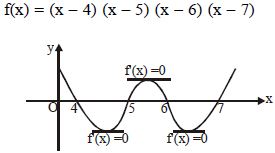
Let $f(x) = (x-4)(x-5)(x-6)(x-7)$ then -
  • A
    $f'(x) = 0$ has four roots
  • Three roots of $f'(x) = 0$ lie in $(4, 5)  \cup  (5, 6)  \cup  (6, 7)$
  • C
    The equation $f'(x) = 0$ has only one root
  • D
    Three roots of $f'(x) = 0$ lie in $(3, 4)  \cup  (4, 5)  \cup  (5, 6)$
Answer

Correct option: B.
Three roots of $f'(x) = 0$ lie in $(4, 5)  \cup  (5, 6)  \cup  (6, 7)$
b

Need a full question paper?

Generate a complete, print-ready paper with questions like this in minutes — across 16+ boards, with answer keys.

Start Generating Free

Similar questions

If two rows of a determinant are identical, then what is the value of the determinant ?
  1. 0
  2. 1
  3. -1
  4. Can be any real value.
Two person $A$ and $B$ take turns in throwing a pair of dice. The first person to through $9$ from both dice will win the game. If $A$ throws first then the probability that $B$ wins the game is
The value of $\int\frac{\cos\sqrt{\text{x}}}{\sqrt{\text{x}}}\text{ dx}$ is:
  1. $2\cos\sqrt{\text{x}}+\text{C}$
  2. $\sqrt{\frac{\cos\text{x}}{\text{x}}}+\text{C}$
  3. $\sin\sqrt{\text{x}}+\text{C}$
  4. $2\sin\sqrt{\text{x}}+\text{C}$
Which one of the following functions is not homogeneous?
If ${\left\{ {\left( \begin{gathered}
  3\,\,1\,\,2 \hfill \\
  8\,\,9\,\,5 \hfill \\
  1\,\,\,1\,\,3 \hfill \\ 
\end{gathered}  \right)\,\left( \begin{gathered}
  1\,\,3\,\,3 \hfill \\
  3\,\,2\,\,7 \hfill \\
  3\,\,7\,\,9 \hfill \\ 
\end{gathered}  \right)\left( \begin{gathered}
  3\,\,8\,\,1 \hfill \\
  1\,\,\,9\,\,1 \hfill \\
  2\,\,5\,\,3 \hfill \\ 
\end{gathered}  \right)} \right\}^2}\, = \,\left( \begin{gathered}
  a_1\,\,a_2\,\,a_3 \hfill \\
  b_1\,\,b_2\,\,b_3 \hfill \\
  c_1\,\,c_2\,\,c_3 \hfill \\ 
\end{gathered}  \right)$ 

then the value of $|a_2 - b_1| + |a_3 - c_1| + |b_3 - c_2|$ is

The derivative of $y = 1 - |x|$ at $x = 0$   is
In linear programming, lack of points for a solution set is said to:
If $[\,\,]$ denotes the greatest integer function, then the integral  $\int\limits_0^\pi  {[\cos \,\,x\,\,dx]} $ is equal 
$\tan\Big(\frac{\pi}{4}+\frac{1}{2}\cos^{-1}\text{x}\Big)+\tan\Big(\frac{\pi}{4}-\frac{1}{2}\cos^{-1}\text{x}\Big)=$
  1. $\text{x}$
  2. $\frac{1}{\text{x}}$
  3. $2\text{x}$
  4. $\frac{2}{\text{x}}$
Let $\vec{v}=\alpha \hat{i}+2 \hat{j}-3 \hat{k}, \vec{w}=2 \alpha \hat{i}+\hat{j}-\hat{k}$, and $\overrightarrow{ u }$ be a vector such that $|\vec{u}|=\alpha > 0$. If the minimum value of the scalar triple product $[\vec{u} \vec{v} \vec{w}]$ is $-\alpha \sqrt{3401}$, and $|\vec{u} . \hat{i}|^2=\frac{m}{n}$ where $m$ and $n$ are coprime natural numbers, then $m + n$ is equal to $.........$.