Question
Let $S=\left\{\left(\begin{array}{cc}-1 & a \\ 0 & b\end{array}\right) ; a, b \in\{1,2,3, \ldots 100\}\right\}$ and let $T_{n}=\left\{A \in S: A^{n(n+1)}=I\right\}$. Then the number of elements in $\bigcap \limits_{n=1}^{100} T_{n}$ is

Answer

c
$A=\left[\begin{array}{cc}-1 & a \\ 0 & b\end{array}\right]$

$A^{2}=\left[\begin{array}{cc}-1 & a \\ 0 & b\end{array}\right]\left[\begin{array}{cc}-1 & a \\ 0 & b\end{array}\right]$

$=\left[\begin{array}{cc}1 & -a+a b \\ 0 & b^{2}\end{array}\right]$

$\therefore T _{ n }=\left\{ A \in S ; A ^{ n ( n +1)}= I \right\}$

$\therefore$ $b$ must be equal to $1$

$\therefore$ In this case $A ^{2}$ will become identity matrix and a can take any value from $1$ to $100$

$\therefore$ Total number of common element will be $100$ .

Need a full question paper?

Generate a complete, print-ready paper with questions like this in minutes — across 16+ boards, with answer keys.
Start Generating Free

Similar questions

If the $n^{th}$ term of geometric progression $5, - \frac{5}{2},\frac{5}{4}, - \frac{5}{8},...$ is $\frac{5}{{1024}}$, then the value of $n$ is
Number of solution of the equation $\frac{d}{{dx}}\,\,\int\limits_{\cos x}^{\sin x} {\,\,\frac{{dt}}{{1 - {t^2}}}}  = 2\sqrt 2 $ in $[0, \pi ]$ is
The number of $7$-$digit$ numbers which are multiples of $11$ and are formed using all the digits $1,2,3,4,5,7$ and $9$ is
The variance of the data $2, 4, 6, 8, 10$ is
$\lim _{n \rightarrow \infty}\left(1+\frac{1+\frac{1}{2}+\ldots \ldots .+\frac{1}{n}}{n^{2}}\right)^{n}=.........$
If the function $f(x)=\left\{\begin{array}{c}\frac{\log _{e}\left(1-x+x^{2}\right)+\log _{e}\left(1+x+x^{2}\right)}{\sec x-\cos x}, x \in\left(\frac{-\pi}{2}, \frac{\pi}{2}\right)-\{0\} \\ k \end{array}\right.$ is continuous at $x =0$, then $k$ is equal to.
Let $A=\{1,2,3,4,5\}$ and $B=\{1,2,3,4,5,6\}$. Then the number of functions $f: A \rightarrow B$ satisfying $f(1)+f(2)=f(4)-1$ is equal to
Let $\mathrm{P}(\alpha, \beta, \gamma)$ be the image of the point $\mathrm{Q}(3,-3,1)$ in the line $\frac{x-0}{1}=\frac{y-3}{1}=\frac{z-1}{-1}$ and $R$ be the point $(2,5,-1)$. If the area of the triangle $\mathrm{PQR}$ is $\lambda$ and $\lambda^2=14 \mathrm{~K}$, then $\mathrm{K}$ is equal to:
For the ellipse $3{x^2} + 4{y^2} = 12$, the length of latus rectum is
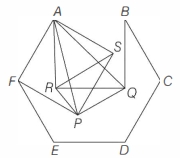
In the figure given below, $A B C D E F$ is a regular hexagon of side length $1$, $A F P S$ and $A B Q R$ are squares. Then, the ratio $\operatorname{ar}(A P Q) \operatorname{lar}(S R P)$ equals