Question
Let $\text{f}\text{(x)}=\frac{\log\Big(1+\frac{\text{x}}{\text{a}}\Big)-\log\Big(1-\frac{\text{x}}{\text{b}}\Big)}{\text{x}},\text{x}\neq0$ Find the value of f at x = 0. So that f becomes continuous at x = 0.

Answer

Given, $\text{f}\text{(x)}=\frac{\log\Big(1+\frac{\text{x}}{\text{a}}\Big)-\log\Big(1-\frac{\text{x}}{\text{b}}\Big)}{\text{x}},\text{x}\neq0$
If f(x) is continuous at x = 0, then
$\lim\limits_{\text{x} \rightarrow 0}\text{f}\text{(x)}=\text{f}(0)$
$\Rightarrow\lim\limits_{\text{x} \rightarrow 0}\begin{pmatrix}\frac{\log\Big(1+\frac{\text{x}}{\text{a}}\Big)-\log\Big(1-\frac{\text{x}}{\text{b}}\Big)}{\text{x}}\end{pmatrix}=\text{f}(0)$
$\Rightarrow\lim\limits_{\text{x} \rightarrow 0}\begin{pmatrix}\frac{\log\Big(1+\frac{\text{x}}{\text{a}}\Big)}{\frac{\text{ax}}{\text{a}}}-\frac{\log\Big(1-\frac{\text{x}}{\text{b}}\Big)}{\frac{\text{bx}}{\text{b}}}\end{pmatrix}=\text{f}(0)$
$\Rightarrow\lim\limits_{\text{x} \rightarrow 0}\begin{pmatrix}\frac{\log\Big(1+\frac{\text{x}}{\text{a}}\Big)}{\frac{\text{x}}{\text{a}}}\end{pmatrix}-\Big(-\frac{1}{\text{b}}\Big)\lim\limits_{\text{x} \rightarrow 0}\begin{pmatrix}\frac{\log\Big(1-\frac{\text{x}}{\text{b}}\Big)}{\frac{-\text{x}}{\text{b}}}\end{pmatrix}=\text{f}(0)$
$\Rightarrow\frac{1}{\text{a}}\times1-\Big(-\frac{1}{\text{b}}\Big)\times1=\text{f}(0)$ $\Big[\text{Using :}\lim_{\text{x} \rightarrow 0}\frac{\text{log(1}+\text{x)}}{\text{x}}=1\Big]$
$\Rightarrow\frac{1}{\text{a}}+\frac{1}{\text{b}}=\text{f}(0)$
$\Rightarrow\frac{\text{a}+\text{b}}{\text{ab}}=\text{f}(0)$

Need a full question paper?

Generate a complete, print-ready paper with questions like this in minutes — across 16+ boards, with answer keys.
Start Generating Free

Similar questions

Show that the line whose vector equation is $\vec{\text{r}}=2\hat{\text{i}}+5\hat{\text{j}}+7\hat{\text{k}}+\lambda(\hat{\text{i}}+3\hat{\text{j}}+4\hat{\text{k}})$ is parallel to the plane whose vector equation is $\vec{\text{r}}\cdot(\hat{\text{i}}+\hat{\text{j}}-\hat{\text{k}})=7$ Also, find the distance between thetm.
Find the inverse of the following matrices by using elementry row transformation:$\begin{bmatrix} 2 & -1 & 3 \\ 1 & 2 &4 \\ 3 & 1 & 1 \end{bmatrix}$
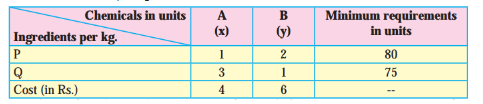
A factory produced two types of chemicals A and B. The following table gives the units of ingredients P and Q (per kg) of chemicals A and B as well as minimum requirements of P and Q and also cost per kg. chemicals A and B :

Image

Find the number of units of chemicals A and B should be produced so as to minimize the cost.

Differentiate the following functions with respect to x:
$\tan^{-1}\Big(\frac{4\text{x}}{1-4\text{x}^2}\Big),-\frac{1}{2}<\text{x}<\frac{1}{2}$
Evaluate the following:
$\begin{pmatrix}\begin{bmatrix}1&3\\-1&-4 \end{bmatrix}+\begin{bmatrix}3&-2\\-1&1 \end{bmatrix}\end{pmatrix}\begin{bmatrix}1&3&5\\2&4&6 \end{bmatrix}$
The coordinates of the foot of the perpendicular drawn from the origin to a plane are (12, -4, 3). Find the equation of the plane.
Evaluate : $\int_0^2 \frac{2^x}{2^x\left(1+4^x\right)} \cdot d x$
Evaluate the following integral:
$\int\frac{1}{\sqrt{(2-\text{x})^2-1}}\text{ dx}$
Find the maximum and minimum values of $\text{y}=\tan \text{x}-2\text{x}$
Solve the following differential equation:
$\frac{\text{dy}}{\text{dx}} = (\text{x}+\text{y})^2$