MCQ
Let the function $f: R \rightarrow R$ be defined by

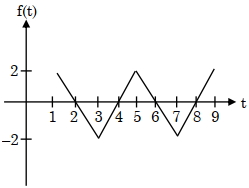
$f(t)=\left\{\begin{array}{cc}(-1)^{n+1} 2, & \text { if } t=2 n-1, n \in N , \\ \frac{(2 n+1-t)}{2} f(2 n-1)+\frac{(t-(2 n-1))}{2} f(2 n+1), & \text { if } 2 n-1 < t < 2 n+1, n \in N \end{array}\right.$

Define $g(x)=\int_1^x f(t) d t, x \in(1, \infty)$. Let $\alpha$ denote the number of solutions of the equation $g(x)=0$ in the interval $(1,8]$ and $\beta=\lim _{x \rightarrow 1+} \frac{g(x)}{x-1}$. Then the value of $\alpha+\beta$ is equal to. . . . . .

  • A
    $3$
  • B
    $4$
  • $5$
  • D
    $6$

Answer

Correct option: C.
$5$
c
$f ( t )=\left\{\begin{array}{ccc}2 & ; & t =1 \\ 4-2 t & ; & 1< t <3 \\ -2 & ; & t =3 \\ -8-2 t & ; & 3< t <5 \\ 2 & ; & t =5 \\ 12-2 t & ; & 5< t <7 \\ -2 & ; & t =7 \\ -16+2 t & ; & 7< t <9\end{array}\right.$

$g(x)=\int_1^x f(t) d t ; g^{\prime}(x)=f(x)$

$\text { for } x \in(1,8]$

$g(x)=0 \Rightarrow x=3,5,7 \therefore \alpha=3$

$\beta=\lim _{x \rightarrow 1^{+}} \frac{g(x)}{x-1}$

$\text { Apply L'pital }$

$=\frac{g^{\prime}\left(1^{+}\right)}{1}=f\left(1^{+}\right)$

$\beta=2$

$\therefore \alpha+\beta=5$

Need a full question paper?

Generate a complete, print-ready paper with questions like this in minutes — across 16+ boards, with answer keys.

Start Generating Free

Similar questions

A square matrix A has 9 elements. What is the possible order of A?
  1. 1 × 9
  2. 9 × 9
  3. 3 × 3
  4. 2 × 7
Let $f$ be defined on $[-5,5]$ as
$
f(x)=\left\{\begin{array}{l}
x \text { if } x \text { is rational } \\
-x \text { if } x \text { is irrational }
\end{array}\right.
$
Then $f(x)$ is
Three six faced fair dice are thrown together. The probability that the sum of the numbers appearing on the dice is $k\,(3 \le k \le 8),$ is
If $\quad A=\left[\begin{array}{cc}\cos \theta & \text { isin } \theta \\ \operatorname{isin} \theta & \cos \theta\end{array}\right], \left(\theta=\frac{\pi}{24}\right)$ and $A^{5}=\left[\begin{array}{ll}a & b \\ c & d\end{array}\right],$ where $i=\sqrt{-1},$ then which one of the following is not true?
$\int\frac{\sin^2\text{x}-\cos^2\text{x}}{\sin^2\text{x}\cos^2\text{x}}\text{dx}$ is equal to:
  1. $\tan\text{x}+\cos\text{x}+\text{c}$
  2. $\tan\text{x}+\text{cosec}\text{x}+\text{c}$
  3. $\tan\text{x}+\text{cot}\text{x}+\text{c}$
  4. $\tan\text{x}+\sec\text{x}+\text{c}$
The area bounded by the curves $y = \sqrt x ,$ $2y + 3 = x$ and $x - $ axis in the $1^{st}$ quadrant is
Set $A$ has three elements and set $B$ has four elements. The number of injections that can be defined from $A$ to $B$ is
Choose the correct answer from given four options in each of the Exercise:
If $\text{A}=\begin{vmatrix}2&\lambda&-3\\0&2&5\\1&1&3\end{vmatrix},$ then A-1 exists, if:
  1. $\lambda=2$
  2. $\lambda\neq2$
  3. $\lambda\neq-2$
  4. $\text{None of these}$
If $\vec{a}=4 \hat{i}+6 \hat{j}$ and $\vec{b}=3 \hat{j}+4 \hat{k}$, then the vector form of the component of $\vec{a}$ along $\vec{b}$ is
The region represented by the inequation system x, y ≥ 0, y ≤ 6, x + y ≤ 3 is: