Question
Let there be a spherically symmetric charge distribution with charge density varying as $\text{p}(\text{r})=\text{p}_0\bigg(\frac{5}{4}-\frac{\text{r}}{\text{R}}\bigg)$ upto r = R and p(r) = 0 for r > R where r is the distance from the origin the electric field at a distance r(r < R) from the origin is given by.
Answer

  1. $\text{p}{_0}^\text{r}\Big(\frac{5}{3}-\frac{\text{r}}{\text{R}}\Big)$

Need a full question paper?

Generate a complete, print-ready paper with questions like this in minutes — across 16+ boards, with answer keys.

Start Generating Free

Similar questions

In Rutherford's $\alpha\text{ - particle}$ scattering experiment, what will be correct angle for α scattering for an impact parameter b = 0?
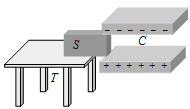
A frictionless dielectric plate $S$ is kept on a frictionless table $T$. A charged parallel plate capacitance $C\ ($of which the plates are frictionless$)$ is kept near it. The plate $S$ is between the plates. When the plate $S$ is left between the plates
Beta particle An unknown particle is being studied in a magnetic field of variable intensity and direction. When the magnetic field is turned off, the particle is observed to move toward the earth. When the magnetic field is turned on, the particle is observed to continue to move toward the earth, no matter the strength or the direction of the magnetic field. Which of the particles listed below is most likely the unknown particle?
In an AC circuit, the impedance is 3​ times the reactance, then the phase angle is.
Two electrolytic cells containing $\mathrm{CuSO}_4$ and $\mathrm{AgNO}_3$ respectively are connected in series and a current is passed through them until $1 \ mg$ of copper is deposited in the first cell. The amount of silver deposited in the second cell during this time is approximately $[$Atomic weights of copper and silver are respectively $63.57$ and $107.88]$
In the Boolean algebra, the following one is wrong:
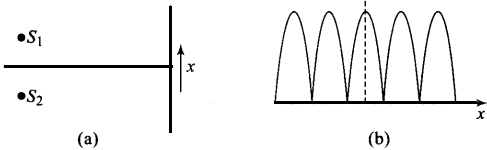
Two source $S_1$ and $S_2$ of intensity $I_1$ and $I_2$ are placed in front of a screen $[$Fig. (a)$]$. The patteren of intensity distribution seen in the central portion is given by Fig. $(b)$.

In this case which of the following statements are true.
In Davison-Germer experiment, an electron beam is incident on a crystal. The reflected beam consists of:
A magnetic dipole of length $10\ cm$ has pole strength of $20Am.$ Find the magnetic moment of the dipole.
What happens to the magnetic field at the centre of a circular current carrying coil if we double the radius of the coil keeping the current unchanged?