Question
Let there be an A.P. with first term $'a'$, common difference $'d'$. If $a_n$​​​​​​​ denotes in $n^{th}​​​​​​​$​​​​​​​ term and $S_n​​​​​​​$​​​​​​​ the sum of first $n$ terms, find.
d, if $a = 3, n = 8$ and $S_n = 192$.

Answer

Here, we have an A.P. whose first term $(a)$, Sum of first n terms $(S_n)$ and the number of terms $(n)$ are given. We need to find common difference $(d)$.
Here,
First term $(a) = 3$
Sum of n terms $(S_n) = 192$
Number of terms $(n) = 8$
So here we will find the value of n using the formula, $a_n = a + (n - 1)d$
So. to find the common difference of this A.P., we use the following formula for the sum of n terms of an A.P.
$\text{S}_\text{n}=\frac{\text{n}}{2}[2\text{a}+(\text{n}-1)\text{d}]$
Where; $a$ = first term for the given A.P.
$d$ = common difference of the given A.P.
$n$ = number of terms
So, using the formula for $n = 8$, we get,
$\text{S}_8=\frac{8}{2}[2(3)+(8-1)(\text{d})]$
$192 = 4[6 + (7)(d)]$
$192 = 24 + 28d$
$28d = 192 - 24$
Furhter solving for d,
$\text{d}=\frac{168}{28}$
$d = 6$
Therefore, the common difference of the given A.P. is $d = 6.$

Need a full question paper?

Generate a complete, print-ready paper with questions like this in minutes — across 16+ boards, with answer keys.

Start Generating Free

Similar questions

If $\alpha$ and $\beta$ are the zeroes of the quadratic polynomial $f(x) = x^2+ px + q$, find a quadratic polynomial whose zeroes are $(\alpha+\beta)^2$ and $(\alpha-\beta)^2.$
Solve the following systems of equations graphically:
x - 2y = 6
3x - 6y = 0
Roohi travels 300km to her home partly by train and partly by bus. She takes 4 hours if she travels 60km by train and the remaining by bus. If she travels 100km by train and the remaining by bus, she takes 10 minutes longer. Find the speed of the train and the bus separately.
Prove that the points A(2, 3) B(-2, 2) C(-1, -2), and D(3, -1) are the vertices of a square ABCD.
Solve for x and y:
3(2x + y) = 7xy,
3(x + 3y) = 11xy $(\text{x}\neq0\ \text{and}\ \text{y}\neq0)$
For the following statments state whether true (T) or false(F):
Two circles with different radii are similar.
From a pack of 52 playing cards Jacks, queens, Kings and aces of red colour are removed. From the remaining, a card is drawn at random. Find the probability that the card drawn is:
  1. A black queen.
  2. A red card.
  3. A black jack.
  4. A picture card (Jacks, queens and Kings are picture cards).
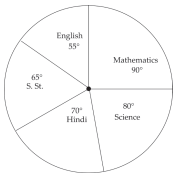
The following pie chart gives the marks scored in an examination by a student in various subjects. If the total marks obtained by the student were 360, answer the following questions
Image
(i) Find the marks obtained in each subject.
(ii) How many more marks he got in Mathematics than in Science?
(iii) Which subject he get the least marks?
Construct a triangle similar to $\triangle\text{ABC}$ in which AB = 4.6cm, BC = 5.1cm, $\angle\text{A}=60^\circ$ with scale factor 4 : 5.