MCQ
Let $\vec{a}$ and $\vec{b}$ be two vectors such that $|\vec{a}+\vec{b}|^{2}=|\vec{a}|^{2}+2|\vec{b}|^{2}, \vec{a} \cdot \vec{b}=3 \quad$ and $\quad|\vec{a} \times \vec{b}|^{2}=75$.Then $|\vec{a}|^{2}$ is equal to $.......$
  • $14$
  • B
    $13$
  • C
    $12$
  • D
    $11$

Answer

Correct option: A.
$14$
a
$|\vec{a}+\vec{b}|^{2}=|\vec{a}|^{2}+2|\vec{b}|^{2} ; \vec{a} \cdot \vec{b}=3$

As $|\vec{a}|^{2}+|\vec{b}|^{2}+2 \vec{a} \cdot \vec{b}=|\vec{a}|^{2}+2|\vec{b}|^{2}$

$|\vec{b}|^{2}=2 \vec{a} \cdot \vec{b}=6$

$|\vec{a} \times \vec{b}|^{2}=75$

$|\vec{a}|^{2}|\vec{b}|^{2}-(\vec{a} \cdot \vec{b})^{2}=75$

$6|\vec{a}|^{2}-9=75 \Rightarrow|\vec{a}|^{2}=14$

Need a full question paper?

Generate a complete, print-ready paper with questions like this in minutes — across 16+ boards, with answer keys.

Start Generating Free

Similar questions

The matrix $\begin{bmatrix}0&5&-7\\-5&0&11\\7&-11&0\end{bmatrix}$ is:
  1. A skew-symmetric matrix.
  2. A symmetric matrix.
  3. A diagonal matrix.
  4. An uppertriangular matrix.
The solution of $x \frac{d y}{d x}+y=e^x$ is
If the system of linear equations $x - 2y + kz = 1$ ; $2x + y + z = 2$ ;  $3x - y - kz = 3$ Has a solution $(x, y, z) \ne 0$, then $(x, y)$ lies on the straight line whose equation is
If $f^{\prime}(x)=\tan ^{-1}(\sec x+\tan x),-\frac{\pi}{2} < x < \frac{\pi}{2},$ and $f(0)=0,$ then $f(1)$ is equal to 
The function $\mathrm{f}(\mathrm{x})$, that satisfies the condition $\mathrm{f}(\mathrm{x})=\mathrm{x}+\int_{0}^{\pi / 2} \sin \mathrm{x} \cdot \cos y \mathrm{f}(\mathrm{y}) \mathrm{dy}$, is :
A vector parallel to the line of intersection of the plance $\vec{\text{r}}.(3\hat{\text{i}}-\hat{\text{j}}+\hat{\text{k}})=1$ and $\vec{\text{r}}.(\hat{\text{i}}-4\hat{\text{j}}+2\hat{\text{k}})=2$ is:
  1. $-2\hat{\text{i}}+7\hat{\text{j}}+13\hat{\text{k}}$
  2. $2\hat{\text{i}}+7\hat{\text{j}}-13\hat{\text{k}}$
  3. $-2\hat{\text{i}}-7\hat{\text{j}}+13\hat{\text{k}}$
  4. $2\hat{\text{i}}+7\hat{\text{j}}+13\hat{\text{k}}$
The degree and the order of the differential equation
$\text{y}=\text{x}\Big(\frac{\text{dy}}{\text{dx}}\Big)^2+\Big(\frac{\text{dx}}{\text{dy}}\Big)^2$  are respectively:
  1. 1, 1
  2. 2, 1
  3. 4, 1
  4. 1, 4
If $\vec{\text{a}},\ \vec{\text{b}},\ \vec{\text{c}}$ are three non-zero vectors, no two of which are collinear and the vector $\vec{\text{a}}+\vec{\text{b}}$ is collinear with $\vec{\text{c}}$$\vec{\text{b}}+\vec{\text{c}}$ is collinear with $\vec{\text{a}}$, then $\vec{\text{a}}+\vec{\text{b}}+\vec{\text{c}}=$
  1. $\vec{\text{a}}$
  2. $\vec{\text{b}}$
  3. $\vec{\text{c}}$
  4. None of these
$\sin[\cot^{-1}\{\cos(\tan^{-1}\text{x})\}]=$
  1. $\sqrt{\frac{\text{x}^2+1}{\text{x}^2+2}}$
  2. $\sqrt{\frac{\text{x}^2-1}{\text{x}^2-2}}$
  3. $\sqrt{\frac{\text{x}-1}{\text{x}-2}}$
  4. $\sqrt{\frac{\text{x}+1}{\text{x}+2}}$
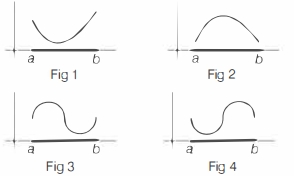
The following figure shows the graph of a differentiable function $y=f(x)$ on the interval $[a, b]$ (not containing $0$ ).  $FIGURE$  Let $g(x)=\frac{f(x)}{x}$. Which of the following is a possible graph of $y=g(x) ?$