Question
$\text{Let}\ \vec{\text{a}}=4\hat{\text{i}}+5\hat{\text{j}}-\hat{\text{k}},\vec{\text{b}}=\hat{\text{i}}-4\hat{\text{j}}+5\hat{\text{k}}$ and $\vec{\text{c}}=3\hat{\text{i}}+\hat{\text{j}}-\hat{\text{k}}$ Find a vector $\vec{\text{d}}$ which is perpendicular to both $\vec{\text{c}}\ \text{and }\vec{\text{b}}\ \text{and}\ \vec{\text{d}}\cdot\vec{\text{a}}=21.$
Answer

$\vec{\text{a}}=4\hat{\text{i}}+5\hat{\text{j}}-\hat{\text{k}}$
$\vec{\text{b}}=-\hat{\text{i}}-4\hat{\text{j}}+5\hat{\text{k}}$
$\vec{\text{c}}=3\hat{\text{i}}+\hat{\text{j}}-\hat{\text{k}}$
To find vector $\vec{\text{d}}$ such that
$\vec{\text{d}}\cdot\vec{\text{c}}=0$
$\vec{\text{d}}\cdot\vec{\text{b}}=0$
$\vec{\text{d}}\cdot\vec{\text{a}}=21$
$\text{Let}\ \vec{\text{d}}=\text{x}\hat{\text{i}}+\text{y}\hat{\text{j}}+\text{z}\hat{\text{k}}$
$\Big(\text{x}\hat{\text{i}}+\text{y}\hat{\text{j}}+\text{z}\hat{\text{k}}\Big)\cdot\Big(3\hat{\text{i}}+\hat{\text{j}}-\hat{\text{k}}\Big)=0$
$3\text{x}+\text{y}-\text{z}=0\ \ \ ....(1)$
$\Big(\text{x}\hat{\text{i}}+\text{y}\hat{\text{j}}+\text{z}\hat{\text{k}}\Big)\cdot\Big(\hat{\text{i}}+5\hat{\text{j}}-\hat{\text{k}}\Big)=0$
$\text{x}-4\text{y}+5\text{z}=0\ \ \ ....(2)$
$\Big(\text{x}\hat{\text{i}}+\text{y}\hat{\text{j}}+\text{z}\hat{\text{k}}\Big)\cdot\Big(4\hat{\text{i}}+5\hat{\text{j}}-\hat{\text{k}}\Big)=21$
$4\text{x}+5\text{y}-\text{z}=21\ \ \ ....(3)$
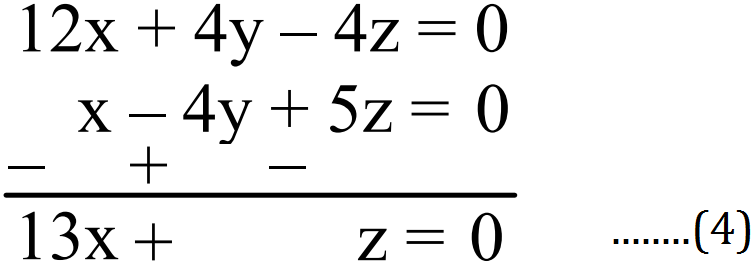
$\text{eq}^\text{n}(1)\times4+\text{eq}^\text{n}(2)$

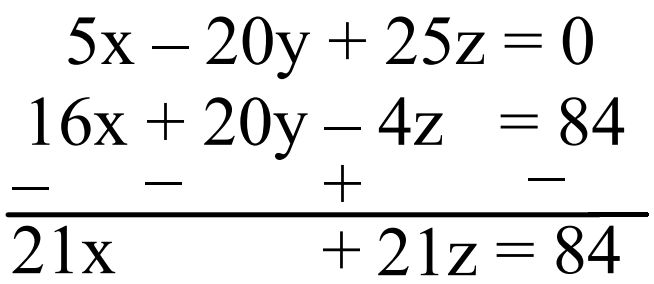
$\text{eq}^\text{n}(2)\times5+\text{eq}^\text{n}(3)\times4$

$21(\text{x}+\text{z})=84$
$\text{x}+\text{z}=4\ \ \ ....(5)$
$\text{eq}.(4)-(5)$
$12\text{x}=-4$
$\text{x}=\frac{-4}{12}=\frac{-1}{3}$
$\text{z}=4-\text{x}$
$\text{z}=4+\frac{1}{3}=\frac{13}{3}$
$\text{Put x}\ \&\ \text{z in }(1)$
$3\text{x}+\text{y}-\text{z}=0$
$3\times\Big(\frac{-1}{3}\Big)+\text{y}-\frac{13}{3}=0$
$\text{y}=\frac{13}{3}+1$
$\text{y}=\frac{16}{3}$
$\vec{\text{d}}=\text{x}\hat{\text{i}}+\text{y}\hat{\text{j}}+\text{z}\hat{\text{k}}$
$\vec{\text{d}}=\frac{-1}{3}\hat{\text{i}}+\frac{16}{3}\hat{\text{j}}+\frac{13}{3}\hat{\text{k}}$

Need a full question paper?

Generate a complete, print-ready paper with questions like this in minutes — across 16+ boards, with answer keys.

Start Generating Free

Similar questions

Show that aii curve for which the slope at any point (x, y) on its is  $\frac{\text{x}^{2}+\text{y}^{2}}{\text{2xy}}$ are rectangular hyperbola.
David wants to invest at most $Rs. 12,000$ in Bonds $A$ and $B.$ According to the rule, he has to invest at least $Rs. 2,000$ in Bond A and at least $Rs. 4,000$ in Bond $B.$ If the rates of interest on Bonds $A$ and $B$ respectively are $8\%$ and $10\%$ per annum, formulate the problem as $L.P.P.$ and solve it graphically for maximum interest. Also determine the maximum interest received in a year.
Evaluate the following integrals:
$\int\sin^{-1}\sqrt{\frac{\text{x}}{\text{a+x}}}\text{dx}$
Three schools A, B and C organised a mela for collecting funds for helping the rehabilitation of flood victims. They sold hand made fans, mats and plates from recycled material at a cost of ₹ 25, 100 and ₹ 50 each. The number of articles sold are given below:
School A B C
Article
Hand - fans 40 25 35
Mats 50 40 50
Plates 20 30 40
Find the funds collected by each school separately by selling the above articles. Also find the total funds collected for the purpose.
Write one value generated by the above situation.
If $\text{x}=\text{a}\sec\theta,\text{y}=b\tan\theta$ prove that $\frac{\text{d}^2\text{y}}{\text{dx}^2}=-\frac{\text{b}^4}{\text{a}^2\text{y}^3}$
Solve the following initial value problems:
$\frac{\text{dy}}{\text{dx}}+\text{y}\tan\text{x}=2\text{x}+\text{x}^2\tan\text{x},\text{ y}(0)=1$
Find the foot of the perpendicular drawn from the point A(1, 0, 3) to the joint of the points B(4, 7, 1) and C(3, 5, 3).
Find the shortest distance between the following pairs of lines whose vector equations are:
$\vec{\text{r}}=(1-\text{t})\hat{\text{i}}+(\text{t}-2)\hat{\text{j}}+(3-\text{t})\hat{\text{k}}$ and $\vec{\text{r}}=(\text{s}+1)\hat{\text{i}}+(2\text{s}-1)\hat{\text{j}}-(2\text{s}+1)\hat{\text{k}}$
Evaluate the following integrals:$\int\frac{\text{x}^3\sin^{-1}\text{x}^2}{\sqrt{1-\text{x}^4}}\text{dx}$
Find the intervals in which the following functions are increasing or decreasing.
$f(x) = \{x(x - 2)\}^2$