Question
$\text{Let}\ \vec{\text{a}}=4\hat{\text{i}}+5\hat{\text{j}}-\hat{\text{k}},\vec{\text{b}}=\hat{\text{i}}-4\hat{\text{j}}+5\hat{\text{k}}$ and $\vec{\text{c}}=3\hat{\text{i}}+\hat{\text{j}}-\hat{\text{k}}$ Find a vector $\vec{\text{d}}$ which is perpendicular to both $\vec{\text{c}}\ \text{and }\vec{\text{b}}\ \text{and}\ \vec{\text{d}}\cdot\vec{\text{a}}=21.$
Answer

$\vec{\text{a}}=4\hat{\text{i}}+5\hat{\text{j}}-\hat{\text{k}}$
$\vec{\text{b}}=\hat{\text{i}}-4\hat{\text{j}}+5\hat{\text{k}}$
$\vec{\text{c}}=3\hat{\text{i}}+\hat{\text{j}}-\hat{\text{k}}$
To find vector $\vec{\text{d}}$ such that
$\vec{\text{d}}\cdot\vec{\text{c}}=0$
$\vec{\text{d}}\cdot\vec{\text{b}}=0$
$\vec{\text{d}}\cdot\vec{\text{a}}=21$
$\text{Let}\ \vec{\text{d}}=\text{x}\hat{\text{i}}+\text{y}\hat{\text{j}}+\text{z}\hat{\text{k}}$
$\Big(\text{x}\hat{\text{i}}+\text{y}\hat{\text{j}}+\text{z}\hat{\text{k}}\Big)\cdot\Big(3\hat{\text{i}}+\hat{\text{j}}-\hat{\text{k}}\Big)=0$
$3\text{x}+\text{y}-\text{z}=0\ \ \ ....(1)$
$\Big(\text{x}\hat{\text{i}}+\text{y}\hat{\text{j}}+\text{z}\hat{\text{k}}\Big)\cdot\Big(\hat{\text{i}}-4\hat{\text{j}}+5\hat{\text{k}}\Big)=0$
$\text{x}-4\text{y}+5\text{z}=0\ \ \ ....(2)$
$\Big(\text{x}\hat{\text{i}}+\text{y}\hat{\text{j}}+\text{z}\hat{\text{k}}\Big)\cdot\Big(4\hat{\text{i}}+5\hat{\text{j}}-\hat{\text{k}}\Big)=21$
$4\text{x}+5\text{y}-\text{z}=21\ \ \ ....(3)$
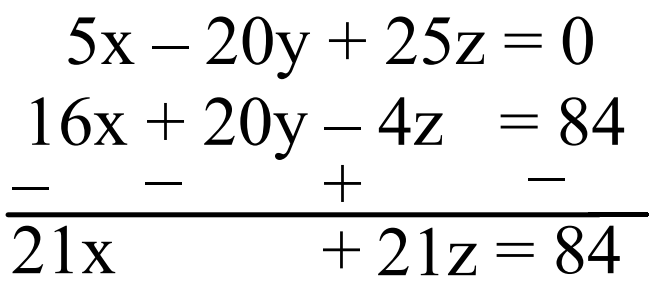
$\text{eq}^\text{n}(1)\times4+\text{eq}^\text{n}(2)$

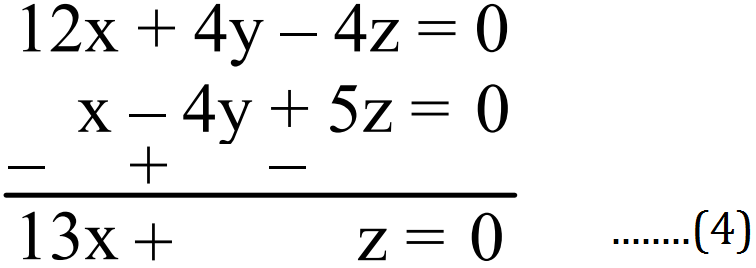
$\text{eq}^\text{n}(2)\times5+\text{eq}^\text{n}(3)\times4$

$21(\text{x}+\text{z})=84$
$\text{x}+\text{z}=4\ \ \ ....(5)$
$\text{eq}.(4)-(5)$
$12\text{x}=-4$
$\text{x}=\frac{-4}{12}=\frac{-1}{3}$
$\text{z}=4-\text{x}$
$\text{z}=4+\frac{1}{3}=\frac{13}{3}$
$\text{Put x}\ \&\ \text{z in }(1)$
$3\text{x}+\text{y}-\text{z}=0$
$3\times\Big(\frac{-1}{3}\Big)+\text{y}-\frac{13}{3}=0$
$\text{y}=\frac{13}{3}+1$
$\text{y}=\frac{16}{3}$
$\vec{\text{d}}=\text{x}\hat{\text{i}}+\text{y}\hat{\text{j}}+\text{z}\hat{\text{k}}$
$\vec{\text{d}}=\frac{-1}{3}\hat{\text{i}}+\frac{16}{3}\hat{\text{j}}+\frac{13}{3}\hat{\text{k}}$

Need a full question paper?

Generate a complete, print-ready paper with questions like this in minutes — across 16+ boards, with answer keys.

Start Generating Free

Similar questions

Show that the differential equation $x^{2} d y+\left(x y+y^{2}\right) d x=0$ is homogenous and find the particular solution, given that $y = 1$ when $x = 1$.
Evaluate the following intregals:
$\int\frac{18}{(\text{x}+2)(\text{x}^2+4)}\text{ dx}$
Evaluate the following integrals:
$\int\limits_{0}^{{\pi}}\frac{1}{5+3\cos\text{x}}\text{ dx}$
A hospital dietician wishes to find the cheapest combination of two foods, $A$ and $B$, that contains at least $0.5$ milligram of thiamin and at least $600$ calories. Each unit of$ A$ contains $0.12$ milligram of thiamin and $100$ calories, while each unit of $B$ contains $0.10 $milligram of thiamin and $150$ calories. If each food costs $10$ paise per unit, how many units of each should be combined at a minimum cost?
Using matrices, solve the following system of linear equations;
$x + 2y - 3z = –4.$
$2x + 3y + 2z = 2.$
$3x – 3y – 4z = 11.$
Differentiate w.r.t. x the function in Exercise:
$\cot^{-1}\Big[\frac{\sqrt{1+\sin\text{x}}+\sqrt{1-\sin\text{x}}}{\sqrt{1+\sin\text{x}}-\sqrt{1-\sin\text{x}}}\Big],\ 0<\text{x}<\frac{\pi}{2}$
Find the slopes of the tangent and the normal to the following curves at the indicated points:
$\text{x}=\text{a}(\theta-\sin\theta),\text{y}=\text{a}(1-\cos\theta)\ \text{at}\ \theta=\frac{-\pi}{2}$
Find the area bounded by the parabola $y^2 = 4x$ and the line $y = 2x - 4:$
By using vertical strips.
Let $d_1, d_2, d_3$ be three mutually exclusive diseases. Let $S$ be the set of observable symptoms of these diseases. A doctor has the following information from a random sample of $5000$ patients: $1800$ had disease $d_1, 2100$ has disease $d_2,$ and others had disease $d_3. 1500$ patients with disease $d_1, 1200$ patients with disease $d_2,$ and $900$ patients with disease $d_3$ showed the symptom. Which of the diseases is the patient most likely to have?
Find the area enclosed by the curve $3x^2 + 5y = 32$ and $y = |x - 2|$