MCQ
Let $\vec{C}=\vec{A}+\vec{B}$ then
  • A
    $|\vec{C}|$ is always greater then $|\vec{A}|$
  • It is possible to have $|\vec{C}|<|\vec{A}|$ and $|\vec{C}|<\vec{B} \mid$
  • C
    $C$ is always equal to $A+B$
  • D
    $C$ is never equal to $A+B$

Answer

Correct option: B.
It is possible to have $|\vec{C}|<|\vec{A}|$ and $|\vec{C}|<\vec{B} \mid$
(b) $\vec{C}+\vec{A}=\vec{B}$.The value of $C$ lies between $A-B$ and $A+B$$\therefore|\vec{C}|<|\vec{A}| \text { or }|\vec{C}|<|\vec{B}|$

Need a full question paper?

Generate a complete, print-ready paper with questions like this in minutes — across 16+ boards, with answer keys.
Start Generating Free

Similar questions

A body of mass $M$ moves with velocity $v$ and collides elastically with a another body of mass $m(M>m)$ at rest then the velocity of body of mass $m$ is
In uni form circular motion
In hydrogen atom, the electron is making $6.6 \times {10^{15}}\,rev/\sec $ around the nucleus in an orbit of radius $0.528\, \mathop A\limits^o $. The magnetic moment $(A - {m^2})$ will be
The coefficient of friction $\mu$ and the angle of friction $\lambda$ are related as
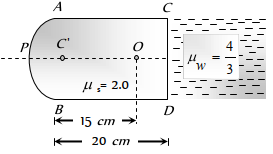
The slab of a material of refractive index 2 shown in figure has curved surface $A P B$ of radius of curvature $10 \mathrm{~cm}$ and a plane surface $C D$. On the left of $A P B$ is air and on the right of $C D$ is water with refractive indices as given in figure. An object $O$ is placed at a distance of $15 \mathrm{~cm}$ from pole $P$ as shown. The distance of the final image of $O$ from $P$, as viewed from the left is
Image
In a thermodynamics process, pressure of a fixed mass of a gas is changed in such a manner that the gas releases $20 \mathrm{~J}$ of heat and 8J of work is done on the gas. If the initial internal energy of the gas was $30 \%$. The final internal energy will be
Work done in converting one gram of ice at $-10^{\circ} \mathrm{C}$ into steam at $100^{\circ} \mathrm{C}$ is
A beaker is completely filled with water at $4^{\circ} \mathrm{C}$. It will overflow if
The current sensitivity of a moving coil galvanometer can be increased by
If $g$ is the acceleration due to gravity at the earth's surface and $r$ is the radius of the earth, the escape velocity for the body to escape out of earth's gravitational field is