Question
Let $\vec{\text{a}}=\hat{\text{i}}+4\hat{\text{j}}+2\hat{\text{k}},\vec{\text{b}}=3\hat{\text{i}}-2\hat{\text{j}}+7\hat{\text{k}}$ and $\vec{\text{c}}=2\hat{\text{i}}-\hat{\text{j}}+4\hat{\text{k}}.$Find a vector $\vec{\text{d}}$ which is perpendicular to both $\vec{\text{a}}$ and $\vec{\text{d}}$ and $\vec{\text{c}}.\vec{\text{d}}=15.$
Answer

Given
$\vec{\text{a}}=\hat{\text{i}}+4\hat{\text{j}}+2\hat{\text{k}}$
$\vec{\text{b}}=3\hat{\text{i}}-2\hat{\text{j}}+7\hat{\text{k}}$
$\vec{\text{c}}=2\hat{\text{i}}-\hat{\text{j}}+4\hat{\text{k}}$
Since d is perpendicular to both a and b, it is parallel to $\vec{\text{a}}\times\vec{\text{b}}.$
Suppose $\text{d}=\lambda\big(\vec{\text{a}}\times\vec{\text{b}}\big)$ for some scalar $\lambda.$
$\text{d}=\lambda\begin{vmatrix}\hat{\text{i}}&\hat{\text{j}}&\hat{\text{k}}\\1&4&2\\3&-2&7 \end{vmatrix}$
$=\lambda\big[(28+4)\hat{\text{i}}-(7-6)\hat{\text{j}}+(-2-12)\hat{\text{k}}\big]$
$\vec{\text{c}}.\vec{\text{d}}=15$ (Given)
$\Rightarrow\big(2\hat{\text{i}}-\hat{\text{j}}+4\hat{\text{k}}\big).\lambda\big(32\hat{\text{i}}-\hat{\text{j}}-14\hat{\text{k}}\big)=15$
$\Rightarrow\lambda(64+1-56)=15$
$\Rightarrow\lambda=\frac{5}{3}$
$\therefore\vec{\text{d}}=\frac{5}{3}\big(32\hat{\text{i}}-\hat{\text{j}}-14\hat{\text{k}}\big)$
$\Rightarrow\vec{\text{d}}=\frac{1}{3}\big(160\hat{\text{i}}-5\hat{\text{j}}-70\hat{\text{k}}\big)$
Disclaimer: The question should contain "Which is perpendicular to both $\vec{\text{a}}$ and $\vec{\text{b}}$ " instead of "Which is perpendicular to both $\vec{\text{a}}$ and $\vec{\text{d}}$ "

Need a full question paper?

Generate a complete, print-ready paper with questions like this in minutes — across 16+ boards, with answer keys.

Start Generating Free

Similar questions

Integrate the following integrals:
$\int\sin\text{x}\cos2\text{x}\sin3\text{x dx}$
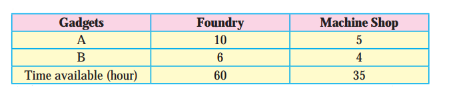
A manufacturing firm produces two types of gadgets A and B, which are first processed in the foundry and then sent to machine shop for finishing. The number of man hours of labour required in each shop for production of A and B per unit and the number of man hours available for the firm are as follows :

Image

Profit on the sale of A is ₹ 30 and B is ₹ 20 per units. Formulate the L.P.P. to have maximum profit.

Solve the following equation for x:
$\tan^{-1}(\text{x}+2)+\tan^{-1}(\text{x}-2)=\tan^{-1}\Big(\frac{8}{79}\Big),\text{x}>0$
Find the percentage error in calculating the surface area of a cubical box if an error of 1% is made in measuring the lengths of edges of the cube.
A population grows at the rate of $5$% per year. How long does it take for the population to double?
find the area of the region common to the circle $x^2 + y^2 = 16$ and the parabola $y^2 = 6x$.
Find the inverse of the following matrices by using elementry row transformation:$\begin{bmatrix}2 & 5 \\ 1 & 3 \end{bmatrix}$
A company sells two different products A and B. The two products are produced in a common production process and are sold in two different markets. The production process has a total capacity of 45000 man-hours. It takes 5 hours to produce a unit of A and 3 hours to produce a unit of B. The market has been surveyed and company officials feel that the maximum number of units of A that can be sold is 7000 and that of B is 10,000. If the profit is Rs. 60 per unit for the product A and Rs. 40 per unit for the product B, how many units of each product should be sold to maximize profit? Formulate the problem as LPP.
Find the points of local maxima or local minima and corresponding local maximum and local minimum values of the following functions. Also, find the points of inflection,
$\text{f}(\text{x})=\text{x}\sqrt{2-\text{x}^{2}}-\sqrt{2}\leq\text{x}\leq\sqrt{2}$
A coin is tossed thrice and all the eight outcomes are assumed equally likely. In which of the following cases are the following events A and B are independent?
A = the number of heads is two,
B = the last throw results in head.