Question
Let x = f(t) and y = g(t) be parametric forms with t as a parameter, then
$\frac{\text{dy}}{\text{dx}}=\frac{\text{dy}}{\text{dt}}\times\frac{\text{dt}}{\text{dx}}=\frac{\text{g}'(\text{t})}{\text{f}'(\text{t})},$ where $\text{f}'(\text{t})\neq0.$
On the basis of above information, answer the following questions.
  1. The derivative of $\text{f}(\tan\text{x})\text{w.r.t.}\text{ g}(\sec\text{x})\text{ at}\text{ x}=\frac{\pi}{4},$ where f'(1) = 2 and $\text{g}'(\sqrt{2})=4,$ is:
  1. $\frac{1}{\sqrt{2}}$
  2. ${\sqrt{2}}$
  3. 1
  4. 0
  1. The derivative of $\sin^{-1}\Big(\frac{2\text{x}}{1+\text{x}^2}\Big)$ with respect to $\cos^{-1}\Big(\frac{1-\text{x}^2}{1+\text{x}^2}\Big)$ is:
  1. -1
  2. 1
  3. 2
  4. 4
  1. The derivative of $\text{e}^{\text{x}^3}$ with respect to log x is:
  1. $\text{e}^{\text{x}^3}$
  2. $3\text{x}^22\text{e}^{\text{x}^3}$
  3. $3\text{x}^3\text{e}^{\text{x}^3}$
  4. $3\text{x}^2\text{e}^{\text{x}^3}+3\text{x}$
  1. The derivative of $\cos^{-1}(2\text{x}^2-1)\text{w.r.t.}\cos^{-1}\text{x}$ is:
  1. $2$
  2. $\frac{-1}{2\sqrt{1-\text{x}^2}}$
  3. $\frac{2}{\text{x}}$
  4. $1-\text{x}^2$
  1. If $\text{y}=\frac{1}{4}\mu^4$ and $\mu=\frac{2}{3}\text{x}^3+5,$ then $\frac{\text{dy}}{\text{dx}}=$
  1. $\frac{2}{27}\text{x}^2(2\text{x}^3+15)^3$
  2. $\frac{2}{7}\text{x}^2(2\text{x}^3+15)^3$
  3. $\frac{2}{27}\text{x}(2\text{x}^3+5)^3$
  4. $\frac{2}{7}(2\text{x}^3+15)^3$

Answer

  1. (a) $\frac{1}{\sqrt{2}}$
Solution:
Now, $\frac{\text{df}(\tan\text{x})}{\text{dg}(\sec\text{x})}=\frac{\text{f}'(\tan \text{x})\sec^2\text{x}}{\text{g}'(\sec\text{x})\sec\text{x}\tan \text{x}}$
$=\frac{\text{f}'(\tan \text{x})\sec\text{x}}{\text{g}'(\sec\text{x})\tan \text{x}}$
$\therefore\Big[\frac{\text{df}(\tan\text{x})}{\text{dg}(\sec\text{x})}\Big]_{\text{x}=\frac{\pi}{4}}=\frac{\text{f}'(1)\sqrt{2}}{\text{g}'(\sqrt{2})\cdot1}=\frac{2\sqrt{2}}{4\cdot1}=\frac{1}{\sqrt{2}}$
  1. (b) 1
  1. (c) $3\text{x}^3\text{e}^{\text{x}^3}$
Solution:
Let $\text{y}=\text{e}^{\text{x}^3},\text{z}=\log\text{x}$
Differentiating w.r.t. x, we get
$\frac{\text{dy}}{\text{dx}}=\text{e}^{\text{x}^3}(3\text{x}^2)=3\text{x}^2\text{e}^{\text{x}^3}$ and $\therefore\frac{\text{dy}}{\text{dz}}=\frac{\frac{\text{dy}}{\text{dx}}}{\frac{\text{dz}}{\text{dx}}}=\frac{3\text{x}^2\text{e}^{\text{x}^3}}{\Big(\frac{1}{\text{x}}\Big)}=3\text{x}^3\text{e}^{\text{x}^3}$
  1. (a) $2$
Solution:
Let $\text{y}=\cos^{-1}(2\text{x}^2-1)=2\cos^{-1}\text{x}$
Differentiating w.r.t. $\cos^{-1}\text{x},$ we get
$\frac{\text{dy}}{\text{d}(\cos^{-1}\text{x})}=\frac{2\text{d}(\cos^{-1}\text{x})}{\text{d}(\cos^{-1}\text{x})}=2$
  1. (a) $\frac{2}{27}\text{x}^2(2\text{x}^3+15)^3$
Solution:
We have, $\text{y}=\frac{1}{4}\text{u}^4\Rightarrow\frac{\text{dy}}{\text{du}}=\frac{1}{4}\cdot4\text{u}^3=\text{u}^3$
and $\text{u}=\frac{2}{3}\text{x}^3+5\Rightarrow\frac{\text{du}}{\text{dx}}=\frac{2}{3}\cdot3\text{x}^2=2\text{x}^2$
$\therefore\frac{\text{dy}}{\text{dx}}=\frac{\text{dy}}{\text{du}}\cdot\frac{\text{du}}{\text{dx}}=\text{u}^3\cdot2\text{x}^2=\Big(\frac{2}{3}\text{x}^3+5\Big)^3(2\text{x})^2$
$=\frac{2}{27}\text{x}^2(2\text{x}^3+15)^3$

Need a full question paper?

Generate a complete, print-ready paper with questions like this in minutes — across 16+ boards, with answer keys.

Start Generating Free

Similar questions

A factory has three machines $A, B$ and $C$ to manufacture bolts. Machine $A$ manufacture $30\%,$ machine $B$ manufacture $20\%$ and machine $C$ manufacture $50\%$ of the bolts respectively. Out of their respective outputs $5\%, 2\%$ and $4\%$ are defective. $A$ bolt is drawn at random from total production and it is found to be defective.
Based on the above information, answer the following questions.
  1. Probability that defective bolt drawn is manufactured by machine $A,$ is:
  1. $\frac{4}{13}$
  2. $\frac{5}{13}$
  3. $\frac{6}{13}$
  4. $\frac{9}{13}$
  1. Probability that defective bolt drawn is manufactured by machine $B,$ is:
  1. $0.3$
  2. $0.1$
  3. $0.2$
  4. $0.4$
  1. Probability that defective bolt drawn is manufactured by machine $C,$ is:
  1. $\frac{16}{39}$
  2. $\frac{17}{39}$
  3. $\frac{20}{39}$
  4. $\frac{15}{39}$
  1. Probability that defective bolt is not manufactured by machine $B,$ is:
  1. $\frac{35}{39}$
  2. $\frac{61}{39}$
  3. $\frac{41}{39}$
  4. None of these.
  1. Probability that defective bolt is not manufactured by machine $C,$ is:
  1. $0.03$
  2. $0.09$
  3. $0.5$
  4. $0.9 $
A rumour on whatsapp spreads in a population of 5000 people at a rate proportional to the product of the number of people who have heard it and the number of people who have not. Also, it is given that 100 people initiate the rumour and a total of 500 people know the rumour after 2 days.

Based on the above information, answer the following questions.

  1. If y(t) denote the number of people who know the rumour at an instant t, then maximum value of y(t) is:
  1. 500
  2. 100
  3. 5000
  4. None of these
  1. $\frac{\text{dn}}{\text{dt}}$ is proportional to:
  1. (y - 5000)
  2. y(y - 500)
  3. y(500 - y)
  4. y(5000 - y)
  1. The value of y(0) is:
  1. 100
  2. 500
  3. 600
  4. 200
  1. The value of y(2) is:
  1. 100
  2. 500
  3. 600
  4. 200
  1. The value of y at any time t is given by:
  1. $\text{y}=\frac{5000}{_\text{e}-5000\text{kt}_{+1}}$
  2. $\text{y}=\frac{5000}{_\text{1+e}-5000\text{kt}}$
  3. $\text{y}=\frac{5000}{_\text{49e}-5000\text{kt}_{+1}}$
  4. $\text{y}=\frac{5000}{_\text{49}{(_\text{1+e}}-5000\text{kt})}$
Read the following text carefully and answer the questions that follow:
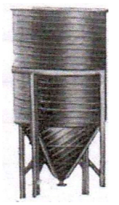
A tank, as shown in the figure below, formed using a combination of a cylinder and a cone, offers better drainage as compared to a flat bottomed tank.
Image

A tap is connected to such a tank whose conical part is full of water.
Water is dripping out from a tap at the bottom at the uniform rate of $2 \ cm^3 / s$.
The semi$-$vertical angle of the conical tank is $45^{\circ}$.
$i.$ Find the volume of water in the tank in terms of its radius $r. (1)$
$ii.$ Find rate of change of radius at an instant when $r =2 \sqrt{2} \ cm. (1)$
$iii.$ Find the rate at which the wet surface of the conical tank is decreasing at an instant when radius $r =2 \sqrt{2} \ cm.(2)$
$OR$
Find the rate of change of height h at an instant when slant height is $4 \ cm. (2)$
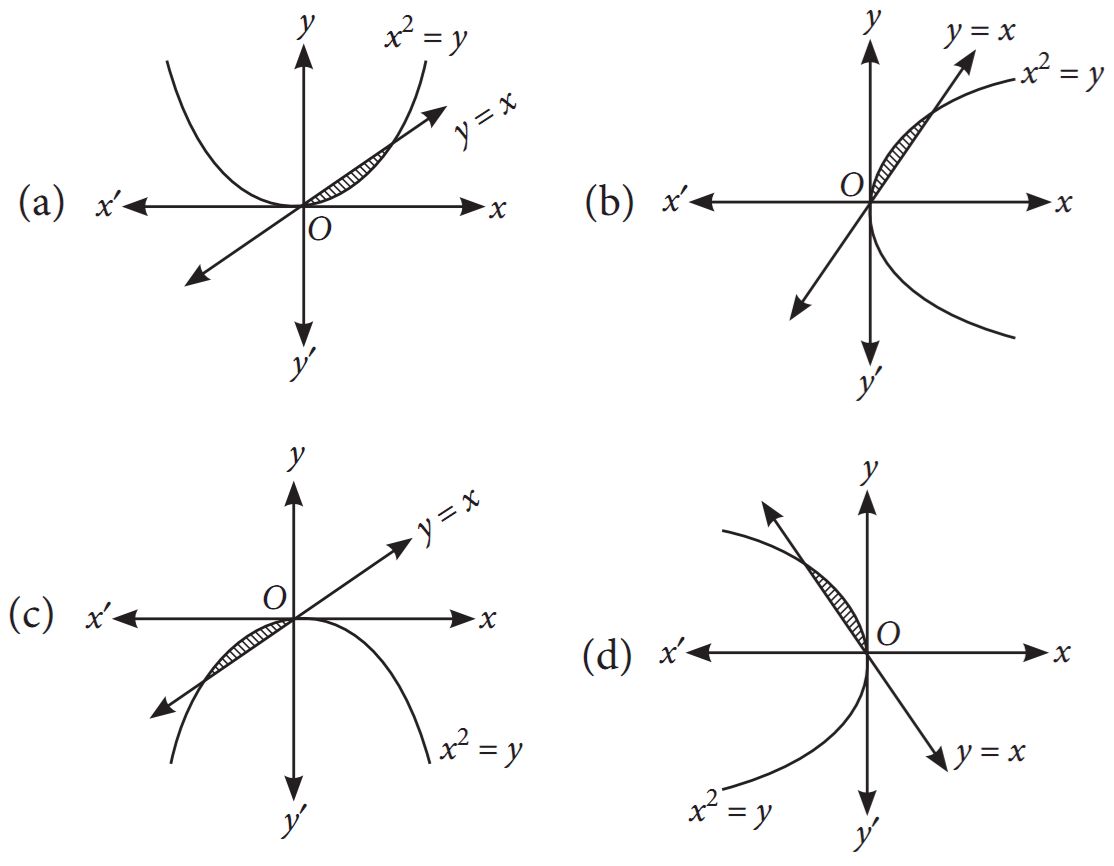
Consider the following equations of curves $x^2 = y$ and $y = x.$ On the basis of above information, answer the following questions.
  1. The point$(s)$ of intersection of both the curves is $($are$).$
  1. $(0, 0)(2, 2)$
  2. $(0, 0)(1, 1)$
  3. $(0, 0)(-1, -1)$
  4. $(0, 0)(-2, -2)$
  1. Area bounded by the curves is represented by which of the following graph?
  1. The value of the integral $\int\limits_{1}^{0}\text{x}\ \text{dx}$ is.
  1. $\frac{1}{4}$
  2. $\frac{1}{3}$
  3. $\frac{1}{2}$
  4. $1$
  1. The value of the integral $\int\limits_{0}^{1}\text{x}^2\ \text{dx}$ is.
  1. $\frac{1}{4}$
  2. $\frac{1}{3}$
  3. $\frac{1}{2}$
  4. $1$
  1. The value of area bounded by the curves $x^2 = y$ and $x = y$ is.
  1. $\frac{1}{6}\text{ sq}.\text{unit}$
  2. $\frac{1}{3}\text{ sq}.\text{unit}$
  3. $\frac{1}{2}\text{ sq}.\text{unit}$
  4. ${1}\text{ sq}.\text{unit}$
The equation of motion of a rocket are: x = 2t, y = -4t, z = 41, where the time 't' is given in seconds, and the distance measured is in kilometres. Based on the above information, answer the following questions.
  1. What is the path of the rocket?
  1. Straight line.
  2. Circle.
  3. Parabola.
  4. None of these.
  1. Which of the following points lie on the path of the rocket?
  1. (0, 1, 2)
  2. (1, -2, 2)
  3. (2, -2, 2)
  4. None of these
  1. At what distance will the rocket be from the starting point (0, 0, 0) in 10 seconds?
  1. 40km
  2. 60km
  3. 30km
  4. 80km
  1. If the position of rocket at certain instant of time is (3, -6, 6), then what will be the height of the rocket from the ground, which is along the xy-plane?
  1. 3km
  2. 2km
  3. 4km
  4. 6km
  1. At certain instant of time, if the rocket is above sea level, where equation of surface of sea is given by 3x - y + 4z = 2 and position of rocket at that instant of time is (1, -2, 2), then the image of position of rocket in the sea is:
  1. $\Big(\frac{20}{13},\frac{15}{13},\frac{18}{13}\Big)$
  2. $\Big(\frac{-20}{13},\frac{-15}{13},\frac{-18}{13}\Big)$
  3. $\Big(\frac{20}{13},\frac{-15}{13},\frac{18}{13}\Big)$
  4. None of these
A tin can manufacturer designs a cylindrical tin can for a company making sanitizer and disinfectors. The tin can is made to hold 3 litres of sanitizer or disinfector. The cost of material used to manufacture the tin can is $₹ 100 / \mathrm{m}^2$.

Image

(i) If $\mathrm{r} \mathrm{cm}$ be the radius and $\mathrm{h} \mathrm{cm}$ be the height of the cylindrical tin can, then express the surface area as a function of radius (r)

(ii) Find the radius of the can that will minimize the cost of tin used for making can?

(iii) Find the height that will minimize the cost of tin used for making can ?

OR

Find the minimum cost of material used to manufacture the tin can.

Two farmers Ankit and Girish cultivate only three varieties of pulses namely Urad, Massor and Mung. The sale (in ₹) of these varieties of pulses by both the farmers in the month of September and October are given by the following matrices A and B.

Image

September sales (in ₹):

$\mathrm{A}=\left(\begin{array}{ccc}\text { Urad } & \text { Masoor } & \text { Mung } \\10000 & 20000 & 30000 \\50000 & 30000 & 10000\end{array}\right) \text { Ankit }$

October sales (in ₹):

$\mathrm{A}=\left(\begin{array}{ccc}\text { Urad } & \text { Masoor } & \text { Mung } \\5000 & 10000 & 6000 \\20000 & 30000 & 10000\end{array}\right) \text { Ankit }$

(i) Find the combined sales of Masoor in September and October, for farmer Girish.

(ii) Find the combined sales of Urad in September and October, for farmer Ankit.

(iii) Find a decrease in sales from September to October.

OR

If both the farmers receive $2 \%$ profit on gross sales, then compute the profit for each farmer and for each variety sold in October.

A student is preparing for the competitive examinations LIC AAO, SSC CGL and Bank P.O. The probabilities that the student is selected independently in competitive examination of LIC AAO, SSC CGL and Bank P.O. are a, band c respectively. Of these examinations, students has 50% chance of selection in at least one, 40% chance of selection in at least two and 30% chance of selection in exactly two examinations.

Based on the above information, answer the following questions.
  1. The value of a+ b + e - ab - be - ca + abe is:
  1. 0.3
  2. 0.5
  3. 0.7
  4. 0.6
  1. The value of ab + be + ae - 2abe is:
  1. 0.5
  2. 0.3
  3. 0.4
  4. 0.6
  1. The value of abe is:
  1. 0.1
  2. 0.5
  3. 0.7
  4. 0.3
  1. The value of ab + be + ae is:
  1. 0.1
  2. 0.6
  3. 0.5
  4. 0.3
  1. The value of a + b + e is:
  1. 1
  2. 1.5
  3. 1.6
  4. 1.4
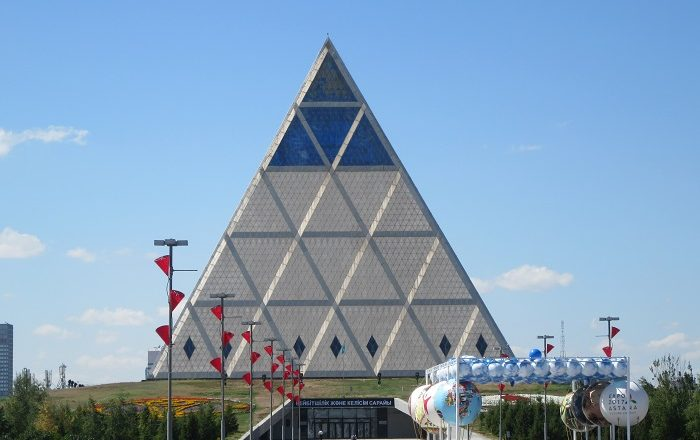
Each triangular face of the Pyramid of Peace in Kazakhstan is made up of $25$ smaller equilateral triangles as shown in the figure.

Using the above information and concept of determinants, answer the following questions.
  1. If the vertices ofoneof the smaller equilateral triangle are $(0, 0), (3,\sqrt{3})$ and $(3,-\sqrt{3}),$ then the area of such triangle is:
  1. $\sqrt{3}\text{ sq}.\text{units}$
  2. $2\sqrt{3}\text{ sq}.\text{units}$
  3. $3\sqrt{3}\text{ sq}.\text{units}$
  4. None of these.
  1. The area of a face of the Pyramid is:
  1. $25\sqrt{3}\text{ sq}.\text{units}$
  2. $50\sqrt{3}\text{ sq}.\text{units}$
  3. $75\sqrt{3}\text{ sq}.\text{units}$
  4. $35\sqrt{3}\text{ sq}.\text{units}$
  1. The length of a altitude of a smaller equilateral triangle is:
  1. $2\ \text{units}$
  2. $3\ \text{units}$
  3. $\sqrt{3}\text{ units}$
  4. $4\ \text{units}$
  1. If $(2, 4), (2, 6)$ are two vertices of a smaller equilateral triangle, then the third vertex will lie on the line represented by:
  1. $\text{x}+\text{y}=5$
  2. $\text{x}=1+\sqrt3$
  3. $\text{x}=2+\sqrt3$
  4. $2\text{x}+\text{y}=5$
  1. Let $A(a, 0), B(0, b)$ and $C(1, 1)$ be three points. If $\frac{1}{\text{a}}+\frac{1}{\text{b}}=1,$ then the three points are:
  1. Vertices of an equilateral triangle.
  2. Vertices of a right angled triangle.
  3. Collinear.
  4. Vertices of an isosceles triangle.
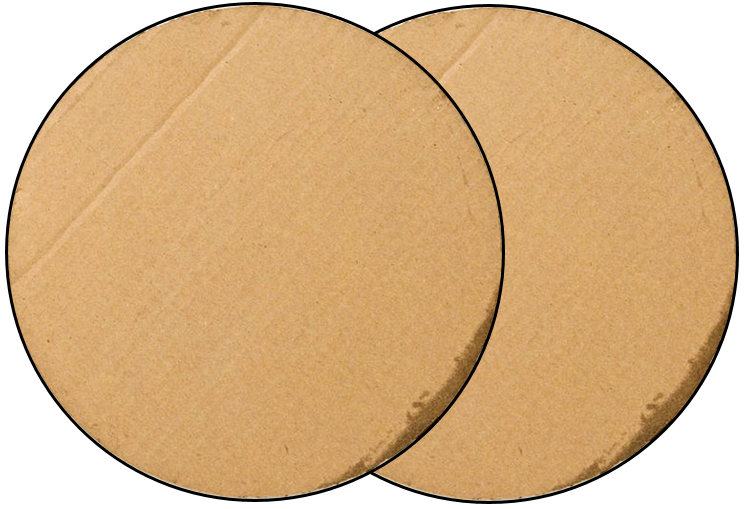
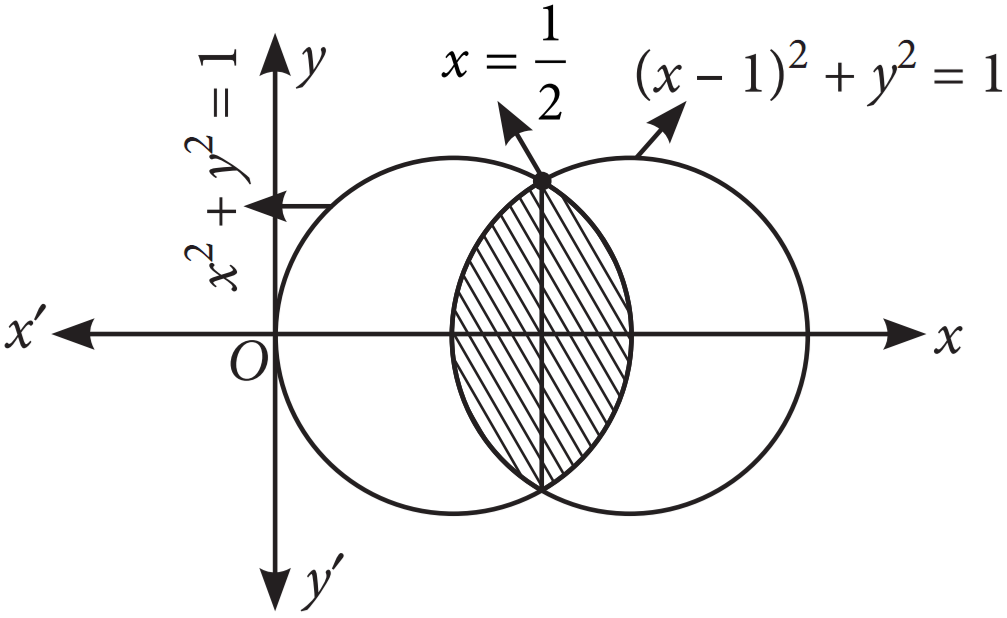
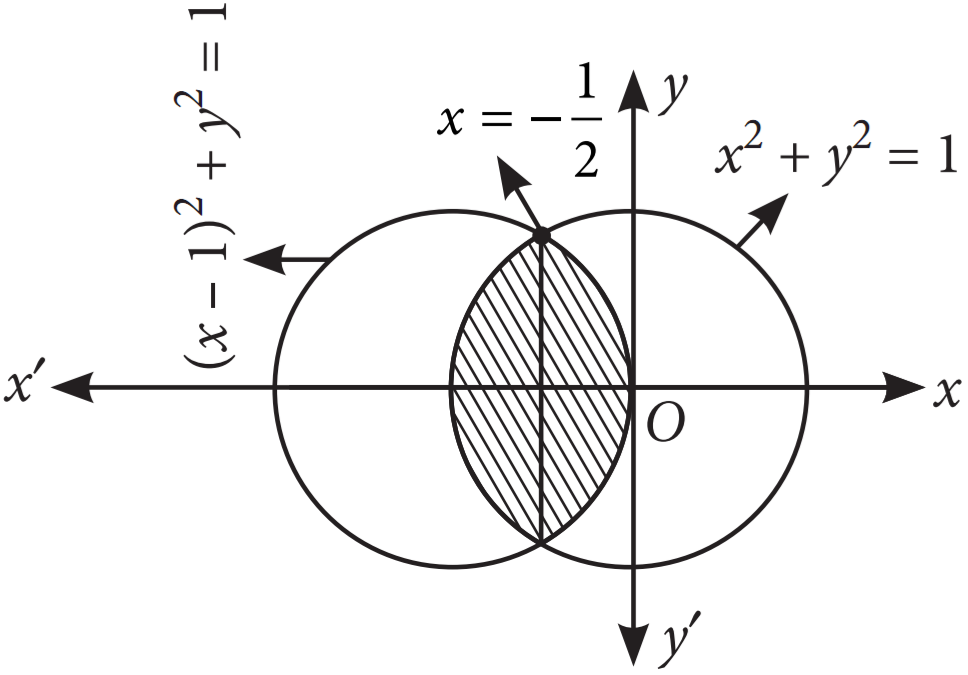
Ajay cut two circular pieces of cardboard and placed one upon other as shown in figure. One of the circle represents the equation $(x - 1)^2 + y^2 = 1,$ while other circle represents the equation $x^2 + y^2 = 1.$​​​​​​​

Based on the above information, answer the following questions.
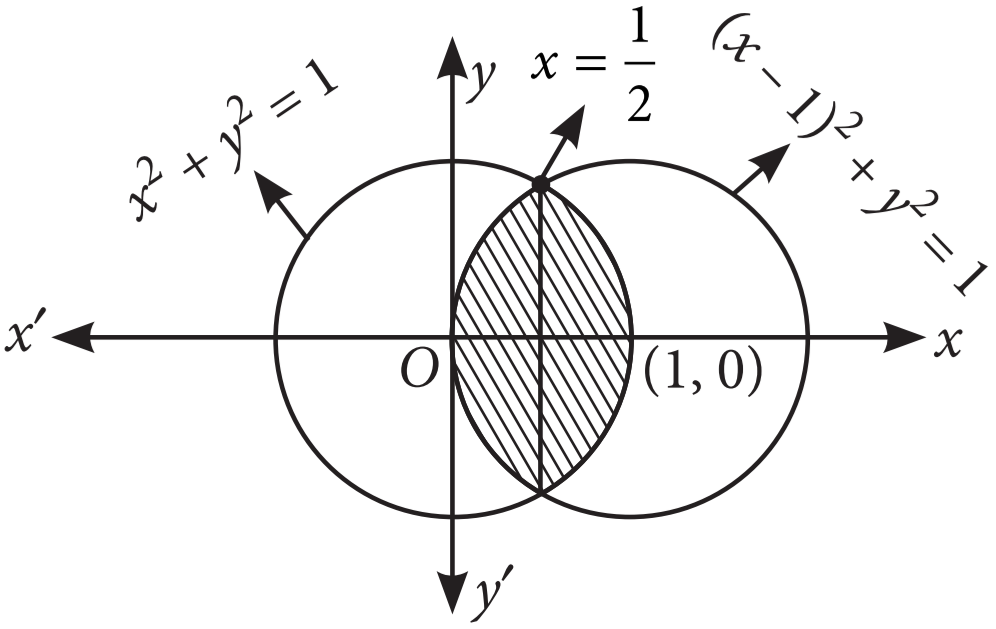
  1. Both the circular pieces of cardboard meet each other at
  1. $\text{x}=1$
  2. $\text{x}=\frac{1}{2}$
  3. $\text{x}=\frac{1}{3}$
  4. $\text{x}=\frac{1}{4}$
  1. Graph of given two curves can be drawn as.
  1. None of these
  1. Value of $\int\limits_{0}^{\frac{1}{2}}\sqrt{1-(\text{x}-1)^2}\text{dx}$ is.
  1. $\frac{\pi}{6}-\frac{\sqrt{3}}{8}$
  2. $\frac{\pi}{6}+\frac{\sqrt{3}}{8}$
  3. $\frac{\pi}{2}+\frac{\sqrt{3}}{4}$
  4. $\frac{\pi}{2}-\frac{\sqrt{3}}{4}$
  1. Value of $\int\limits_{\frac{1}{2}}^{1}\sqrt{1-\text{x}^2}\text{dx}$ is.
  1. $\frac{\pi}{6}+\frac{\sqrt{3}}{4}$
  2. $\frac{\pi}{6}+\frac{\sqrt{3}}{8}$
  3. $\frac{\pi}{6}-\frac{\sqrt{3}}{8}$
  4. $\frac{\pi}{2}-\frac{\sqrt{3}}{4}$
  1. Area of hidden portion of lower circle is.
  1. $\bigg(\frac{2\pi}{3}+\frac{\sqrt{3}}{2}\bigg)\text{ sq.units}$
  2. $\bigg(\frac{\pi}{3}-\frac{\sqrt{3}}{8}\bigg)\text{ sq.units}$
  3. $\bigg(\frac{\pi}{3}+\frac{\sqrt{3}}{8}\bigg)\text{ sq.units}$
  4. $\bigg(\frac{2\pi}{3}-\frac{\sqrt{3}}{2}\bigg)\text{ sq.units}$