Question
Let x = f(t) and y = g(t) be parametric forms with t as a parameter, then
$\frac{\text{dy}}{\text{dx}}=\frac{\text{dy}}{\text{dt}}\times\frac{\text{dt}}{\text{dx}}=\frac{\text{g}'(\text{t})}{\text{f}'(\text{t})},$ where $\text{f}'(\text{t})\neq0.$
On the basis of above information, answer the following questions.
  1. The derivative of $\text{f}(\tan\text{x})\text{w.r.t.}\text{ g}(\sec\text{x})\text{ at}\text{ x}=\frac{\pi}{4},$ where f'(1) = 2 and $\text{g}'(\sqrt{2})=4,$ is:
  1. $\frac{1}{\sqrt{2}}$
  2. ${\sqrt{2}}$
  3. 1
  4. 0
  1. The derivative of $\sin^{-1}\Big(\frac{2\text{x}}{1+\text{x}^2}\Big)$ with respect to $\cos^{-1}\Big(\frac{1-\text{x}^2}{1+\text{x}^2}\Big)$ is:
  1. -1
  2. 1
  3. 2
  4. 4
  1. The derivative of $\text{e}^{\text{x}^3}$ with respect to log x is:
  1. $\text{e}^{\text{x}^3}$
  2. $3\text{x}^22\text{e}^{\text{x}^3}$
  3. $3\text{x}^3\text{e}^{\text{x}^3}$
  4. $3\text{x}^2\text{e}^{\text{x}^3}+3\text{x}$
  1. The derivative of $\cos^{-1}(2\text{x}^2-1)\text{w.r.t.}\cos^{-1}\text{x}$ is:
  1. $2$
  2. $\frac{-1}{2\sqrt{1-\text{x}^2}}$
  3. $\frac{2}{\text{x}}$
  4. $1-\text{x}^2$
  1. If $\text{y}=\frac{1}{4}\mu^4$ and $\mu=\frac{2}{3}\text{x}^3+5,$ then $\frac{\text{dy}}{\text{dx}}=$
  1. $\frac{2}{27}\text{x}^2(2\text{x}^3+15)^3$
  2. $\frac{2}{7}\text{x}^2(2\text{x}^3+15)^3$
  3. $\frac{2}{27}\text{x}(2\text{x}^3+5)^3$
  4. $\frac{2}{7}(2\text{x}^3+15)^3$

Answer

  1. (a) $\frac{1}{\sqrt{2}}$

Solution:

Now, $\frac{\text{df}(\tan\text{x})}{\text{dg}(\sec\text{x})}=\frac{\text{f}'(\tan \text{x})\sec^2\text{x}}{\text{g}'(\sec\text{x})\sec\text{x}\tan \text{x}}$

$=\frac{\text{f}'(\tan \text{x})\sec\text{x}}{\text{g}'(\sec\text{x})\tan \text{x}}$

$\therefore\Big[\frac{\text{df}(\tan\text{x})}{\text{dg}(\sec\text{x})}\Big]_{\text{x}=\frac{\pi}{4}}=\frac{\text{f}'(1)\sqrt{2}}{\text{g}'(\sqrt{2})\cdot1}=\frac{2\sqrt{2}}{4\cdot1}=\frac{1}{\sqrt{2}}$

  1. (b) 1
  1. (c) $3\text{x}^3\text{e}^{\text{x}^3}$

Solution:

Let $\text{y}=\text{e}^{\text{x}^3},\text{z}=\log\text{x}$

Differentiating w.r.t. x, we get

$\frac{\text{dy}}{\text{dx}}=\text{e}^{\text{x}^3}(3\text{x}^2)=3\text{x}^2\text{e}^{\text{x}^3}$ and $\therefore\frac{\text{dy}}{\text{dz}}=\frac{\frac{\text{dy}}{\text{dx}}}{\frac{\text{dz}}{\text{dx}}}=\frac{3\text{x}^2\text{e}^{\text{x}^3}}{\Big(\frac{1}{\text{x}}\Big)}=3\text{x}^3\text{e}^{\text{x}^3}$

  1. (a) $2$

Solution:

Let $\text{y}=\cos^{-1}(2\text{x}^2-1)=2\cos^{-1}\text{x}$

Differentiating w.r.t. $\cos^{-1}\text{x},$ we get

$\frac{\text{dy}}{\text{d}(\cos^{-1}\text{x})}=\frac{2\text{d}(\cos^{-1}\text{x})}{\text{d}(\cos^{-1}\text{x})}=2$

  1. (a) $\frac{2}{27}\text{x}^2(2\text{x}^3+15)^3$

Solution:

We have, $\text{y}=\frac{1}{4}\text{u}^4\Rightarrow\frac{\text{dy}}{\text{du}}=\frac{1}{4}\cdot4\text{u}^3=\text{u}^3$

and $\text{u}=\frac{2}{3}\text{x}^3+5\Rightarrow\frac{\text{du}}{\text{dx}}=\frac{2}{3}\cdot3\text{x}^2=2\text{x}^2$

$\therefore\frac{\text{dy}}{\text{dx}}=\frac{\text{dy}}{\text{du}}\cdot\frac{\text{du}}{\text{dx}}=\text{u}^3\cdot2\text{x}^2=\Big(\frac{2}{3}\text{x}^3+5\Big)^3(2\text{x})^2$

$=\frac{2}{27}\text{x}^2(2\text{x}^3+15)^3$

Need a full question paper?

Generate a complete, print-ready paper with questions like this in minutes — across 16+ boards, with answer keys.

Start Generating Free

Similar questions

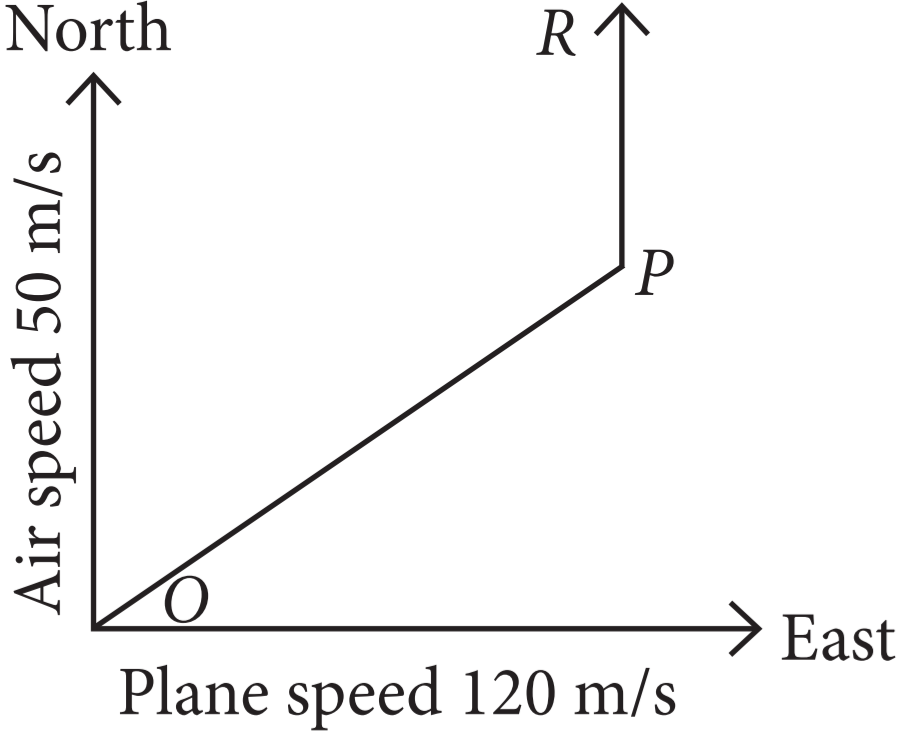
A plane started from airport situated at O with a velocity of 120m/s towards east. Air is blowing at a velocity of 50m/ s towards the north as shown in the figure.
The plane travelled 1hr in OP direction with the resultant velocity. From P to R the plane travelled 1hr keeping velocity of 120m/s and finally landed at R.

Based on the above information, answer the following questions.
  1. What is the resultant velocity from O to P?
  1. 100m/ s
  2. 130m/ s
  3. 126m/ s
  4. 180m/ s
  1. What is the direction of travel of plane from O to P with East?
  1. $\tan^{-1}\Big(\frac{5}{12}\Big)$
  2. $\tan^{-1}\Big(\frac{12}{3}\Big)$
  3. 50
  4. 80
  1. What is the displacement from O to P?
  1. 600km
  2. 468km
  3. 532km
  4. 500km
  1. What is the resultant velocity from P to R?
  1. 120m/ s
  2. 70m/ s
  3. 170m/ s
  4. 200m/ s
  1. What is the displacement from P to R?
  1. 450km
  2. 532km
  3. 610km
  4. 612km
If the area of a circle increases at a uniform rate, then prove that perimeter varies inversely as the radius.
Linear programming is a method for finding the optimal values (maximum or minimum) of quantities subject to the constraints when relationship is expressed as linear equations or inequations.

Based on the above information, answer the following questions.

  1. The optimal value of the objective function is attained at the points:
  1. On X-axis.
  2. On Y-axis.
  3. Which are comer points of the feasible region.
  4. None of these.
  1. The graph of the inequality 3x + 4y < 12 is:
  1. Half plane that contains the origin.
  2. Half plane that neither contains the origin nor the points of the line 3x + 4y = 12.
  3. Whole XOY-plane excluding the points on line 3x + 4y = 12.
  4. None of these.
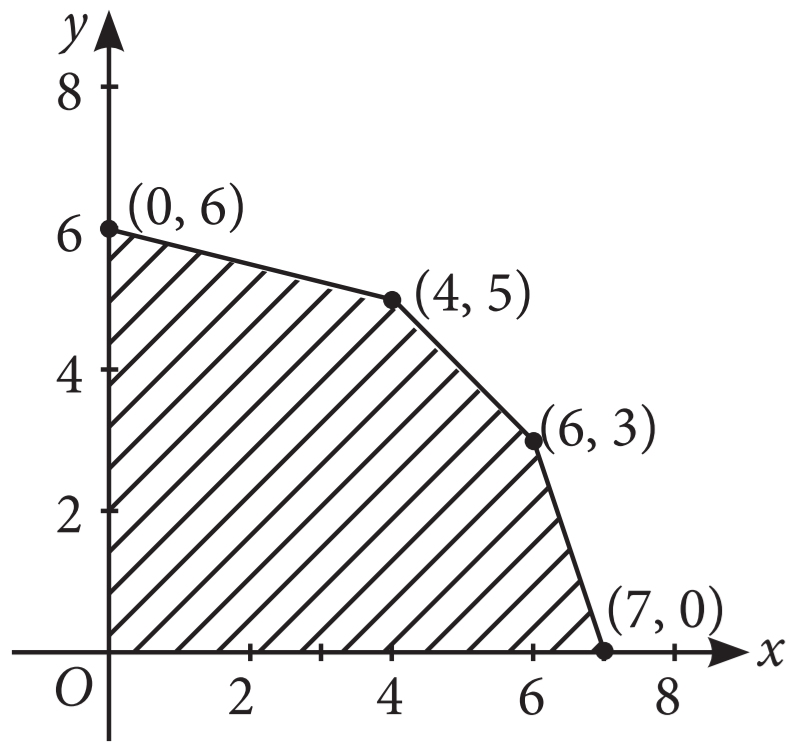
  1. The feasible region for an LPP is shown in the figure. Let Z = 2x + 5y be the objective function. Maximum of Z occurs at:

  1. (7, 0)
  2. (6, 3)
  3. (0, 6)
  4. (4, 5)
  1. The corner points of the feasible region determined by the system of linear constraints are (0, 10), (5, 5), (15, 15), (0, 20). Let Z = px + qy, where p, q > 0. Condition on p and q so that the maximum of Z occurs at both the points ( 15, 15) and (0, 20) is:
  1. p = q
  2. p = 2q
  3. q = 2p
  4. q = 3p
  1. The comer points of the feasible region determined by the system of linear constraints are (0, 0), (0, 40), (20, 40), (60, 20), (60, 0). The objective function is Z = 4x + 3y.

Compare the quantity in Column A and Column B

Column A
Column B
Maximum of Z
325
  1. The quantity in column A is greater.
  2. The quantity in column Bis greater.
  3. The two quantities are equal.
  4. The relationship cannot be determined on the basis of the information supplied.
Read the following passage and answer the questions given below. 

Image

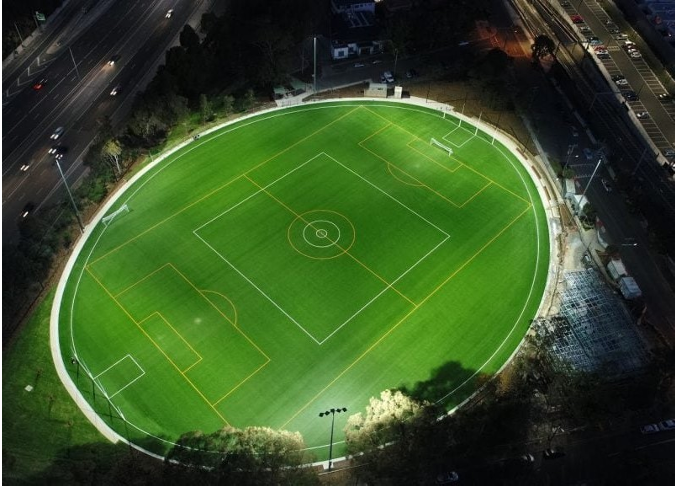
In an elliptical sport field the authority wants to design a rectangular soccer field with the maximum possible area. The sport field is given by the graph of $\frac{x^2}{a^2}+\frac{y^2}{b^2}=1$

(i) If the length and the breadth of the rectangular field be $2 x$ and $2 y$ respectively, then find the area function in terms of $x$.

(ii) Find the critical point of the function.

(iii) Use First derivative Test to find the length $2 x$ and width $2 y$ of the soccer field (in terms of $a$ and b) that maximize its area.

OR

(iii) Use Second Derivative Test to find the length $2 x$ and width $2 y$ of the soccer field (in terms of $a$ and $b$ ) that maximize its area.

Consider the mapping f: A → B is defined by f(x) = x - 1 such that f is a bijection.
Based on the above information, answer the following questions.
  1. Domain of f is:
  1. R - {2}
  2. R
  3. R - {1, 2}
  4. R - {0}
  1. Range of f is:
  1. R
  2. R - {2}
  3. R - {0}
  4. R - {1, 2}
  1. If g: R - {2} → R - {1} is defined by g(x) = 2f(x) - 1, then g(x) in terms of x is:
  1. $\frac{\text{x}+2}{\text{x}}$
  2. $\frac{\text{x}+1}{\text{x}-2}$
  3. $\frac{\text{x}-2}{\text{x}}$
  4. $\frac{\text{x}}{\text{x}-2}$
  1. The function g defined above, is:
  1. One-one
  2. Many-one
  3. into
  4. None of these
  1. A function f(x) is said to be one-one iff.
  1. f(x1) = f(x2) ⇒ -x= x2
  2. f(-x1) = f(-x2) ⇒ -x1 = x2
  3. f(x1) = f(x2) ⇒ x1 = x2
  4. None of these
Let f : A → B and g : B → C be two functions defined on non-empty sets A, B, C, then gof : A → C be is called the composition of f and g defined as, $\text{gof}(\text{x})=\text{g}\{\text{f(x)}\}\forall\text{ x }\in\text{ A}.$
Consider the functions $\text{f}(\text{x})=\begin{cases}\sin\text{x},&\text{x}\geq0\\1-\cos\text{x},&\text{x}\leq0\end{cases},\text{g}(\text{x})=\text{e}^\text{x}$ and then answer the following questions.
  1. The function gof(x) is defined as:
  1. $\text{gof}(\text{x})=\begin{cases}\text{e}^\text{x}&,\text{x}\geq0\\1-\text{e}^{\cos\text{x}}&,\text{x}\leq0\end{cases}$
  2. $\text{gof}(\text{x})=\begin{cases}\text{e}^{\sin\text{x}}&,\text{x}\leq0\\\text{e}^{1-\cos\text{x}}&,\text{x}\geq0\end{cases}$
  3. $\text{gof}(\text{x})=\begin{cases}\text{e}^{\sin\text{x}}&,\text{x}\leq0\\1-\text{e}^{\cos\text{x}}&,\text{x}\geq0\end{cases}$
  4. $\text{gof}(\text{x})=\begin{cases}\text{e}^{\sin\text{x}}&,\text{x}\geq0\\\text{e}^{1-\cos\text{x}}&,\text{x}\leq0\end{cases}$
  1. $\frac{\text{d}}{\text{dx}}\{\text{gof}(\text{x})\}=$
  1. $[\text{gof}(\text{x})]'=\begin{cases}\cos\text{x}\cdot\text{e}^{\sin\text{x}}&,\text{x}\geq0\\\text{e}^{1-\cos\text{x}}\cdot\sin\text{x}&,\text{x}\leq0\end{cases}$
  2. $[\text{gof}(\text{x})]'=\begin{cases}\cos\text{x}\cdot\text{e}^{\sin\text{x}}&,\text{x}\geq0\\-\sin\text{x}\cdot\text{e}^{1-\cos\text{x}}&,\text{x}\leq0\end{cases}$
  3. $[\text{gof}(\text{x})]'=\begin{cases}\cos\text{x}\cdot\text{e}^{\sin\text{x}}&,\text{x}\geq0\\\sin\text{x}\cdot({1-\cos\text{x}})&,\text{x}\leq0\end{cases}$
  4. $[\text{gof}(\text{x})]'=\begin{cases}\cos\text{x}\cdot\text{e}^{\sin\text{x}}&,\text{x}\geq0\$1-{\sin\text{x}})\cdot\text{e}^{1-\cos\text{x}}&,\text{x}\leq0\end{cases}$
  1. R.H.D. of gof(x) at x = 0 is:
  1. 0
  2. 1
  3. -1
  4. 2
  1. L.H.D. of gof(x) at x = 0 is:
  1. 0
  2. 1
  3. -1
  4. 2
  1. The value of f'(x) at $\text{x}=\frac{\pi}{4}$ is:
  1. $\frac{1}{9}$
  2. $\frac{1}{\sqrt2}$
  3. $\frac{1}{2}$
  4. Not defined.
A relation R on a set A is said to be an equivalence relation on A iff it is:
  1. Reflexive i.e., $(\text{a, a})\in\ \text{R} \ \forall \ \text{a}\in\text{A}.$
  2. Symmetric i.e., $(\text{a, b})\in\ \text{R} \Rightarrow \text{(b, a) } \in\text{R}\ \forall \ \text{a, b}\in\text{A}.$
  3. Transitive i.e., $(\text{a, b})\in\ \text{R} \ \text{and}\ \text{(b, c) } \in\text{R}\Rightarrow\text{(a, c)}\in\text{R}\ \forall \ \text{a, b, c}\in\text{A}.$
Based on the above information, answer the following questions.
  1. If the relation R = {(1, 1), (1, 2), (1, 3), (2, 2), (2, 3), (3, 1), (3, 2), (3, 3)} defined on the set A = {1, 2, 3}, then R is:
  1. Reflexive
  2. Symmetric
  3. Transitive
  4. Equivalence
  1. If the relation R = {(1, 2), (2, 1), (1, 3), (3, 1)} defined on the set A = {1, 2, 3}, then R is:
  1. Reflexive
  2. Symmetric
  3. Transitive
  4. Equivalence
  1. If the relation R on the set N of all natural numbers defined as R = {(x, y): y = x + 5 and x < 4}, then R is:
  1. Reflexive
  2. Symmetric
  3. Transitive
  4. Equivalence
  1. If the relation R on the set A = {1, 2, 3, ........., 13, 14} defined as R = {(x, y): 3x - y = O}, then R is:
  1. Reflexive
  2. Symmetric
  3. Transitive
  4. Equivalence
  1. If the relation R on the set A = {I, 2, 3} defined as R = {(1, 1), (1, 2), (1, 3), (2, 1), (2, 2), (2, 3), (3, 1), (3, 2), (3, 3)}, then R is:
  1. Reflexive only
  2. Symmetric only
  3. Transitive only
  4. Equivalence
To hire a marketing manager, it's important to find a way to properly assess candidates who can bring radical changes and has leadership experience. Ajay, Ramesh and Ravi attend the interview for the post of a marketing manager.
Ajay, Ramesh and Ravi chances of being selected as the manager of a firm are in the ratio $4: 1: 2$ respectively. The respective probabilities for them to introduce a radical change in marketing strategy are $0.3,0.8$, and 0.5 . If the change does take place.

Image

(i) Find the probability that it is due to the appointment of Ajay (A).

(ii) Find the probability that it is due to the appointment of Ramesh (B).

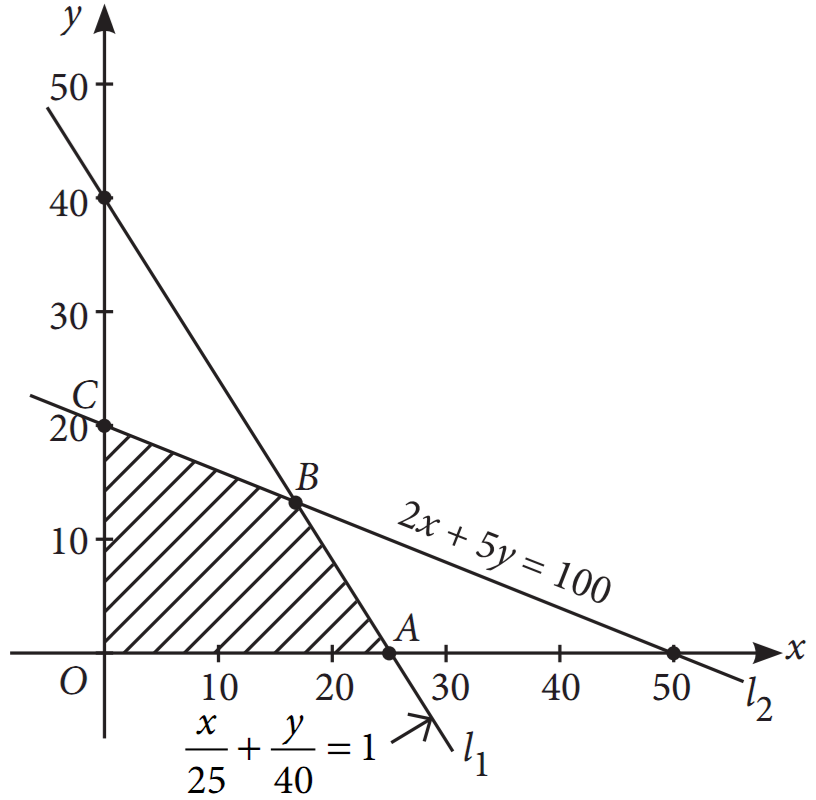
Deepa rides her car at 25 km/ hr. She has to spend ₹ 2 per km on diesel and if she rides it at a faster speed of 40 km/ hr, the diesel cost increases to ₹ 5 per km. She has ₹ 100 to spend on diesel. Let she travels x kms with speed 25 km/ hr and y kms with speed 40 km/ hr. The feasible region for the LPP is shown below:

Based on the above information, answer the following questions.

  1. What is the point of intersection of line l1 and l2?
  1. $\Big(\frac{40}{3},\frac{50}{3}\Big)$

  2. $\Big(\frac{50}{3},\frac{40}{3}\Big)$

  3. $\Big(\frac{-50}{3},\frac{40}{3}\Big)$

  4. $\Big(\frac{-50}{3},\frac{-40}{3}\Big)$

  1. The comer points of the feasible region shown in above graph are:
  1. $(0,25),(20,0),\Big(\frac{40}{3},\frac{50}{3}\Big)$

  2. $(0, 0), (25, 0), (0, 20) $

  3. $(0,0),\Big(\frac{40}{3},\frac{50}{3}\Big),(0,20)$

  4. $(0,0),(25,0),\Big(\frac{50}{3},\frac{40}{3}\Big),(0,20)$

  1. If Z = x + y be the objective function and max Z = 30. The maximum value occurs at point:
  1. $\Big(\frac{50}{3},\frac{40}{3}\Big)$
  2. (0, 0)
  3. (25, 0)
  4. (0, 20)
  1. If Z = 6x - 9y be the objective function, then maximum value of Z is:
  1. -20
  2. 150
  3. 180
  4. 20
  1. If Z = 6x + 3y be the objective function, then what is the minimum value of Z?
  1. 120
  2. 130
  3. 0
  4. 150
Consider the following equations of curves $\text{y}=\cos\text{x},\text{y}=\text{x}+1$ and y = 0.
On the basis of above information, answer the following questions.
  1. The curves $\text{y}=\cos\text{x}$ and y = x + 1 meet at:
  1. (1, 0)
  2. (0, 1)
  3. (1, 1)
  4. (0, 0)
  1. $\text{y}=\cos\text{x}$ meet the x-axis at:
  1. $\Big(\frac{-\pi}{2},0\Big)$
  2. $\Big(\frac{\pi}{2},0\Big)$
  3. Both (a) and (b).
  4. None of these.
  1. Value of the integral $\int\limits_{-1}^{0}(\text{x}+1)\text{dx}$ is:
  1. $\frac{1}{2}$
  2. $\frac{2}{3}$
  3. $\frac{3}{4}$
  4. $\frac{1}{3}$
  1. Value of the integral $\int\limits_{0}^{\frac{\pi}{2}}\cos\text{x dx}$ is:
  1. 0
  2. -1
  3. 2
  4. 1
  1. Area bounded by the given curves is:
  1. $\frac{1}{2}\text{ sq}.\text{units}$
  2. $\frac{3}{2}\text{ sq}.\text{units}$
  3. $\frac{3}{4}\text{ sq}.\text{units}$
  4. $\frac{1}{4}\text{ sq}.\text{units}$