MCQ
Let $y=t^{10}+1$ and $x=t^8+1$, then $\frac{d^2 y}{d x^2}$ is equal to
  • A
    $\frac{5}{2} t$
  • $\frac{5}{16 t^6}$
  • C
    $20 t^8$
  • D
    None of these

Answer

Correct option: B.
$\frac{5}{16 t^6}$
We have, $y=t^{10}+1, x=t^8+1$
$\Rightarrow \frac{d y}{d t}=10 t^9, \frac{d x}{d t}=8 t^7$
$\therefore \frac{d y}{d x}=\frac{d y / d t}{d x / d t}=\frac{10 t^9}{8 t^7}=\frac{5}{4} t^2$
$\Rightarrow \frac{d^2 y}{d x^2}=\frac{5}{4}(2 t) \frac{d t}{d x}$
$=\frac{5}{4} \times 2 t \times \frac{1}{8 t^7}$
$=\frac{5}{16 t^6}$

Need a full question paper?

Generate a complete, print-ready paper with questions like this in minutes — across 16+ boards, with answer keys.
Start Generating Free

Similar questions

If $\alpha,\beta,\gamma$ are the angle which a half ray makes with the positive directions of the axis then $\sin^2\alpha + \sin^2\beta + \sin^2\gamma =$
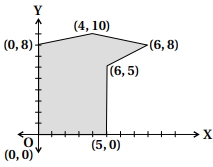
The feasible solution for a LPP is shown in Figure Let $z=3 x-4 y$ be the objective function. (Maximum value of $z+$ Minimum value of $z$ ) is equal to $....$
While measuring the side of an equilateral triangle an error of $k \%$ is made, the percentage error in its area is :
If $A$ is an invertible matrix of order $3,$ then which of the following is not true:
$\smallint \frac{{dx}}{{\cos x + \sqrt 3 \sin x}} = $
The distance of line $3 y-2 z-1=0=3 x-z+4$ from the point $(2,-1,6)$ is :
A function f from the set of natural numbers to the set of integers defined by $\text{f(n)}\begin{cases}\frac{\text{n}-1}{2},&\text{when n is odd}\\-\frac{\text{n}}{2},&\text{when n is even}\end{cases}$ is:
An urn contains 5 red and 2 black balls. Two balls are randomly drawn. Let X represent the number of black balls. What are the possible values of X? Is X a random variable?
$\int \frac{e^x}{x+1}[1+(x+1) \log (x+1)] d x$ equals
Let $ABC$ be a triangle such that $\overrightarrow{ BC }=\overrightarrow{ a }, \overrightarrow{ CA }=\overrightarrow{ b }$, $\overrightarrow{ AB }=\overrightarrow{ c },|\overrightarrow{ a }|=6 \sqrt{2}, \quad|\overrightarrow{ b }|=2 \sqrt{3}$ and $\overrightarrow{ b } \cdot \overrightarrow{ c }=12$ Consider the statements.

$( S 1):|(\overrightarrow{ a } \times \overrightarrow{ b })+(\overrightarrow{ c } \times \overrightarrow{ b })|-|\overrightarrow{ c }|=6(2 \sqrt{2}-1)$

$( S 2): \angle ABC =\cos ^{-1}\left(\sqrt{\frac{2}{3}}\right)$. Then