MCQ
Lewis base is
- A$C{O_2}$
- B$S{O_3}$
- C$S{O_2}$
- ✓$ROH$
Generate a complete, print-ready paper with questions like this in minutes — across 16+ boards, with answer keys.
$(I)$ When $X$ dimerises bond angle decreases
$(II)$ When $X$ dimerises bond angle increases
$(III)$ In $X-Y$ molecule $C-C$ bond length is less than that in $Y-Y$ molecule
$(IV)$ Bond angle in $X$ is greater than that in $Y$
$(A) i)$ Lindlar's catalyst, $H _2$; $ii$) $SnCl _2 / HCl$; iii) $NaBH _4$; iv) $H _3 O ^{+}$
$(B) i)$ Lindlar's catalyst, $H _2$; $ii$) $H _3 O ^{+}; iii)$ $SnCl _2 / HCl$; iv) $NaBH _4$
$(C) i)$ $NaBH _4; ii)$ $SnCl _2 / HCl; $iii$)$ $H _3 O ^{+}; iv)$ Lindlar's catalyst, $H _2$
$(D) i)$ Lindlar's catalyst, $H _2$; $ii$) $NaBH _4; iii)$ $SnCl _2 / HCl; iv)$ $H _3 O ^{+}$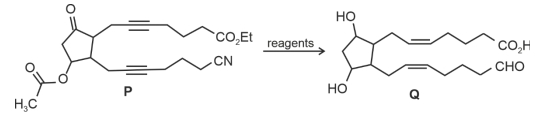
$(A)$ Atoms of different elements differ in mass.
$(B)$ Matter consists of divisible atoms.
$(C)$ Compounds are formed when atoms of different element combine in a fixed ratio.
$(D)$ All the atoms of given element have different properties including mass.
$(E)$ Chemical reactions involve reorganisation of atoms.
Choose the correct answer from the options given below :